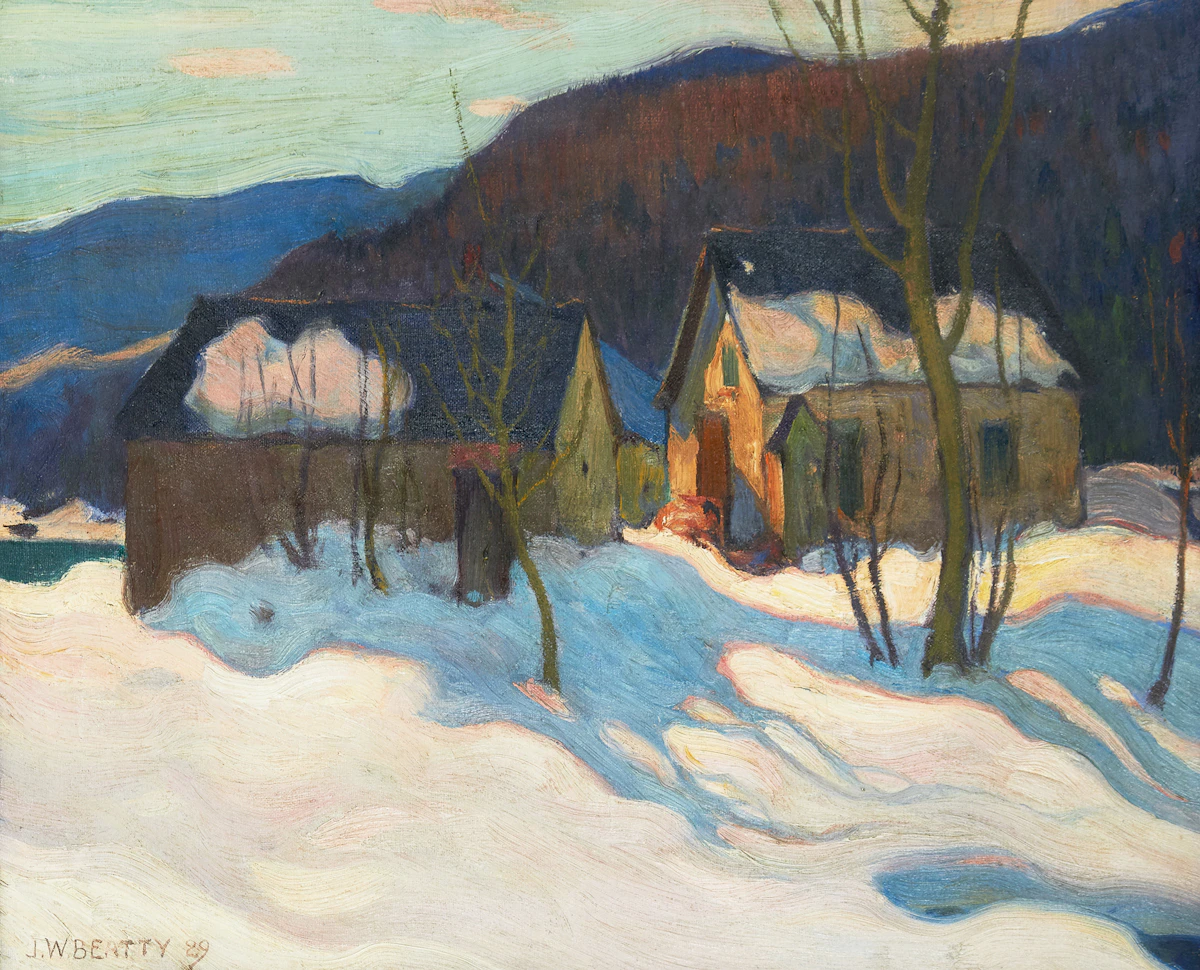
As a teacher, Dorothy Farr described J.W. Beatty's landscape instruction as providing his sometimes challenging vision to his students, aspects of which are evident in much of his work, including “Baie St. Paul”, the traditionalist teaching “sound technique” and seeking to “sharpen the visual perceptions of his students.” Encouraging his students to be “sensitive to their perceptions of light”, Beatty told them “There is no black in nature, only a mixture of colours,” the artist going as far as to remove a black tube of paint from a student's box if it was discovered.
While likely difficult to some under his tutelage, Beatty's lessons speaks to the painter's vision and technique. “Baie St. Paul” acts as a firm example of his mastery of depicting the behaviour of light through the employment an extended gradient of colour, with no shade of colour clearly repeated in multiple areas of the scene. As soft blue shadows crawl across the packed snow of the foreground, they are bordered with dark pinks which dissolve into lighter and varied grades of the pigment throughout the lower half of the composition. The snow acts as its own canvas, as light and shadow interplay harmoniously. Beneath a pale blue sky, rolling hills of alternate blues, mauves and crimson are accented with strokes of green and red. A frozen turquoise pool provides yet another shade of blue at the base of the ridge at the left edge. At the centre, the two cottages sit behind a partial screen of thin trees, the winter leaving the branches bare and providing a clear view of the homestead. The buildings are treated to differing levels of light and shadow from all sides, their yellows beaming a shade of canary when reflecting direct light from behind, the gradient sliding to a reddish brown when in full shadow. As the snow fights to hold to the roofs, we see that Beatty manages to avoid black even here, the tops of the houses painted in deep navy blues, reflecting rather than absorbing light. Beatty's incredibly interplay of light, shadow and colour provides a scene of both warmth and frigidity, the perceived unforgiving elements of the scene secondary to the glow from the high sun on this winter day.