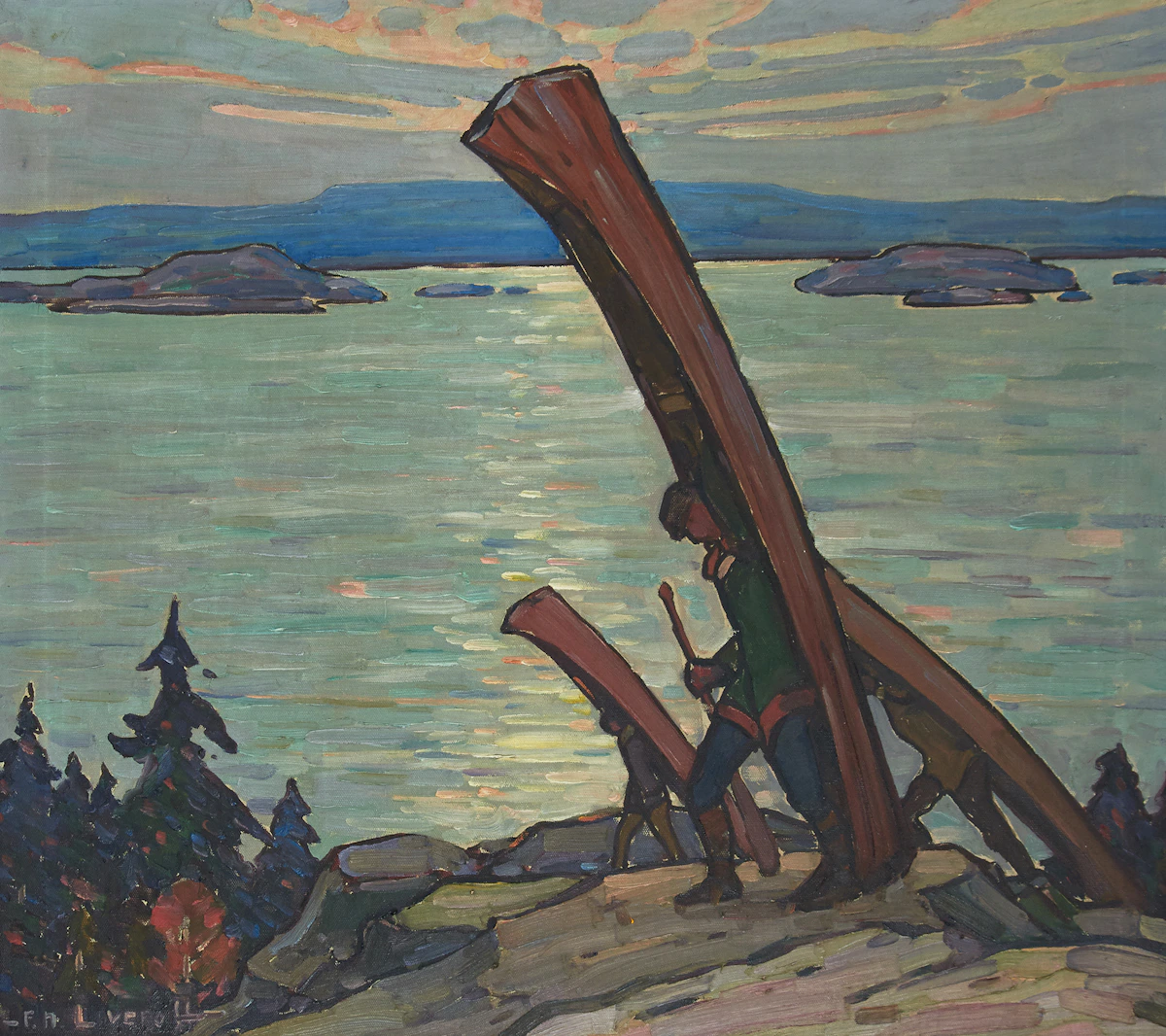
Kevin Forrest, “The Paintings of Frederick Nicholas Loveroff”, Norman Mackenzie Art Gallery, Regina, 1981, pages 7, 11 and 15
Through the 1920s, Loveroff exhibited annually with the Royal Canadian Academy, the Ontario Society of Artists and the Canadian National Exhibition. During this time, the artist travelled extensively, frequenting the rugged Canadian north country where he would find inspiration for works such as “The Portage”.
Forrest describes the artist's remarkably consistent painting method: “He used a light-coloured underpainting of white with burnt amber, an adaptation of the common practice of Thomson and the Group, in preparation for the charcoal outline. The outline was in turn overpainted with a very dark pigment. On both sides of the painted outline, the artist placed strokes of colour... carefully orchestrated in intensity. He left both the underpainting and the outline showing as part of his statement.”
Loveroff's three figures in “The Portage” (painted circa 1925) are reminiscent of the labourers in another major canvas, “Toilers of the Land” (1924), which features a group of men “fatigued at the end of a long day...depicted against Loveroff's distinctive ribbon-like sunset cloud pattern.” Like the tired labourers, the portagers venture across the rocky landscape, their figures slightly hunched over as the weight of the canoes are a burden by sundown. Loveroff reveals his fondness for the colour effects of sunsets as the mauve, light pink and yellow pigments are masterfully echoed in the glistening northern lake.
“The Portage” is instilled with Loveroff's unique vision of the Canadian experience. A striking and rare subject for the artist, this work may have been exhibited as “Portaging, Cross Lake” in the Ontario Society of Artists 53rd Annual Exhibition held in March of 1925.