Robert Pilot, “Maurice Cullen, R.C.A.”, Address given at the Arts Club of Montreal, 1937, page 2
Sylvia Antoniou, “Maurice Cullen: 1866-1934”, Agnes Etherington Art Centre, Kingston, 1982, pages ix, 19 and 33, page 71 for an artwork entitled “Fishing Stages, Newfoundland” that shares similar compositional elements (circa 1911, National Gallery of Canada)
Maurice Cullen was born in St. John's, Newfoundland in 1866, then a British Colony. At the age of four, Cullen moved with his family to Montreal, which would become his home for the remainder of his life. Cullen would first return to the island in 1907, now an internationally trained and celebrated painter. Cullen's father, James, a Newfoundlander, was still living in St. John's and Cullen “no doubt went there to visit him and to paint on the island.” At least five works created during this visit would be included in the “Five Canadian Artists Exhibition” held in December at the Art Association of Montreal. It would be during this trip that Cullen would meet Barbara Pilot, a St. John's widow with five children. The couple would marry three years later with Cullen becoming step-father to the children, including Robert Pilot.
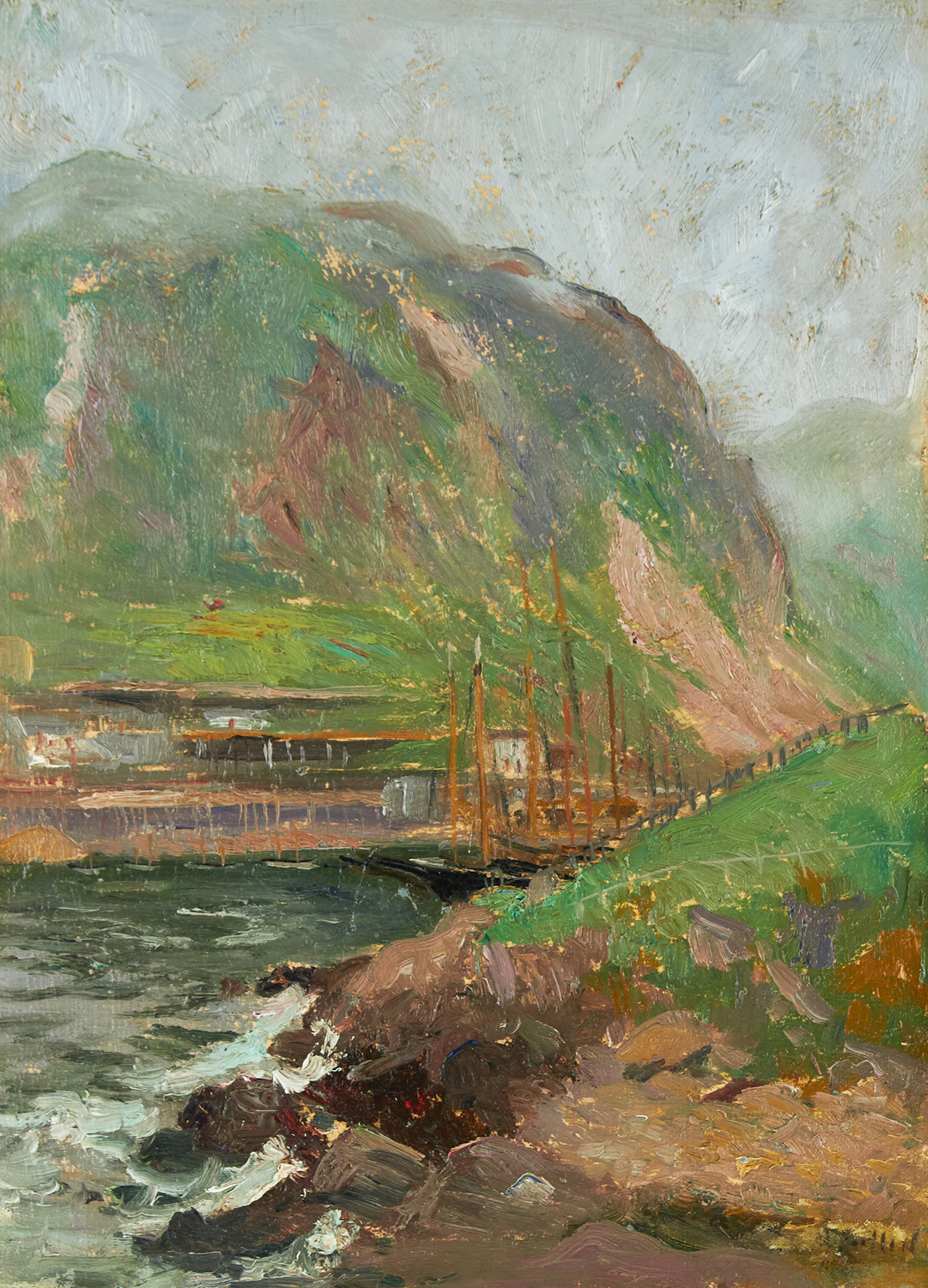
Sylvia Antoniou describes Maurice Cullen's depictions of Newfoundland as “a search for his historical roots”, noting that Cullen would return to St. John's to summer in 1910 and that “in November, even before his return, the Montreal press was anticipating the Newfoundland paintings.” The day before the fall Royal Canadian Academy show opened, J.W. Morrice wrote to the Globe's Newton MacTavish, “Cullen I see from the Montreal papers has painted a good picture of St. John's Newfoundland. He is the man in Canada who gets at the guts of things.” In discussing “Fishing Stages, Newfoundland”, which holds composition similarities with this painting, Antoniou describes the “oil sketch of the fishing stages found near the Narrows south of St. John's Harbour” as a work where “the brush stroke has a life of its own as an expressive visual element. The thickness of the paint and clearly separate strokes - sweeping broadly across one area, piling up the paint by quick short strokes in another, and elsewhere putting it on by single isolated draws of the brush - create the effect of the rough, powerful impact of the Atlantic Ocean.”