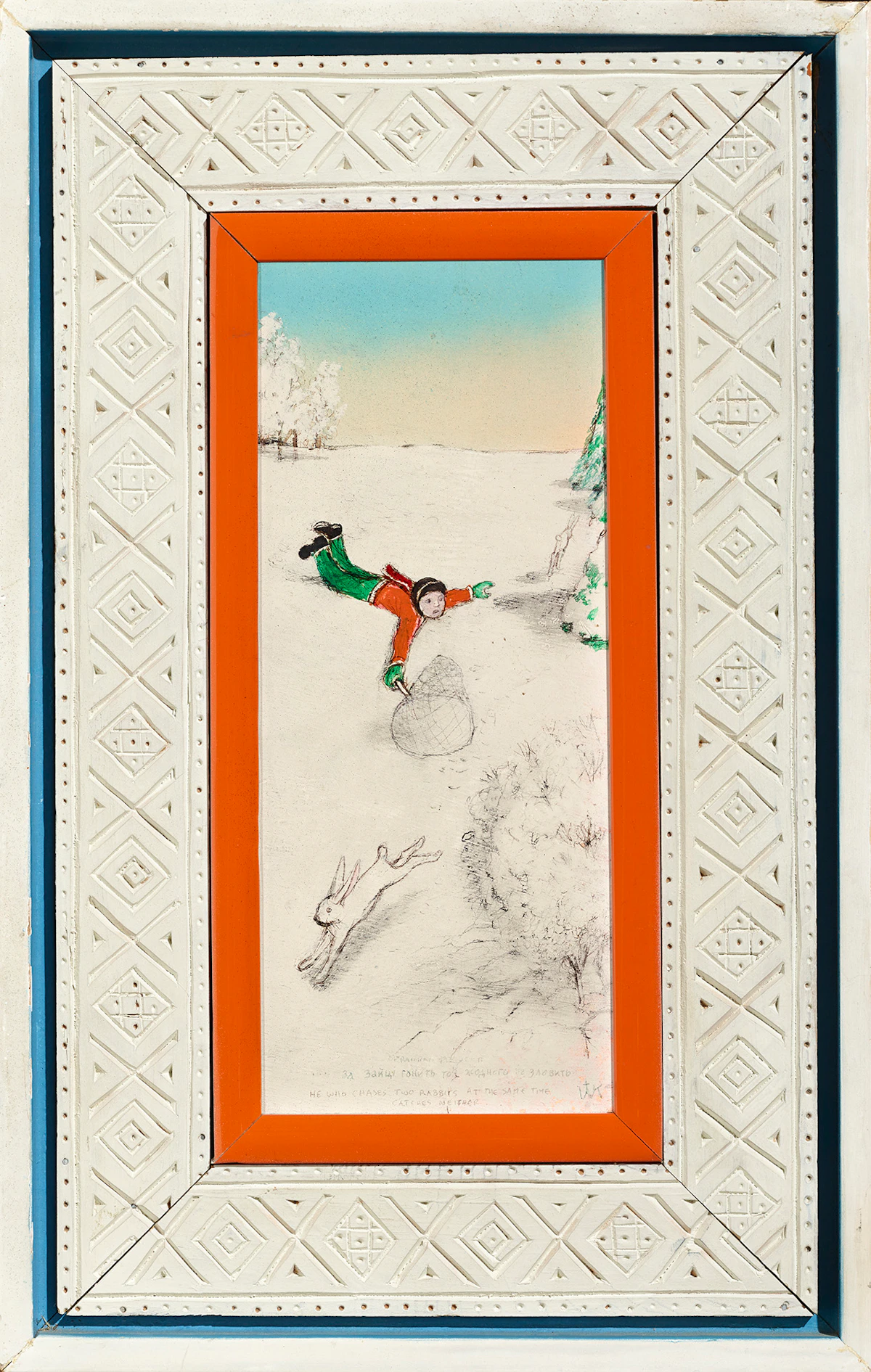
signed with initials lower right, inscribed “He who chases two rabbits at the same time catches neither” in Ukrainian and English; dated 1974 and titled (twice) on the reverse
10 × 4.5 in (25.4 × 11.4 cm)
Auction Estimate:$15,000 - $20,000
Sale date:November 19 - 28, 2014
Price Realized
$41,400
(including Buyer's Premium)
Provenance
Gift of the artist
Private Collection, Toronto
Literature
Avrom Isaacs, “Knowing Kurelek”, “William Kurelek: The Messenger”, Altona, Manitoba, 2011, page 20
William Kurelek, “A Prairie Boy's Winter”, Montreal, 1973, pages 14 and 42
“A Prairie Boy's Winter” closes with a brief passage describing William Kurelek's formative years, raised on a “dairy farm in Manitoba, not far from the United States border”, the setting for the majority of the artist's most celebrated work depicting life on the Canadian prairies. When Kurelek enrolled in high school in the city age sixteen, “he was eager to tell his new friends about his adventures living close to nature.” However, “no one seemed interested in listening and it was many years before Kurelek found a way to hold an audience – through his pictures.”
Kurelek's gift as a storyteller is arguably the trait which most captivates his admirers, the painter expertly weaving meaning through his work, often conveying his passionate point of view related to his personal life, his faith or his Ukrainian heritage. Not uncommon with many of Kurelek's most celebrated paintings, “Ukrainian Proverb” dabbles effectively in all three. The setting and activity is reminiscent of Kurelek's youth (the artist wrote of snaring jack-rabbits with his brother, John, on the “frozen sea of snow that stretched across farmlands broken only by barbed-wire fences...”), while the proverb (inscribed in both English and Ukrainian) provides a well-known passage which broadcasts a simple, but moral message. As the rabbits sprint into the foreground and towards the horizon, the child's greed leaves him sprawling and empty-handed, chin digging into the icy snow, the lesson his only catch.
Av Isaacs, Kurelek's Toronto dealer, noted that the painter's “genius was the gift he had of an endless supply of stored literal images. He had a warehouse of images that were crystal clear in his mind”, an inventory of countless stories ready to be told. Isaacs recalls that Kurelek “had so much to say that he allowed himself only five hours a night to sleep. When I questioned this, he replied that he would have plenty of time to rest in the next world.”
“Ukrainian Proverb” was acquired by the parents of the current owner as a gift from Kurelek. The family would provide fresh garden vegetables and homemade pastries to their neighbour, a professional photographer, in return for photographs of the children and grandchildren. During one such visit to the photographer, they met Kurelek, who tasted their apple strudel and declared it to be “as good or better” than his mother's. The parents crossed the street and returned with a basket full of the strudel, a gift to the artist. A couple of days later, the artist arrived on the consignor's doorstep, delivering “Ukrainian Proverb” as a gift in response to their generosity. The identity of the artist was not discussed by the family, the artwork hanging prominently in the family home for decades, a sentimental token of a memorable encounter with a friendly artist (with great taste).