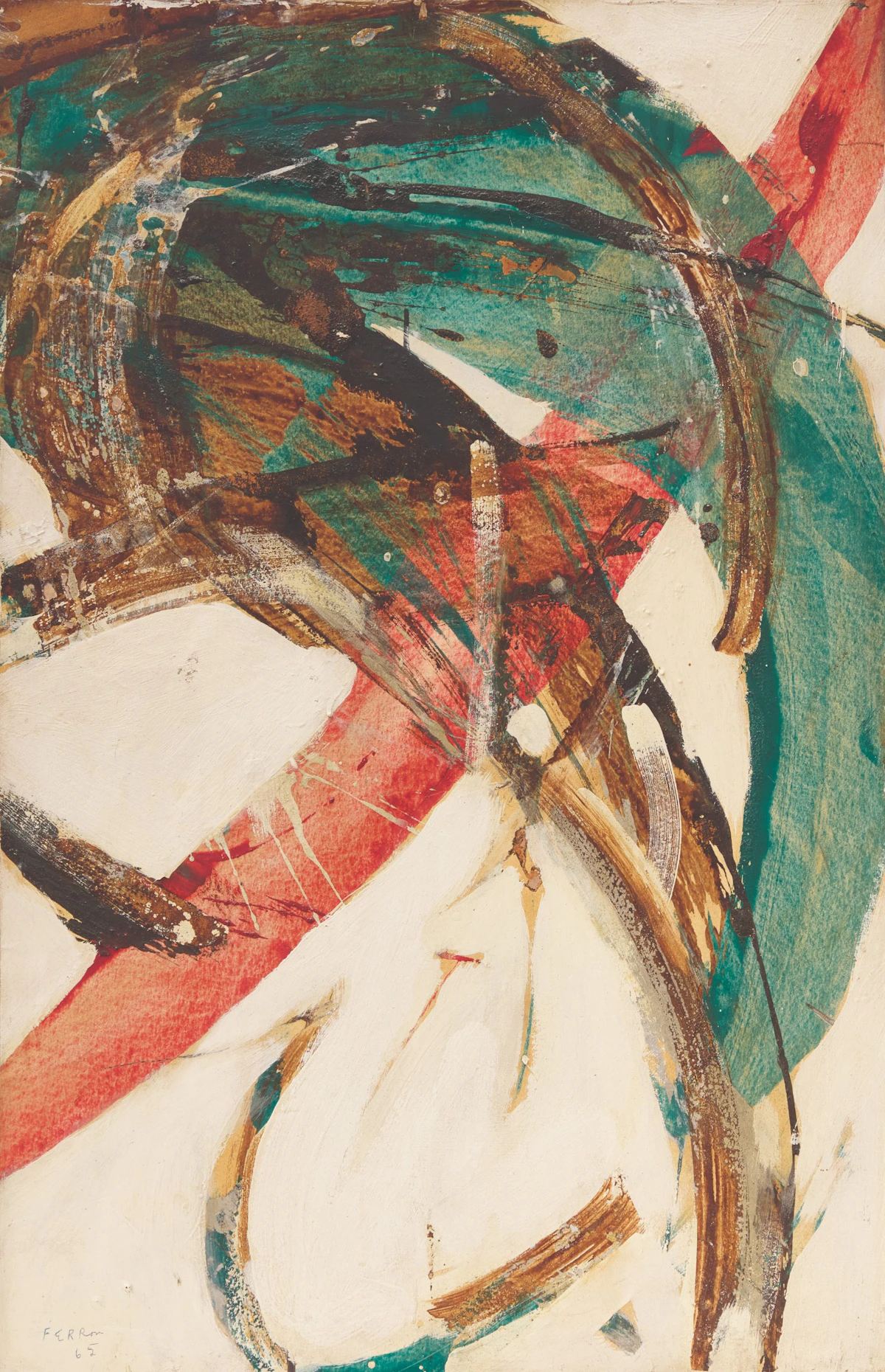
signed and titled 1965 lower left; dated on the gallery label on the reverse
36 × 23.25 in (91.4 × 59.1 cm)
Gallery Moos, Toronto
Private Collection, California, United States
Roald Nasgaard, Abstract Painting in Canada, Vancouver/Toronto, 2007, page 84
Marcelle Ferron remained faithful to Automatism throughout her career, driven by its aesthetic principles, the solidarity of the group, and especially the teachings of Paul-Émile Borduas, who promised at their first meeting to show her how to find the “joy” in her painting. Ferron had experienced an artistic crisis in the years preceding their meeting in 1946, and the impact of Borduas’s art and personality on the young painter was profound and enduring. A signatory of Refus global in 1948, Ferron was one of seven women to sign the manifesto and, at twenty-four, one of its youngest signatories. Her work consistently celebrated the Automatistes’ aim of liberating consciousness, when “man is freed from useless chains, to realize a plenitude of individual gifts, in necessary, unpredictability, spontaneity and resplendent anarchy.”
By the mid-1950s Ferron had achieved significant success in Quebec and across Canada. She moved to Paris in 1953 and exhibited throughout Europe until 1965. She was granted a silver medal at the São Paulo Biennale in 1962, which marked the most recognition a female artist from Quebec had ever received. Always carving her own artistic path, in 1966 Ferron abandoned painting to work in stained glass for several years, she was drawn to creating public art that would reach out to the “ordinary people” she loved so much.
