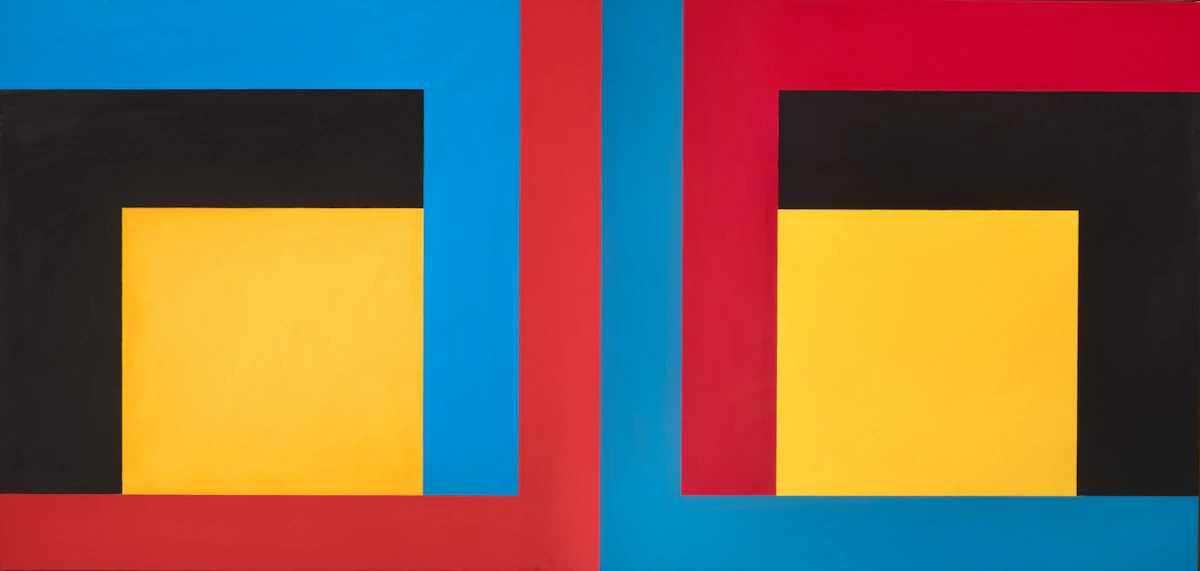
signed, titled and dated 1991 on the stretcher on the reverse
39 × 82 in (99.1 × 208.3 cm)
Private Collection, Toronto
Jaan Poldaas was born in Sweden to Estonian refugees and raised in Northern Ontario. Initially trained as an architect at the University of Toronto, he developed a geometric abstract painting practice based in conceptual thinking. Beginning in the early 1970s, Poldaas explored various methods of creating colour sequences through numerical, mechanical, and chance-based systems. He established self-imposed rules for each body of work or series, drawing on mathematical principles, physical laws, and elements of chance to organize colour and forms. In some cases, he even used dice or playing cards to determine compositional arrangements. Poldaas was interested in what happens when an artist deliberately relinquishes some conventional artistic decisions.
The artist’s Inverse Squares series dates to 1991, a pivotal period in his exploration of pre-established geometric systems and compositions. In this series of twelve oil paintings, Poldaas calculated square roots of included shapes to develop compositions mathematically. He placed four increasingly smaller squares in the corners of the next largest squares, and each square’s size was determined by the sequential square roots of 4, 3, 2, and 1. The word “inverse” is not only descriptive of the visual effect; it refers to the mathematical operation underlying the construction.
Colour is also a central component in Poldaas’s practice. While his paintings may appear minimal at first glance, they are highly controlled and deliberate, prioritizing optical experience over expression or narrative. He consistently emphasized the flatness of the picture plane and the relationships between tonal variations. The twelve Inverse Squares paintings are all composed of varying arrangements of black, red, blue and yellow rectangles.
In a written statement by the artist, Poldaas explains the complex ‘Law of Inverse Squares’ as the inspiration for this series: “In Newtonian physics, the Law of Inverse Squares applies to electromagnetic radiation and gravity, and defines the intensity of forces acting at a distance as being inversely proportional to the square of the distance. If a light shining on a wall has a certain intensity at a given distance, then that intensity is divided by four when the distance is doubled. Newton discovered this principle in the seventeenth century and used it (along with his nascent calculus) to plot the paths of the planets. The principle itself is implicit in the laws of perspective, which were formulated about a century earlier by painters in Italy and Holland.”
In 1990–1991, Poldaas was producing several related bodies of work based around geometric structures and colour. The artist remarked: “When it had become obvious, by the early 1990s, that perspective drawing was being taken over by machines, I involved myself nostalgically by making several series of paintings that used a sequential square-root variation of width to produce equal areas of different size and shape.” Immediately preceding Inverse Squares were the Vertical Composition and Square Composition series, completed in 1990. In 1991, the artist participated in the exhibition Abstract Practices at Toronto's Power Plant, alongside Claude Tousignant
Works from the Inverse Squares series are held in the permanent collections of the Art Gallery of Hamilton, Kenderdine Art Gallery, Art Museum of Estonia, and Art Bank, Ottawa.
