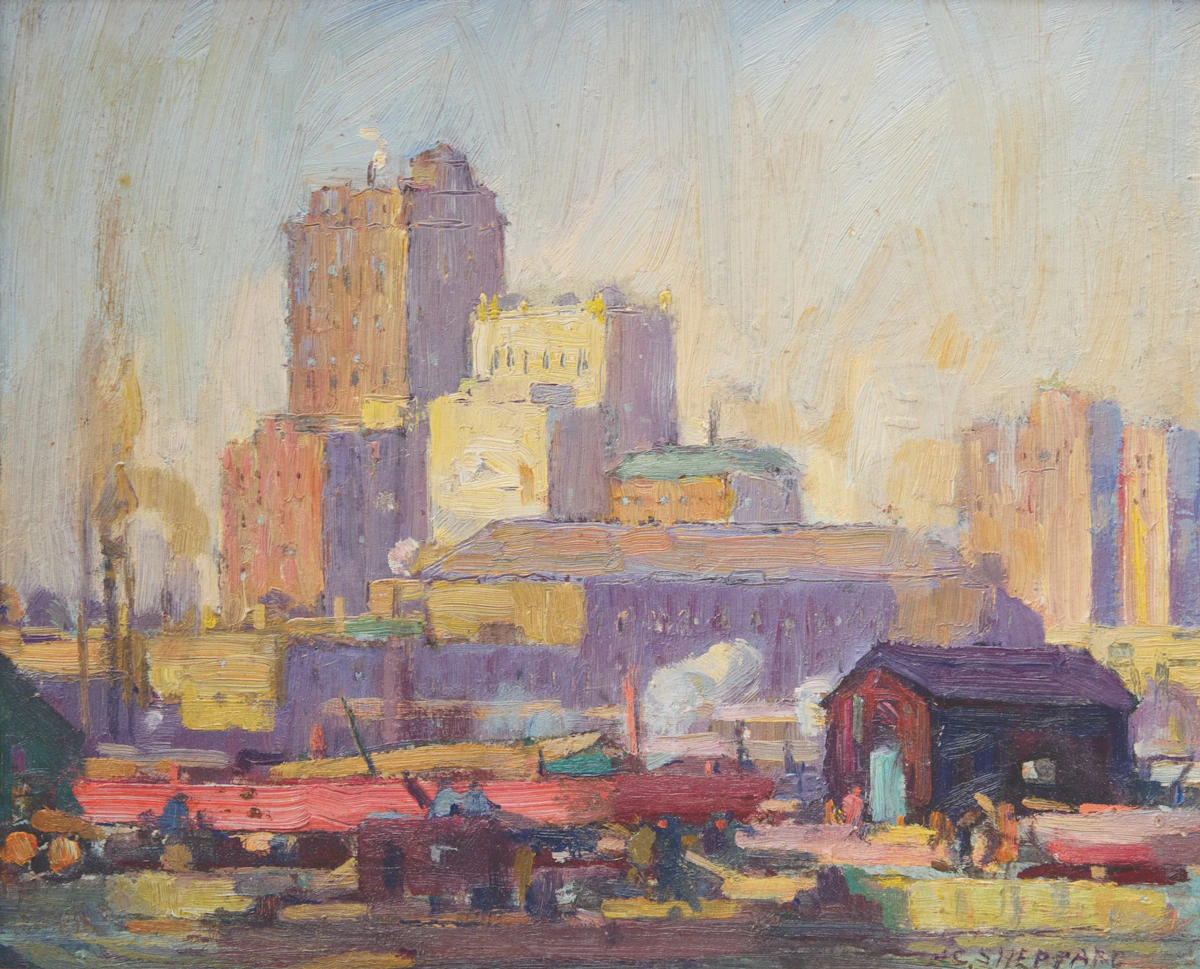
signed lower right; with unfinished study on the reverse and estate no. LG145 on the reverse
8.5 × 10.5 in (21.6 × 26.7 cm)
Estate of the Artist
Private Collection, Toronto
Tom Smart, Peter Clapham Sheppard: His Life and Work, Richmond Hill, 2018, reproduced page 33 as The City
Peter Clapham’s Sheppard’s robust study of the Toronto skyline from southwest of Union Station captures Toronto in one of its stages of coming into being. This time it is the onset of the second quarter of the twentieth-century, the First World War is years behind and the economy is thriving. The study’s vantage is a few hundred metres west of that of the related canvas. The season, subject, weather and quality of light connect the works and open our understanding of Sheppard’s method. In the study’s foreground, the predecessor to the current Union Station is being dismantled. Just beyond, the magnificent Beaux-Arts Union Station anchors Front Street West as the new terminus for travel to and from the city.
Much of the Toronto we know now was undreamt then, while all of the monuments in this study remain today. Immediately beyond Union Station is the cluster of commercial skyscrapers around King and Yonge Streets. From left to right they are Dominion Bank Building (1914) on the west side of Yonge, and the Royal Bank of Canada (1915), Canadian Pacific Railway Building (1913), and Trader’s Bank Building (1905) on the east side. When the buildings were completed little more than a decade earlier the Trader’s and Royal Bank buildings were the tallest in the Empire. Further west on King Street, the King Edward Hotel is in the centre-right of the composition and was the premiere hotel in Toronto prior to the construction of the Royal York. Sheppard caught Toronto’s commercial potential and pulse here as he did at his best—from the ground up and redolent with the brilliance, smells and textures of the city.
We extend our thanks to Gregory Humeniuk, independent art historian, curator and consultant, for contributing the preceding essay.
