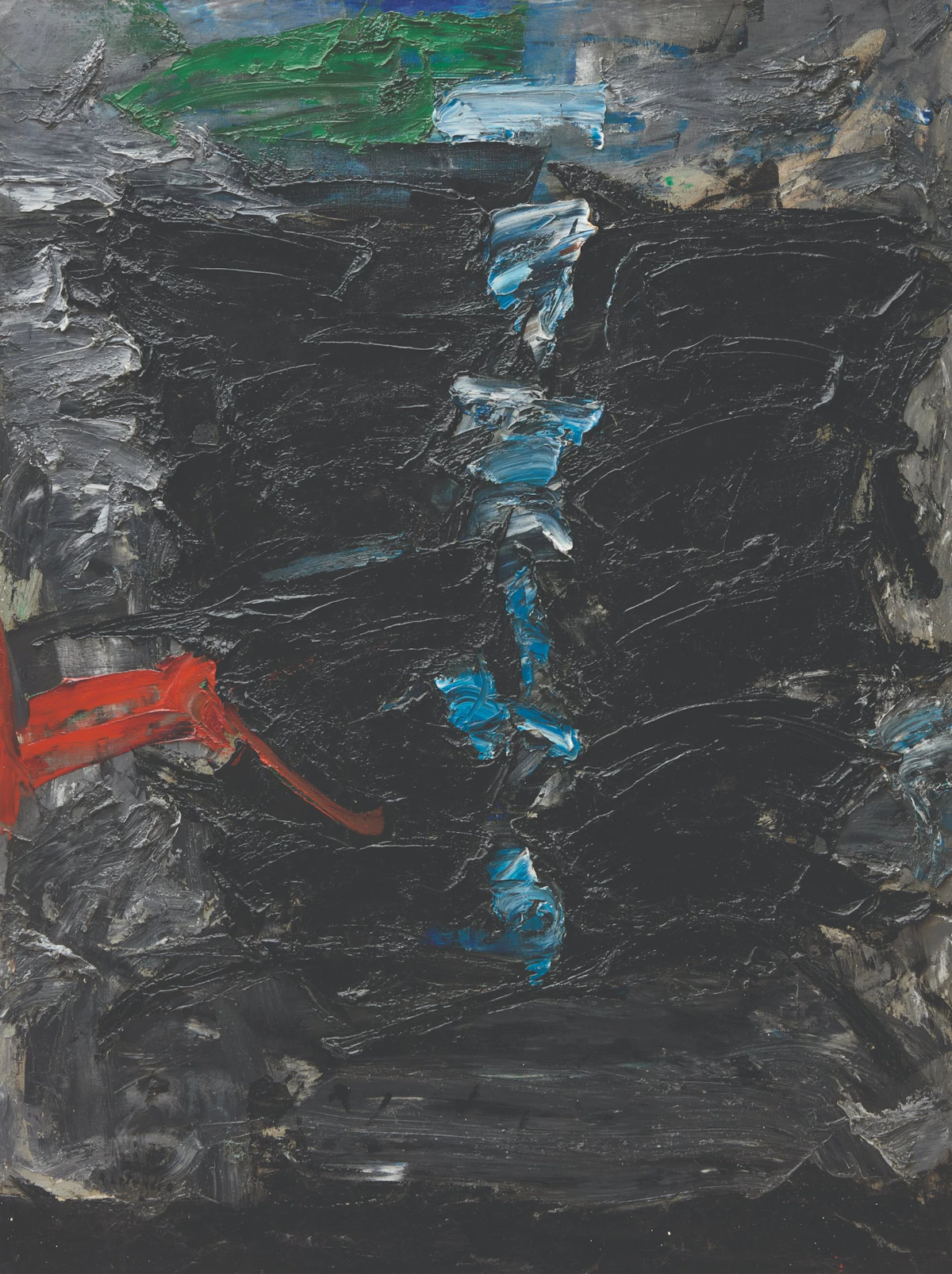
signed and dated 1961 lower left; signed, titled and dated on the reverse
40 × 30 in (101.6 × 76.2 cm)
Galerie Camille Hébert, Montreal
Joyner, auction, Toronto, 29 May 2001, lot 145
Private Collection, Toronto
Contemporary Canadian Art, National Gallery of Canada, Ottawa, August-November 1962, no. 9
Rita Letendre, Galerie Camille Hébert, Montreal, from 20 November 1963
Born in Drummondville, Quebec, Rita Letendre moved to Montreal at the age of fourteen with her Abenaki-Québécois mother, Québécois-Mohawk father, and her six siblings. In 1948, Letendre enrolled at the École des beaux-arts after a customer at the coffee shop where she worked encouraged her artistic ambitions and helped her pursue formal training. Previously self-taught, she developed her artistic knowledge by studying reproductions of European masters and Indigenous artists in art books and catalogues borrowed from her local library.
The rigid methodology and conservative environment of the École des beaux-arts’ proved ill-suited to Letendre’s interest in creative exploration. Ulysse Comtois, a fellow student who became a lifelong friend and companion, introduced her to the Automatiste circle surrounding Paul-Émile Borduas. She exhibited with the Automatists in Montreal between 1952 and 1955, and held her first solo exhibition that year at L’Échouerie, a café-bar run by Guido Molinari. Molinari presented a second solo exhibition of her work in 1956 at his newly opened gallery, L’Actuelle. Throughout the late 1950s, Letendre continued to experiment with luminosity and movement, developing a distinctive approach that set her work apart from that of many of her male contemporaries. These concerns would remain central to her practice over the course of her more than six-decade career.
In 1956, Letendre joined the Non-figurative Artists’ Association of Montreal, formed to promote the work of local abstract artists. Her approach was distinctly her own, resisting easy classification as either gestural or hard-edge abstraction. Her work drew on a diverse range of influences, from the forceful brushwork of Franz Kline to the geometric precision of Frank Stella. Throughout her career, Letendre found ways to work through the seemingly impossible unification of expressionism, lyrical abstraction, and hard-edged abstraction. In the early 1960s, she began to explore luminosity and dynamism by bringing heavy, gestural masses into conflict with each other. In these paintings, including Embryon stellaire, dating to 1961, Letendre arranged combinations of rich colours in heavy impastos against black paint, creating an oscillation between foreground and background. In this large canvas, a central mass of black evokes a tornado, drawing loose patches of red, blue and green into its swirling vortex. The grey background is built up with equally thick impasto, blurring the distinction between figure and ground.
In 1960, the National Gallery of Canada organized the exhibition Non-Figurative Artists of Montreal, which travelled to other venues in Canada and solidified Letendre's place in the forefront of Canadian non-figurative abstraction. Embryon stellaire was included in a 1962 exhibition of contemporary Canadian art at the National Gallery, and subsequently included in a show at Galerie Camille Hébert in Montreal in November 1963. The 1960s brought new opportunities and growing recognition for Letendre. In 1962, she received a Canada Council grant and travelled to Europe with Ulysse Comtois, visiting Paris and Rome before continuing to Israel.
