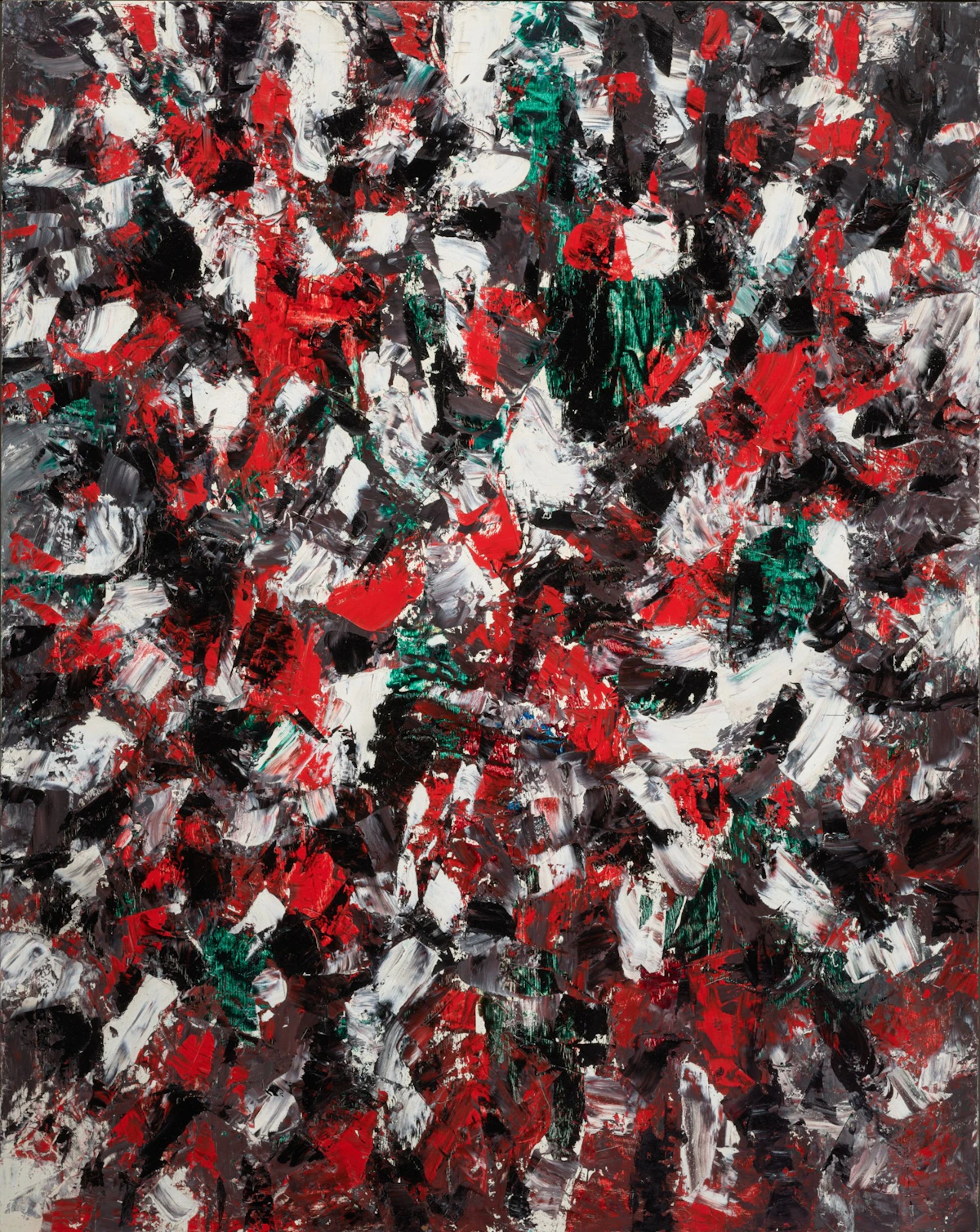
signed and dated 1959 on the stretcher on the reverse; titled on a label on the reverse
50 × 40 in (127.0 × 101.6 cm)
Jean Paul Riopelle, Paris
The Montreal Museum of Fine Arts, Art Sales and Rental Gallery
Galerie John A. Schweitzer, Montreal
Private Collection
Sotheby's & Ritchies, auction, Toronto, 27 May 2003, lot 188
Private Collection, Toronto
Lise Gervais, Thirty Years, 1953-1983, Bishop's University, Lennoxville, Quebec, 29 September-12 October 1983 (collection of John A. Schweitzer)
Lise Gervais: Peintures importantes des années 50, Galerie John A. Schweitzer, Montreal, March 1989
John A. Schweitzer, Lise Gervais; Thirty Years, 1953-1983, Lennoxville, 1983
Lise Gervais studied painting and sculpture at the École des beaux-arts de Montréal from 1950 to 1954 and steadily developed a forceful, gestural approach to abstraction influenced by the legacy of Paul-Émile Borduas and the Automatistes. She was associated with this broader movement but was not a formal member of the original group. Gervais was concerned with the limitations of paint itself, opting for bold pigments with high contrast, creating energy in her works. In Évolution naturelle, Gervais uses short bursts of layered colour, ranging from thin veils to opaque strokes of paint. Building on top of one another, each stroke of paint creates depth, movement and an invigorating contrast of black, white and red, not unlike Riopelle’s colour palette of the time. In this early work, the viewer can see the foundations of the artist's technique, focused on the limitations of the medium she developed throughout the 1960s. The liberation of painting is the central purpose of this work, breaking from narrative and landscape painting which dominated the dialogue of the medium within Canada until this critical period of revolution in art history.
Back in Montreal in 1961, Gervais had her first solo show at the Galerie Denyse Delrue. She would go on to show with Gallery Moos in 1962. Gervais then returned to teaching for sixteen years, at the École des beaux-arts, Concordia University and L’Université de Québec in Montreal. This work was owned by Canadian artist and art critic John A. Schweitzer, who championed and collected Gervais’ work.
