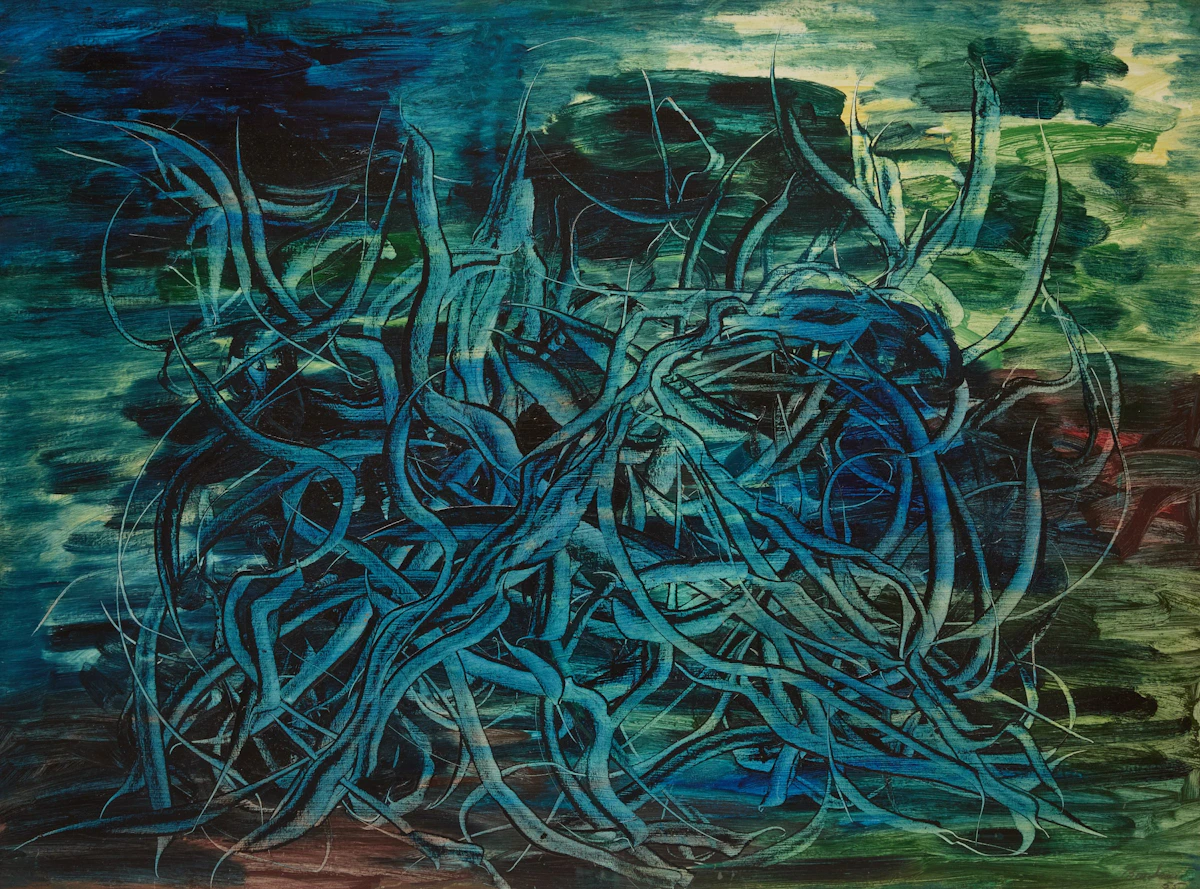
signed and dated 1955 lower right
30 × 40 in (76.2 × 101.6 cm)
Collection of John and Lynda Shearer
Private Collection, Toronto
The Automatiste Revolution: Montreal 1941-1960, The Varley Art Gallery, Markham; travelling to the Albright Knox Gallery, Buffalo; Art Gallery of Alberta, Edmonton; the Prairie Art Gallery, Grand Prairie and the Mendel Art Gallery, Saskatoon, 23 October 2009-15 September 2013 as Sans titre, 1953
Roald Nasgaard and Ray Ellenwood, The Automatiste Revolution: Montreal 1941-1960, Vancouver/Toronto/Berkeley, 2009, page 79, reproduced page 83, plate 50 as Sans titre, 1953
The influence of Automatiste philosophies are readily apparent in this work by Christian Marcel Barbeau. Prior to the publication and signing of the Refus global in 1948, Barbeau had re-examined his paintings of this period and destroyed many works deemed not radical enough for total abstraction. When Jean Paul Riopelle and Paul-Émile Borduas left Montreal for Paris and New York respectively and the other signatories formed the Plasticiens, Barbeau began to investigate his own form of abstraction. He exhibited small ink non-objective paintings in New York City in 1952, and following his divorce in the same year, he began to travel more and exhibited in Montreal, Ottawa and Quebec City.
By 1955, he was pursuing increasingly expansive abstract compositions, exploring the expressive possibilities of spontaneous gesture, all-over arrangement and nuanced colour. In this 1955 work, vigorous, overlapping lines animate the picture plane, sending the viewer’s eye in multiple directions. The gestural, spontaneous composition recalls Paul-Émile Borduas’ Automatiste paintings, with their emphasis on unconscious expression. Against a dark green ground, the interwoven lines form a dense network of marks that hints at a mysterious, almost landscape-like space. As Roald Nasgaard notes, Barbeau “continued to produce some dazzling Automatiste-like pictures in the early 1950s, such as Untitled, 1953, which performs an underwater reprise of his own.”
Barbeau pursued a distinctly individual path within Quebec's avant-garde. His work was rooted in the Automatiste's emphasis on spontaneous expression, yet his continued experimentation would lead him toward other forms of abstraction in subsequent decades. In 1957 he returned to drawing from live models and experimented with calligraphy, then focused on drawing and collage until pursuing Op-Art in the 1960s.
