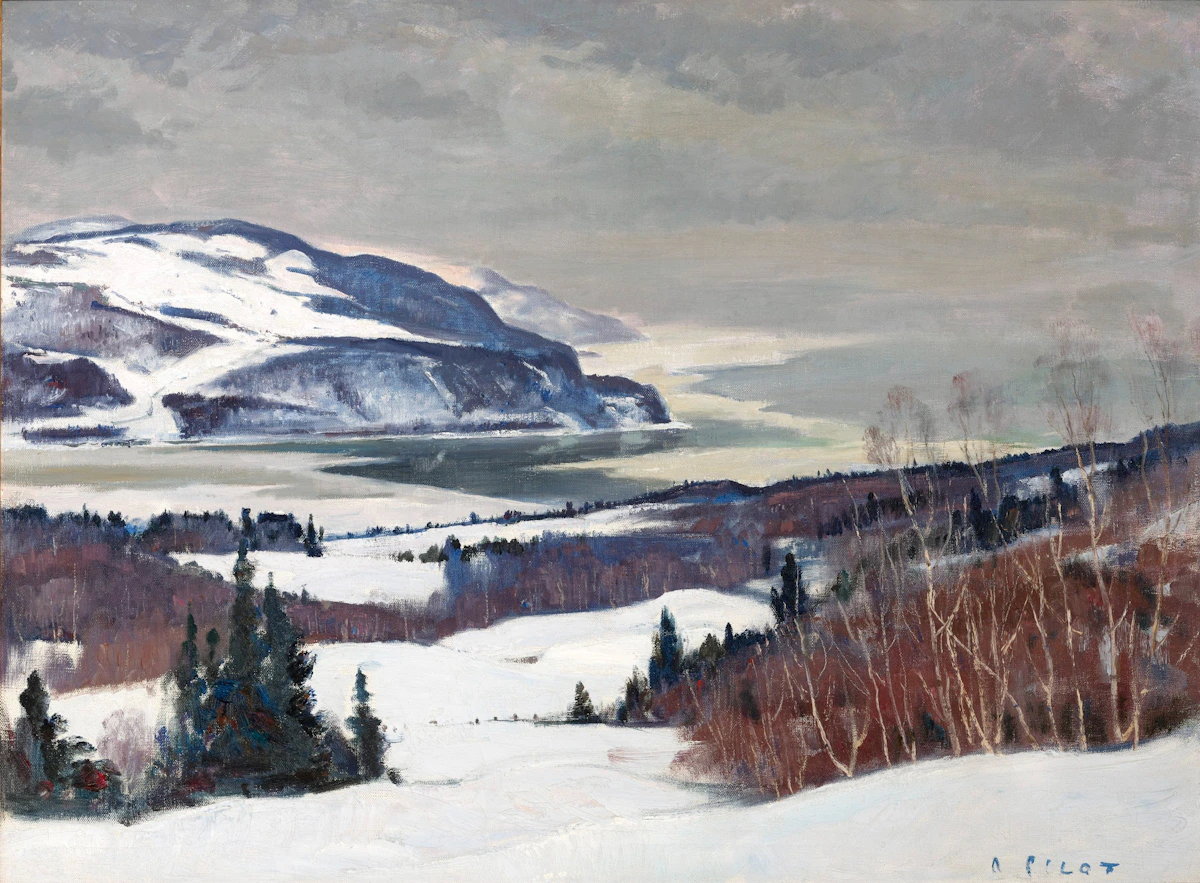
signed lower right; titled on the stretcher on the reverse
24 × 32 in (61.0 × 81.3 cm)
Roberts Gallery, Toronto
Private Collection, Toronto
A.K. Prakash, Impressionism in Canada: A Journey of Rediscovery, Stuttgart, 2015, pages 621, 632
Similar to his stepfather Maurice Cullen, Robert Pilot's most renowned work focuses on the villages and towns of Quebec and eastern Canada. Pilot’s poetic compositions share the same search for identity that motivated J.W. Morrice, Clarence Gagnon and Albert Robinson—his Quebec predecessors and counterparts. Recognized for his artistic abilities early on, the artist had already received training with art organizations throughout Montreal before enlisting and serving as a gunner in the First World War. Soon after his return, the painter was invited by A.Y. Jackson to include two of his works in the Group of Seven's first exhibition in 1920. Following the exhibition, A.K. Prakash explains that Pilot declined “to formalize an association with these artists. Like Cullen, he differed philosophically from the group's nationalistic approach to art.” Prakash, describing the work for which Pilot received accolades throughout his life, says that through his work, the painter “offered his own interpretation of the Canadian landscape, one he handled with great visual clarity and sharp focus. Although he painted many charming subjects throughout Canada, Spain, Morocco, England, France, and Italy, it was the countryside and the urban life of old Quebec that were his preferred subjects – as they had been for Cullen, Suzor-Coté, and Gagnon before him.”
