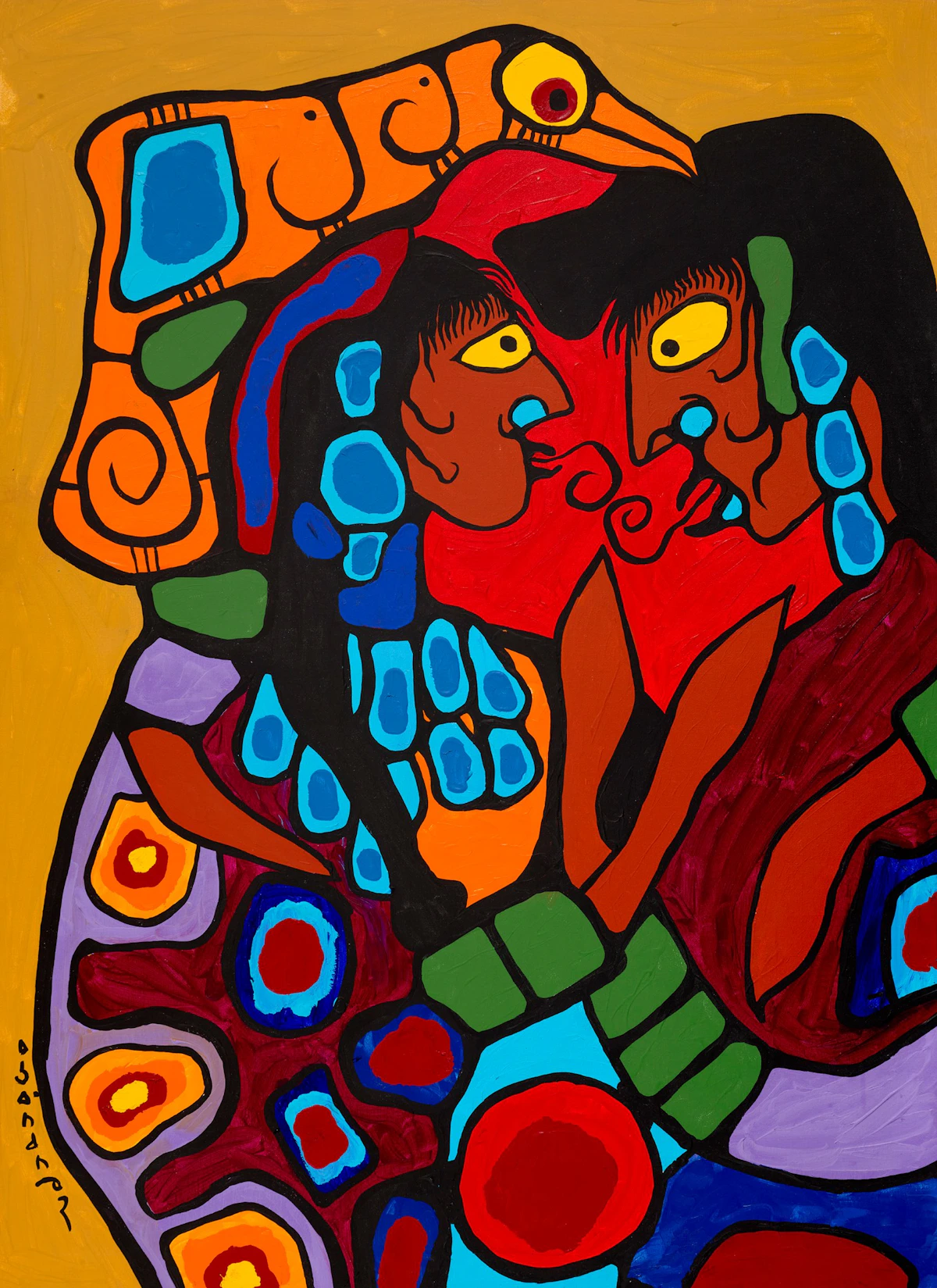
signed in syllabics lower left; titled and dated 1978 on gallery labels on the reverse
52.5 × 38 in (133.3 × 96.5 cm)
The Pollock Gallery, Toronto
Kinsman Robinson Gallery, Toronto, 1978
Private Collection, Toronto
Lister Sinclair and Jack Pollock, The Art of Norval Morrisseau, Toronto, 1979, pages 116, 133
Armand Garnet Ruffo, Norval Morrisseau, Man Changing into Thunderbird, British Columbia, 2014, pages 196, 198
Norval Morrisseau is considered to be a trailblazer of contemporary Indigenous art. He was the eldest of five siblings, born to Grace Theresa Nanakonagos and Abel Morrisseau. Following Anishinaabe customs, he was sent to live with his maternal grandparents at the Sand Point First Nation (now known as Bingwi Neyaashi Anishinaabek), located on the shores of Lake Nipigon in Ontario. It was there that Morrisseau immersed himself in the rich stories and cultural traditions of his people, guided by his grandfather, Moses Potan Nanakonagos, who was a shaman trained in the Midewiwin spiritual tradition. Unlike other children his age, Morrisseau preferred the company of elders and enjoyed listening and learning about traditions or being by himself immersed in his artistic pursuits. Fascinated by local petroglyphs, Morrisseau wanted to depict things he had heard about or seen, such as sacred bears, Thunderbirds or shamans.
Norval Morrisseau’s complex visual language was rooted in cultural traditions which included the shaman artists of the Midiwewin scrolls, the Agawa Bay rock paintings and the Peterborough petroglyphs. Morrisseau’s innovative and expressive artistic vision would provide an essential influence for the artists of the Woodland School. The artist’s maternal grandfather, Moses Nanakonagos, was an Anishinaabe storyteller and was recognized as a shaman by his peers. Morrisseau grew up surrounded by this spiritual tradition. Morrisseau himself became deeply interested in shamanism and eventually identified himself as a shaman artist. He described his painting practice as a means of accessing other spiritual realms, and scholars have characterized his paintings as functioning as a kind of spiritual intermediary. In Shaman and Apprentice, two figures are closely intertwined, and appear engaged in a transfer of power. The figures’ protruding tongues are nearly touching, possibly suggesting an exchange of otherworldly energy in historic Woodlands iconography.
In 1976 Norval Morrisseau was introduced by his assistant, Eva Quan, to Eckankar, a belief system that welcomes past lives, dreams and the ability of the soul to travel. As Lister Sinclair states, “Morrisseau has been devoted to Eckankar, a body of teaching which centers around soul travel. Once again he has found a way of systematically using personal visions to liberate his artistic imagination. Once again, for all his uniqueness as an artist and as a human being, he shows himself securely placed in the Indian tradition of a vision–generating shaman.” As Jack Pollock reflected, “As soon as Morrisseau joined the Eckankar movement in 1976, he gave up drinking altogether. Not an easy task.” The artist’s use of colour became bolder and brighter in his later paintings of the 1970s.
As Armand Garnet Ruffo writes of Morrisseau, “a light goes on that illuminates the world and confirms everything taught to him by his grandfather Potan all those years ago. He connects Eckankar’s emphasis on soul travel through the astral planes to his traditional Ojibway teachings.” Morrisseau began to deeply explore myths and legends, reinventing them from the various worlds of the Great Ojibway. Throughout his career, Morrisseau repeatedly used the same classic, balanced compositional forms. The subjects are often depicted in a pyramid, with a central, symmetrical arrangement of figures or groupings balanced on the ground of the work, as exemplified in Shaman and Apprentice of 1978.
By the mid-1970s, Morrisseau had entered the mainstream art world, with his work finding its way into major institutional collections across the country. In 1978, the same year he painted Shaman and Apprentice, Morrisseau was appointed to the Order of Canada—an acknowledgement of an artist at the height of his powers.
Morrisseau was represented by Jack Henry Pollock, founder of The Pollock Gallery in Toronto. Pollock was a painter, art educator, author and gallerist who represented Canadian artists and played a defining role in the Toronto art scene for over three decades. In the summer of 1962, while teaching painting workshops in Northern Ontario funded by the Ontario Government, Pollock met Morrisseau; he immediately recognized the artist's genius and arranged for a solo exhibition at his Toronto gallery that September. The sold-out 1962 exhibition received unanimous praise and is considered both the launch of Morrisseau’s career but also one of the most important events of the burgeoning Toronto art scene at the time. Morrisseau went on to arguably become Canada's most important Indigenous artist. Pollock developed a reputation for identifying talent in young artists and was instrumental in the careers of many notable artists, including Ken Danby, Charles Pachter, Robert Bateman, Ron Martin and Jack Bush. The Pollock Gallery also exhibited an impressive array of international artists, many of whom for the first time in Canada, including Willem de Kooning, David Hockney, Josef and Anni Albers, and Victor Vasarely. Pollock became known for his discerning eye and his legacy is most closely associated with his discovery and promotion of Norval Morrisseau.
This artwork is accompanied by a certificate of authenticity issued by John Zemanovich of Art Experts Canada Inc.
