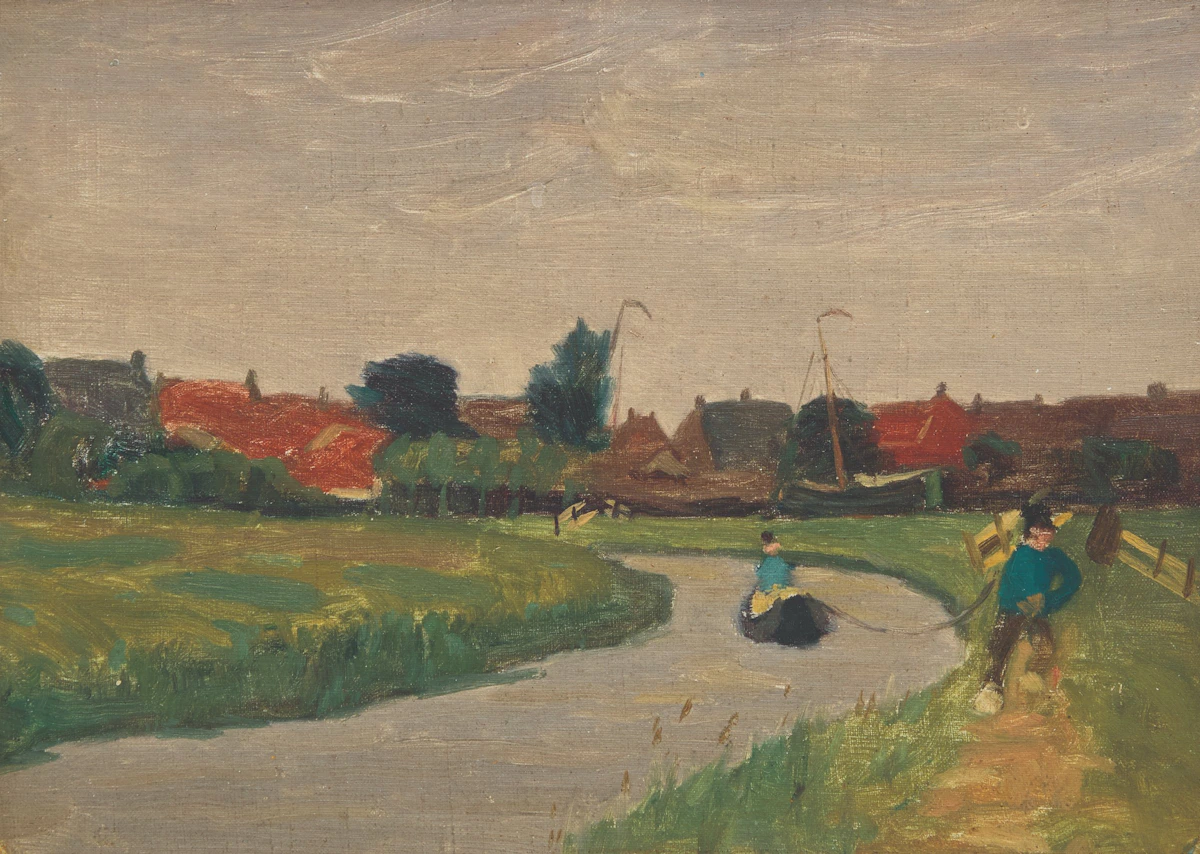
titled on a gallery label and inscribed "From the studio of J.W. Morrice - J.C. Heaton", "30" and "Along the tow path of Dutch canal" on the reverse
8.75 × 12 in (22.2 × 30.5 cm)
Studio of the Artist
Wm Scott & Sons (inv. no. M121)
Continental Galleries, Montreal (no. 30)
Mrs. J.C. (Margary) Dallas, Chilliwack, B.C., 24 March 1949
Laing Galleries, before 1970
Private Collection, London
Joyner, auction, Toronto, 29 May 2007, lot 87
Private Collection, Toronto
Joyner, auction, Toronto, 22 November 2010, lot 43
Private Collection, Toronto
Paintings from the Dallas Collection shown during the "Summer Home Festival", Chilliwack and District Museum, B.C., 1-4 July 1959
London Collects, London Public Library and Art Museum, London, 6-30 October 1972, no. 117
Off the Wall: Art Treasures from Niagara Collections, Riverbrink Art Museum, Queenston, Summer 2011, no. 22
Charles C. Hill, Morrice, A Gift to the Nation: The G. Blair Laing Collection, Ottawa, 1992, see page 35 for similar examples of river compositions by J.W. Morrice
At the turn of the twentieth century, Holland briefly became a fashionable destination for artists seeking picturesque subject matter. Some local customs puzzled North American artists, including the practice of having people tow boats along canals too narrow for rowing. Yet travel guides recommended this leisurely mode of transportation as an ideal way to appreciate the fertile countryside, where cattle were prized for their milk production rather than used for labour.
James Wilson Morrice painted what he observed on a grey day in southern Holland, not far from the historic city of Dordrecht. He felt no need to include a windmill where none was visible, or to lower the horizon in the manner of the Old Dutch Masters so popular with Canadian collectors. If a man was pulling a boat, Morrice included him, though he was no ethnographer and did not fully understand the technique: the rope had to be wrapped tightly around the chest and arms several times to distribute the weight of the load.
This oil painting was based on a very loose pencil sketch. Although the dates and frequency of Morrice’s visits to Dordrecht are unknown, he had painted there on more than one occasion before 1895. Most of his Dutch drawings depict landscapes featuring the characteristic windmills and sailboats, but they also reveal an emerging interest in the lives of working people, which would come to the fore in his depictions of Cancale, Brittany, the following summer. This small painting is quite luminous despite the grey sky and water. Every colour is carefully considered, from the varied tones of the roof tiles, echoed in the earthy path, to the two distinct shades of blue worn by the figures. The delicate colour harmonies that would become a hallmark of Morrice’s mature work are already evident in this charming painting, one of his last before the influence of Whistler and his discovery of Venice ushered in a new phase of his career.
We extend our thanks to Lucie Dorais, Canadian art historian and author of J.W. Morrice (National Gallery of Canada, 1985), for her assistance in researching this artwork.
