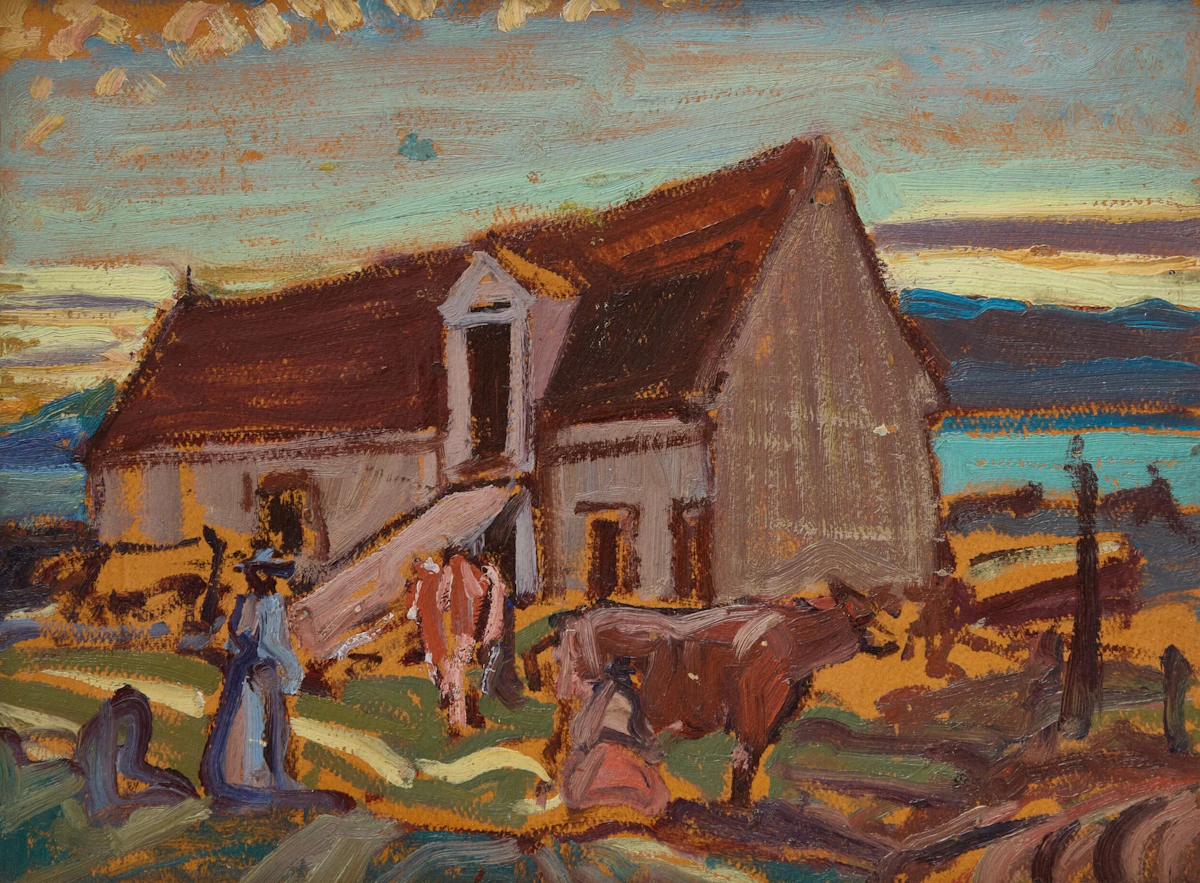
signed and titled on the reverse
12 × 16 in (30.5 × 40.6 cm)
Joyner, auction, Toronto, 14 May 2002, lot 126
Private Collection, Toronto
Paul Duval, Canadian Art-Vital Decades, Toronto, 1970, unpaginated, a similar sketch reproduced titled Old Barn, Quebec, 1926
Lois Darroch, Bright Land, A Warm Look at Arthur Lismer, Toronto/Vancouver, 1981, a similar pen and ink work reproduced page 115 titled Barn, Île D'Orléans, 1925 (fig. 84)
Sotheby's, Important Canadian Art, Toronto, 21 November 2005, a similar sketch reproduced as lot 114 titled A French Canadian Barn, Île D'Orléans, circa 1926
The sea and coast were among Arthur Lismer’s favourite landscape subjects. His depictions of turbulent seashores and dramatic skies harkened back to his early studies of John Constable and the Romantic painters. Lismer worked from both Canadian coasts throughout his career, and had lived in Nova Scotia from 1916 to 1919. There, he was commissioned to capture scenes of the Halifax harbour with Navy vessels from the First World War. Following a return to Toronto, his position as vice-principal at the Ontario College of Art allowed Lismer to go on numerous sketching expeditions during the summer. In August of 1925, Lismer travelled to the region of the lower St. Lawrence River, along with A.Y. Jackson and the renowned ethnologist Marius Barbeau. The Gaspé region offered a multitude of ideal painting subjects for Lismer, and the artist’s output on the trip was abundant. He was documented as visiting Île d’Orléans, Baie-Saint-Paul and Saint-Hilarion Île-aux-Coudres in 1925. In his autobiography, Jackson writes about being with Lismer in Saint-Hilarion and Île d’Orléans. This trip marked an important period where he expanded his focus beyond Ontario to the rural and Laurentian landscapes of Quebec. Old Barn, Île d’Orléans, P.Q. wonderfully exemplifies Lismer’s Group period en plein air sketches, with its fresh immediacy and painterly brushstrokes. This charming work reflects Lismer’s broader exploration of Canadian identity through scenes of labour, industry, and the natural environment, capturing his vision of the Canadian landscape as a place shaped by both nature and human activity.
