estate stamp lower left; inscribed "1948 liner" and with FW monogram on the reverse
32 × 24 in (81.3 × 61.0 cm)
The Fine Art Galleries, T. Eaton Co., Toronto
Private Collection, circa 1950
By descent to the present Private Collection
Possibly Emily Carr, The Fine Art Galleries, T. Eaton Co., Toronto, from 3 December 1949
Lawren Harris and Emily Carr Correspondence, Emily Carr Fonds (MS-2181), B.C. Archives, Royal B.C. Museum, Victoria
Graham McInnes, "World of Art," Saturday Night (3 April 1937), page 8
Doris Shadbolt, The Art of Emily Carr, Toronto, 1979, pages 62-64
Emily Carr, Hundreds and Thousands, Toronto, 1996, page 188, entry dated July 1, 1935
Kathryn Bridge, Unvarnished: Autobiographical Sketches by Emily Carr, Victoria, 2021, page 126
Emily Carr’s style evolved considerably over the years. Her early works reflected the English-centric nineteenth-century manner encouraged by her training. After a year in France, her approach shifted to a Post-Impressionist style with moments of Fauvism. However, just when it seemed she was about to hit her stride, the artist painted little for the next fifteen years. This dormant period preceded an explosion of output which would last the rest of her life. Her new style developed rapidly and was marked by a distinctive approach and a conviction, which distinguished Carr’s work thereafter.
In June 1935, Emily Carr travelled to Albert Head, along Metchosin Road, approximately eighteen miles west of Victoria, where she spent a highly productive summer sketching from her caravan. She worked in oil paint thinned with gasoline on inexpensive manila paper, a technique she had begun using in 1932. This method offered the transparency and spontaneity of watercolour while retaining the richness of oil paint. Its low cost was an added advantage for Carr, who was often short of money.
At Albert Head, Carr returned to a subject she had explored in 1931 and 1932: second-growth trees rising amid thick undergrowth. Her blended brushstrokes give the forms a sculptural presence, drawing the surrounding vegetation around the young tree. Yet in these 1935 works, her attention had shifted towards movement, which became the dominant force shaping her compositions.
Carr’s paintings from that summer were exhibited at the Women’s Art Association in Toronto in early December and attracted the admiration of Graham McInnes, who wrote about them in Saturday Night on 7 December. He observed: “[Emily Carr] paints quickly and with a fierceness and passion that are completely convincing. Her technique is astonishing. Viewed closely, the sheer audacity of her rapid brushstrokes compels admiration, while each picture, regarded as a whole, has in it the concentrated essence of the impact of a deeply sensitive and fervent nature on a scene for which she feels with an intensity that only prolonged study and profound conviction can bring. … [Carr is] an artist who is, in her own way, as possessed with the creative urge as that powerful and tragic figure of the last century whose name was Vincent van Gogh.”
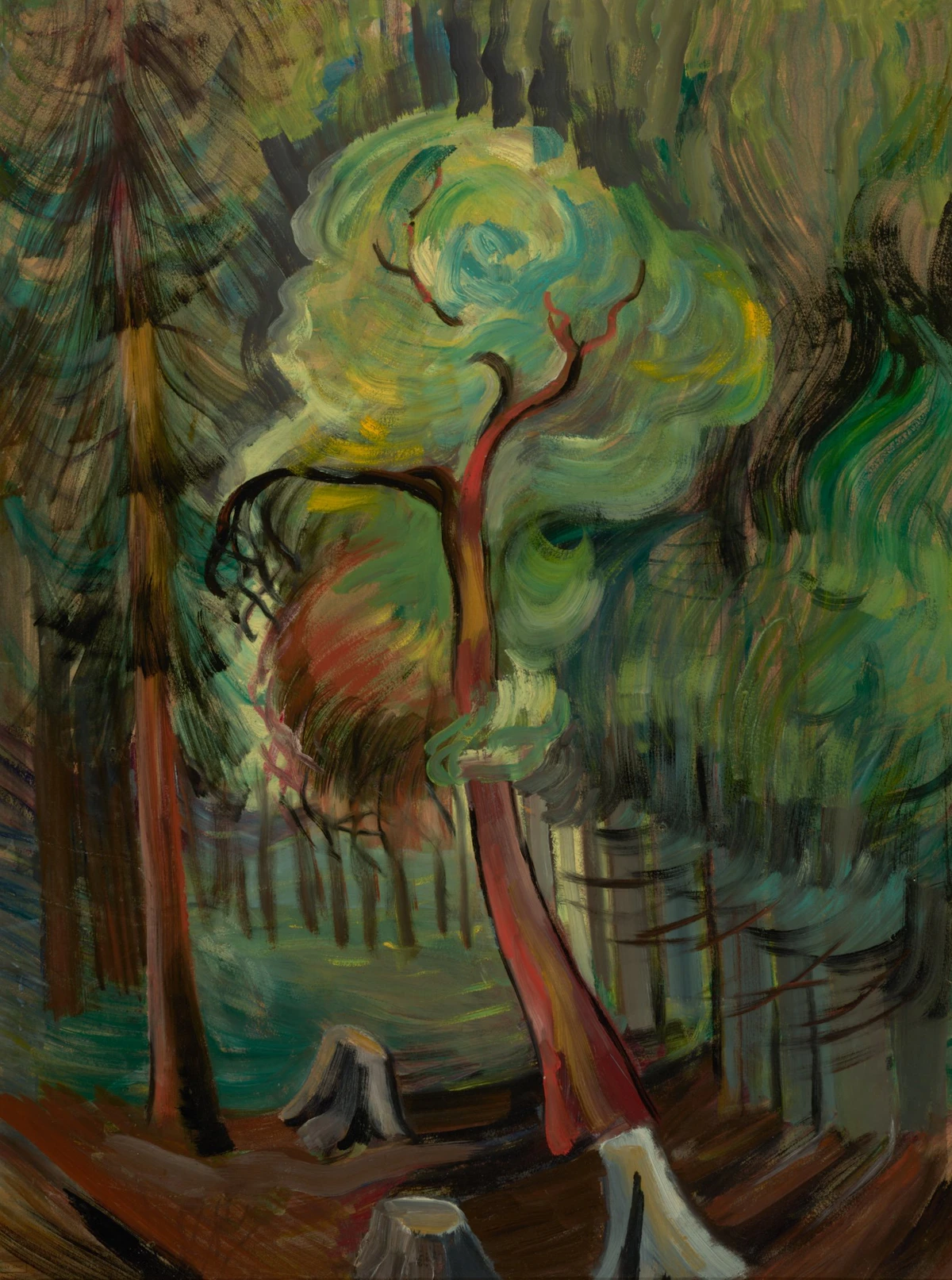
Emily Carr’s Forest Interior belongs to the group of paintings she described as her “woodsey” subjects. The work likely dates to a period when, as Carr recalled, she was “furiously happy from the moment she woke,” immersed in painting from her caravan, which she affectionately nicknamed “The Elephant.” Here, she conveys her delight in the swirling yellow and green foliage of a tree set against a second-growth forest, previously logged yet still mysterious and richly evocative. Trees crowd the composition on all sides, rising in the foreground, framing the scene and extending into the background to create an overwhelming sense of density. Light filters through the foliage, illuminating the area around the base of the central tree.
In Forest Interior, Carr explores the forest as a world unto itself. Her trees embody both vulnerability and resilience: the conspicuous stumps scattered throughout the scene bear witness to human intervention, while the surrounding vegetation speaks to the forest’s continuing verdancy and renewal. Through her vigorous brushwork and swirling forms, Carr captures not simply the appearance of the woods but their underlying vitality, conveying the dynamism of the landscape as a living whole.
Carr recorded in a diary entry in June 1936 that she was parked down the road from a “dense, junglely wood” where she did much study, and she found it “so big and thick you could easily [lose] your bearings”. Carr was intensely drawn to painting her home, her ‘native’ land in British Columbia, as both her paintings of the monumental art and villages of the First Nations and her landscapes of British Columbia suggest.
Forest Interior, circa 1940, recalls features of her early landscape works such as Wood Interior (1929-1930, Robert McLaughlin Gallery, Oshawa) in both composition and medium. She may have thought of earlier work upon viewing the dense foliage, tree trunks and lit-up central image of the tree in the landscape. In Forest Interior, the paint appears thick, not diluted, and more like an oil on canvas.
Carr surely would have remembered the words of the American artist Mark Tobey in 1928 when he held a three-week advanced course in her studio. He told her that she should "pep-up" her dark canvases by using lit areas which "pushed" against the dark.
Forest Interior offers the collector a painting from the hand of the first among the famous women artists of Canada. Though her career was long, productive and marked by outstanding quality, it is her silent, dark forests and tall firs that created a visual legend of the West Coast. It was also during this period of her work, towards the end of her life, that she expressed her view of nature and life as energy. Carr had become deeply religious and the movement within the picture came to represent the spiritual energy, cosmic consciousness and growth. This period is the culmination of a life spent living, working and travelling within British Columbia. A comprehensive body of work that integrates a clear, universal framework while drawing on specific regional insights. Forest Interior was painted during one of Carr’s many “spiritual” sketching excursions throughout British Columbia.
We extend our thanks to Joan Murray, Canadian art historian, for contributing the preceding essay. We also extend our thanks to Charles Hill, Canadian art historian, curator and author for his assistance in researching this artwork.
