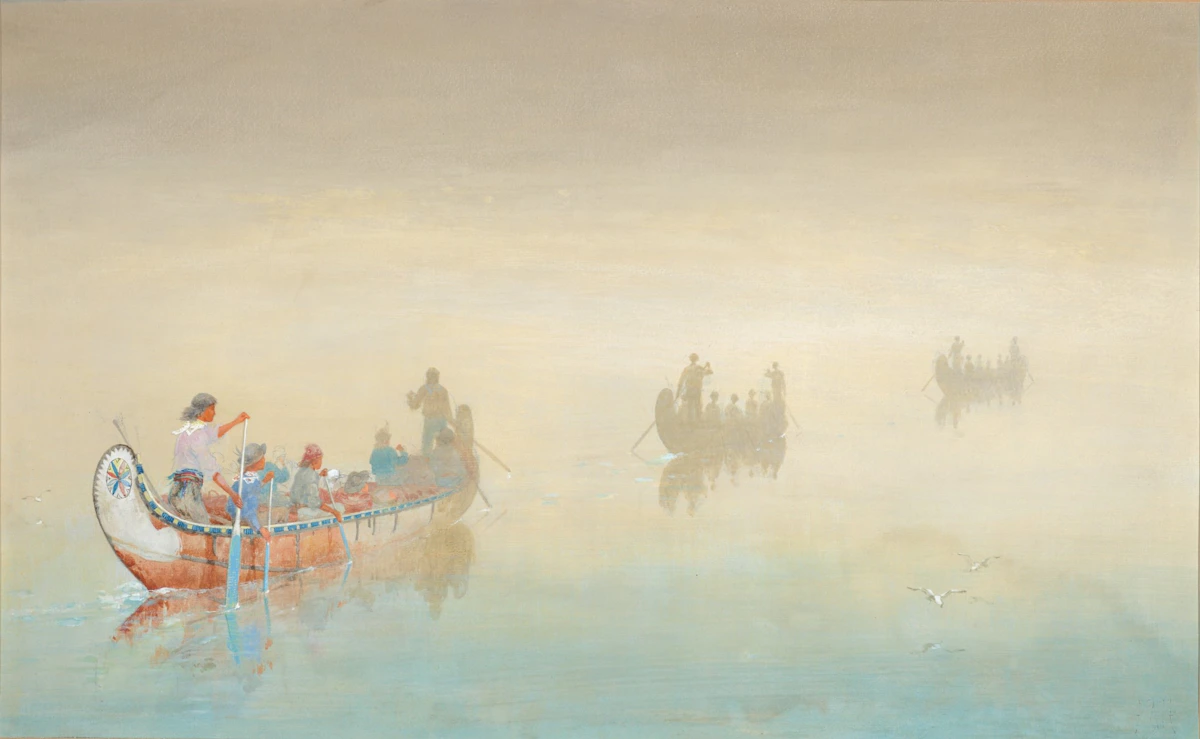
signed with initials lower right
13.75 × 22.25 in (34.9 × 56.5 cm) (sight)
Collection of Rev. Stephen Henry Phillimore (1881-1956)
By descent to Robert Phillimore, 1950s
By descent to the present Private Collection, United Kingdom
Possibly Mrs. F.A. Hopkins, One-Artist Exhibition, Modern Gallery, London, March 1912, no. 33 as Canoes in a Fog
"Art Notes: Canada at The Modern Gallery", The Daily Graphic, London, 9 March 1912, page 1015
Janet E. Clarke, Frances Anne Hopkins 1838-1919: Canadian Scenery, Thunder Bay, 1990, see page 85 for a similar work in the collection of the Glenbow Museum
Thomas Schultze, Frances Anne Hopkins, Images from Canada, Manotick, 2008, see pages 81-83 for similar works in the collection of the Glenbow Museum
MaryEllen Weller-Smith, Frances Anne Hopkins: Hudson’s Bay Company Wife, Voyageurs’ Artist, Madison, Wisconsin, 2022, pages 113, 144
Frances Anne Hopkins holds an important place in Canadian art history. She is best known for her depictions of everyday life in Canada during a period of significant change. Canoe brigades and timber rafts began to give way to steamboats and railways, and Confederation took shape amid growing concerns over American aggression in the post-Civil War era. Hopkins documented a country undergoing significant social, economic and political change. Her paintings and drawings reveal a deep affection for the land where she spent nearly twelve years of her life, raising a family while observing and recording the urban and rural landscapes around her. Even after returning to England, she continued to draw inspiration from Canadian subjects, revisiting the experiences and imagery that had shaped her artistic career.
Born in London in 1836, Hopkins grew up in a distinguished artistic family. Her grandparents and uncles were artists, while her father, Captain Frederick Beechey, R.N., was a noted Arctic explorer and accomplished amateur artist. It is likely that she received her early instruction in drawing and painting from members of her own family. In 1858, she married Edward Martin Hopkins, a Hudson’s Bay Company official and widower fifteen years her senior, and moved to Canada to help raise his three sons from his first marriage. The couple subsequently had six children, only two of whom survived to adulthood. Despite the considerable demands of managing a large household, Hopkins continued to pursue her artistic interests, becoming involved with both the Art Association of Montreal and the Montreal Sketching Club.
When the family settled in Lachine, the historic eastern terminus of Montreal’s fur trade, Hopkins immediately began documenting her new surroundings. She sketched the shores of the St. Lawrence River, the Lachine pier and Dorval Island, capturing the landscape and rhythms of everyday life. Her early Canadian sketchbooks contain delicate pencil drawings and watercolours depicting the area surrounding the family home, offering an intimate record of the community in which she lived. She also accompanied her husband on canoe excursions around Montreal and along the St. Lawrence and Ottawa Rivers, experiences that would become central to her artistic practice.
Hopkins undertook three particularly significant journeys during her years in Canada. In 1864, she travelled along the north shore of Lake Superior, from Fort William to Michipicoten. Two years later, she journeyed up the Ottawa River into the Temagami District, and in July and August 1869, she travelled by canoe with her husband from Fort William to Montreal. Her enthusiasm for these expeditions was evident, as her husband observed in a letter to one of his fur trade colleagues: “Canoe travel agrees with her.”
In 1871, the Art Journal drew attention to a scene of canoe travel through the Canadian wilderness, exhibited at the Royal Academy by Hopkins. She had first attracted attention at the Academy in 1869 with an atmospheric depiction inspired by her own journey by birchbark canoe through the mists of Lake Superior. The following year, she presented a more intricately detailed composition of voyageurs transporting two European passengers through the fur-trading territories of the Hudson’s Bay Company, one of whom was, once again, a woman.
These paintings distinguished themselves on several fronts. Canadian subjects of this kind remained relatively uncommon in British art exhibitions of the 1860s and early 1870s, and while scenes of travel had long been a familiar feature of the Royal Academy, they were seldom submitted by women artists, and rarer still were depictions of women undertaking adventures of their own. Hopkins’s work thus presented the London art press with an unfamiliar combination of subject and perspective. Her North American experiences became the defining subject of her artistic output, as she drew upon the extensive plein air sketches made during her time in Canada. She had already exhibited her work in Canada on several occasions, most recently at the Art Association of Montreal’s Exhibition in 1870. The exhibition featured sixteen watercolours inspired by her canoeing journeys and the vanishing traditions of voyageur travel, reflecting her interest in a way of life that was rapidly disappearing.
Featured in this auction, Canoes in a Fog, Lake Superior is one of several preparatory works Hopkins produced during her first journey along Lake Superior in July 1864. The sketch served as the foundation for her first painting accepted for exhibition at London’s Royal Academy, in 1869, the 100th anniversary year of the Academy. This painting was hung in Gallery 1, a prestigious position for presentation and it was reported that Queen Victoria visited the exhibition five times. This canvas was acquired by the Glenbow Museum in 1955, reaching a wider audience when Knoedler & Co. selected it for engraving and publication in 1873. Hopkins exhibited with the Royal Academy thirteen times over her career, as well as being accepted to exhibit with the Society of British Artists and the Society of Women Artists, establishing herself within the art world of Britain.
Six related Hopkins sketches are now known: three are held by the Glenbow Museum, one belongs to the Art Gallery of Hamilton, and another appeared in Cowley Abbott’s Spring 2025 Live Auction (Price Realized $240,000). The present sketch is distinguished by its remarkably well-preserved, luminous colours and the exquisite rendering of the figures’ clothing. Beyond its visual appeal, the work varies from the final painting; the position of the hands of the steersman in the closest canoe; the paddler who is not pausing for a drink of water; the reversed positions of the two passengers, with the woman on the left rather than the right. Lastly, the flotsam (branch) present in both the painting and the print is omitted.
As MaryEllen Weller-Smith describes, "The white paint on the canoe’s ends is the distinguishing mark on Hudson Bay Company canoes, and Frances Anne Hopkins consistently includes it. The exact symbol painted there varies. The lauburu of the Mi’kmaq people of the Atlantic coast (also a cherished symbol of the European Basques) appears on three of her large oils: Shooting the Rapids, 1874, Canoe Manned by Voyageurs Passing a Waterfall, 1869, and The Red River Expedition at Kakabeka Falls, 1877. The first is described as the ‘Governor’s Canoe,’ the last carries Colonel Wolseley, and the middle painting carries important passengers as indicated by the Red Ensign in its stern. In each case, the lauburu is associated with high-status owners or passengers. She chose the wheel-star symbol (also a Mi’kmaq symbol and favored by the Mohawks as well) for the oil painting Canoes in a Fog, Lake Superior. Mrs. Hopkins declared years later in a 1907 letter to D.R. McCord that this symbol was on all her canoes, but the various early studies for the oil painting show that she tried out several symbols before settling on the wheel-star." The eight-pointed wheel on the end of the canoe in this watercolour incorporates the colours blue, yellow, white, red, and black.
At the age of seventy-four in March 1912, Hopkins was hosted at the Modern Gallery at 61 New Bond Street in London for a solo exhibition. This watercolour was perhaps acquired at this exhibition by Reverend Stephen Henry Phillimore through dealer, Edward Freeman. In a review of this exhibition, it is noted that the watercolours "derive additional interest from their subjects, which are chosen with great discrimination from the Canadian rivers and lumber regions. Canoes in a Fog (33), in which touches of gay colour are admirably disposed on the silvery background."
Rev. Phillimore’s father was Lord Chief Justice of England and Phillimore travelled to Kootenay, British Columbia to take the position of pastor at the Anglican Church in Nakusp and Arrow Lake parish from circa 1910-1912. Rev. Phillimore embraced his time in Nakusp, working with families and the community. He had a launch sent from England, which he named “Victory”, and this allowed him to drink in the natural beauty of the Arrow Lakes. Upon his return to England after his time in Nakusp, Rev. Phillimore may have been inspired to acquire a watercolour by Hopkins that reflected his time in Canada and the nostalgia he had for the experience. The watercolour has been treasured in the family’s collection ever since, passed through the generations.
We extend our thanks to Jim Burant, art historian and curator, and to MaryEllen Weller-Smith, art historian and author, for their assistance in researching this artwork.
