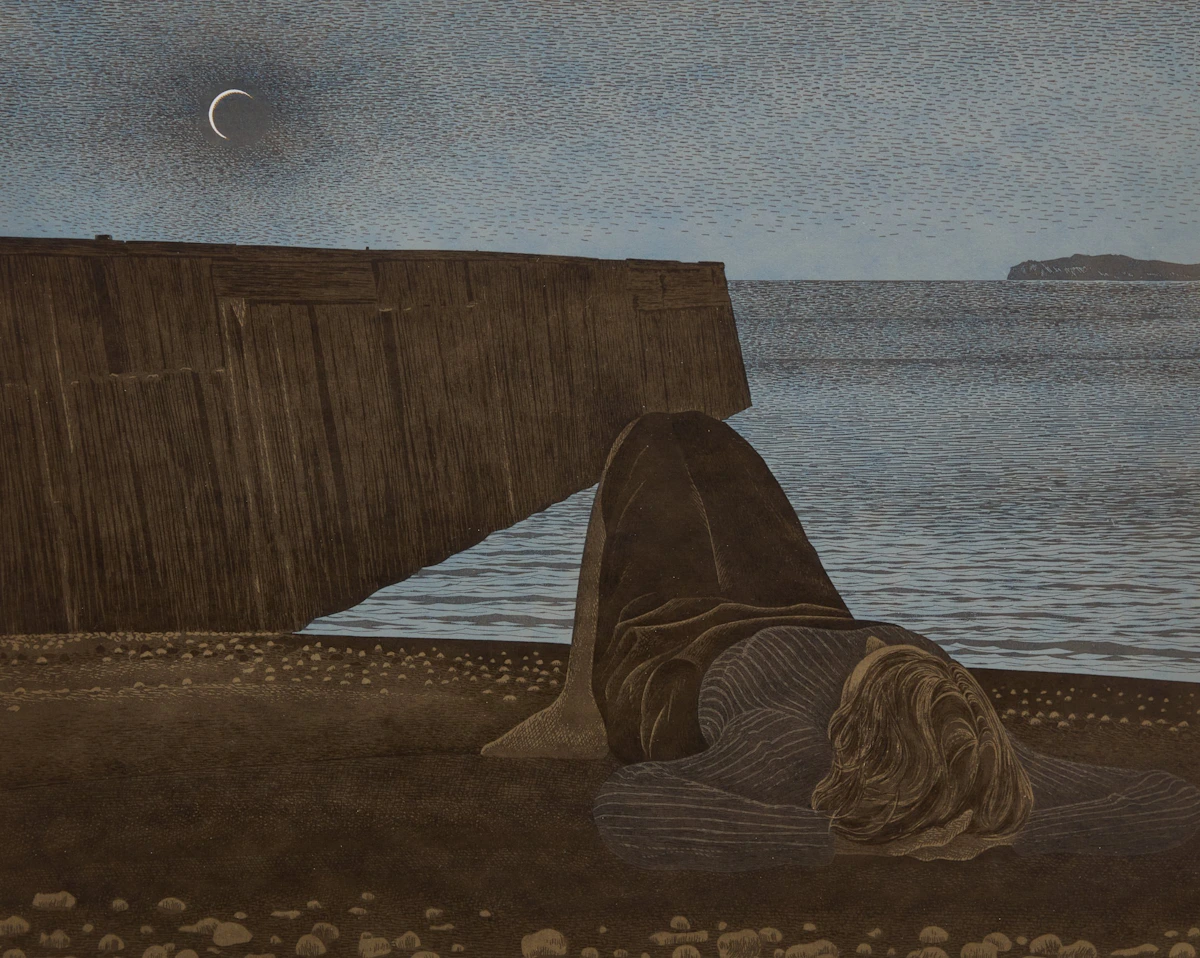
signed, dated 1980 and numbered 30/70 in the lower margin; inscribed "Dock" on a label on the reverse
14 × 17.5 in (35.6 × 44.5 cm) (image)
Private Collection, Toronto
David Burnett, Colville, Toronto, 1983, illustrated page 236
David Burnett, Alex Colville, Prints/Estampes, 1985, illustrated page 15
Ray Cronin, Alex Colville: Life & Work [online publication], Art Canada Institute, Toronto, 2017, pages 50, 65
Alex Colville is known for his meticulously constructed images, in which seemingly ordinary subjects often take on an enigmatic, psychologically charged quality. Mark Cheetham notes that his artworks have a literary approach, without telling a specific story. He writes: “To suggest that Colville’s images are imbued with narrative elements by viewers is not to claim that he narrates the scenes that he constructs. By the same token, though he is careful to depict only what he understands, not all that he shows is his experience. He creates fictions, just as the novelists that he admires do.” New Moon exemplifies Colville’s moody, cinematic approach, leaving the narrative open to interpretation.
Colville worked with serigraphy as of 1955, making thirty-five screenprint subjects until 2002, including New Moon, dating to 1980. Colville made all his prints himself and never reproduced his paintings in this medium. The relative immediacy of the technique, the unforgiving nature of making images with colour applied through screens, and the inherent limits of the process, drew Colville’s interest: “One of the appeals of print-making is the discipline of the printing technique; in painting almost anything is possible—in print-making there are limitations of means; the concept must be adapted to a more economical mode of expression.”
