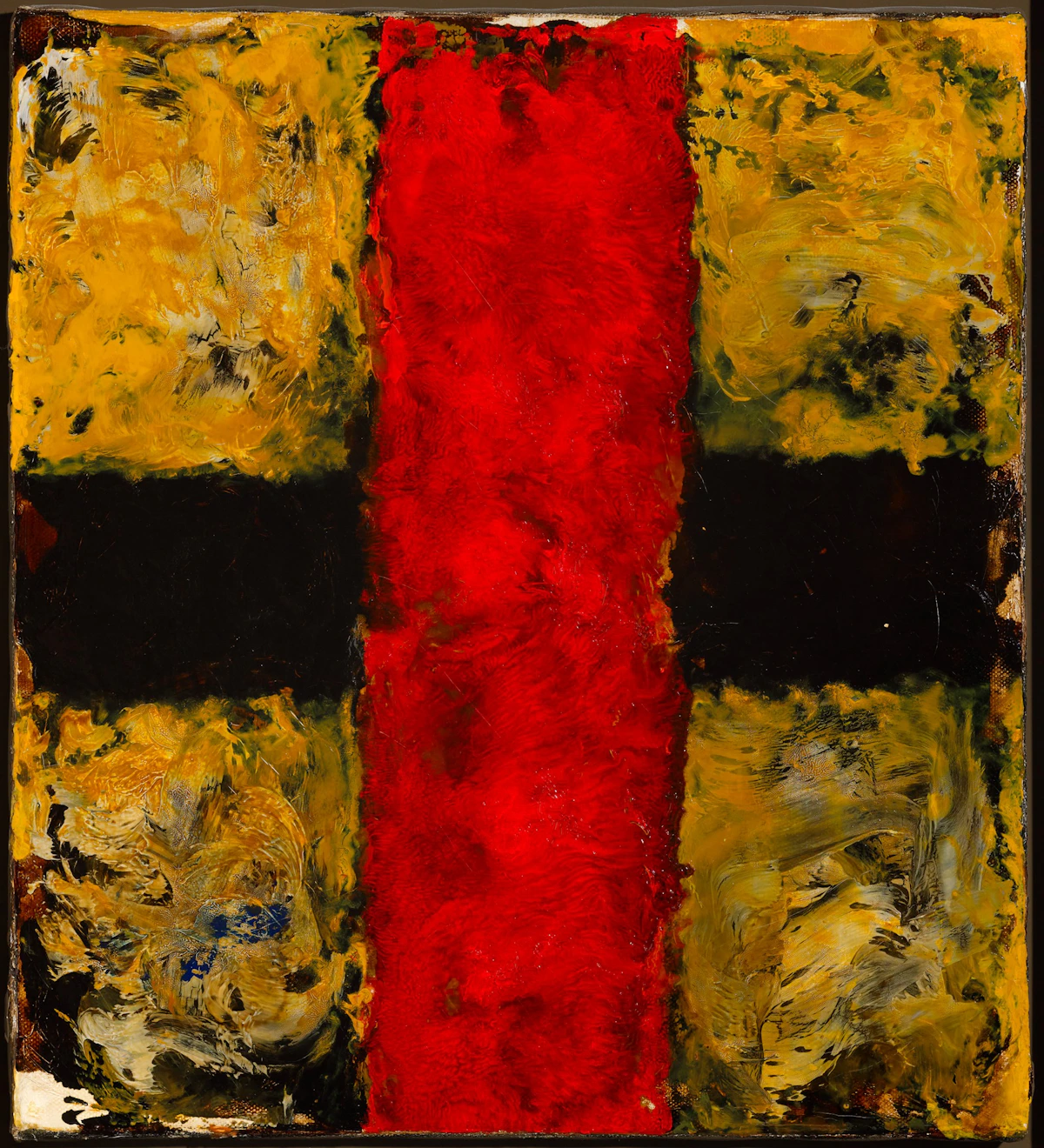
titled on the reverse and dated on a gallery label on the reverse
20 × 18 in (50.8 × 45.7 cm)
Marlborough Godard Gallery, Toronto
Kaspar Gallery, Toronto
Private Collection, Toronto
Fernande Saint-Martin, McEwen, 1953-73, Musée d’Art contemporain, Montreal, 1973, not paginated
Roald Nasgaard, Abstract Painting in Canada, Vancouver/Toronto, 2007, pages 174
Jean McEwen was a Montreal-born painter who moved away from figurative work in the late 1940s and became a leading figure in Quebec abstraction. The artist’s distinctive approach to painting is rooted in texture and luminosity. Rather than treating colour as a way to describe objects, he used it as the central subject of his paintings. His works often build up translucent layers of pigment, creating a sense of depth, luminosity and colour seeming to emerge from within the canvas. Fernande Saint-Martin writes that McEwen “repeatedly stresses that what is important to him is the establishment of chromatic juxtapositions so extreme and rich, that they impose themselves on the spectator. Colour is to McEwen a mutable and expressive element to which he can never refer in terms of single pigments: he tends to talk of ‘the yellows’ or ‘the purples’ in the plural, suggesting thereby the emotional impact and symphonic potential of colour in concert.”
Grande icône was painted during McEwen’s mature period in the early 1960s. The artist had already firmly established his reputation in Montreal and had captured the interest of Toronto gallerist Walter Moos, who, in turn, introduced McEwen to New York dealer Martha Jackson. McEwen’s paintings from this period explore the relationship between colour and structure, often featuring the fiery reds and golds that became hallmarks of his most acclaimed works. Works from 1960–1963 also often feature a central vertical band or dividing line, with contrasting fields of colour on either side, as is in Grande icône. He layered oil paint and varnish, sometimes working directly with his fingers, to create surfaces that alternate between opacity, transparency and varying depth.
Roald Nasgaard remarks on McEwen’s technique: “His continuous coloured textures are built out of strata of superimposed paint layers, sometimes as many as a dozen. Their ever more variegated hues and tones lie in ambiguous depths, sometimes opaque and other times transparent and luminous.” Grande icône explores shifting, ambiguous depths through contrasting treatments of colour and surface. The central red column consists of monochromatic layers that evoke flames, while the gold sections reveal multiple layers of different pigments. In contrast, the opaque black bands absorb light, resembling black holes within the composition.
The year 1963 was a very active year for Jean McEwen. He held a solo exhibition at the prestigious Martha Jackson Gallery in New York in February 1963, presenting his work to an important American audience. He reduced his hours at the pharmaceutical company Frosst to devote more time to painting. The artist also won the Jessie Dow Prize at the Montreal Museum of Fine Arts’ Spring Salon. McEwen then represented Canada at the seventh São Paulo Biennial in the fall of 1963, where he received an honourable mention.
