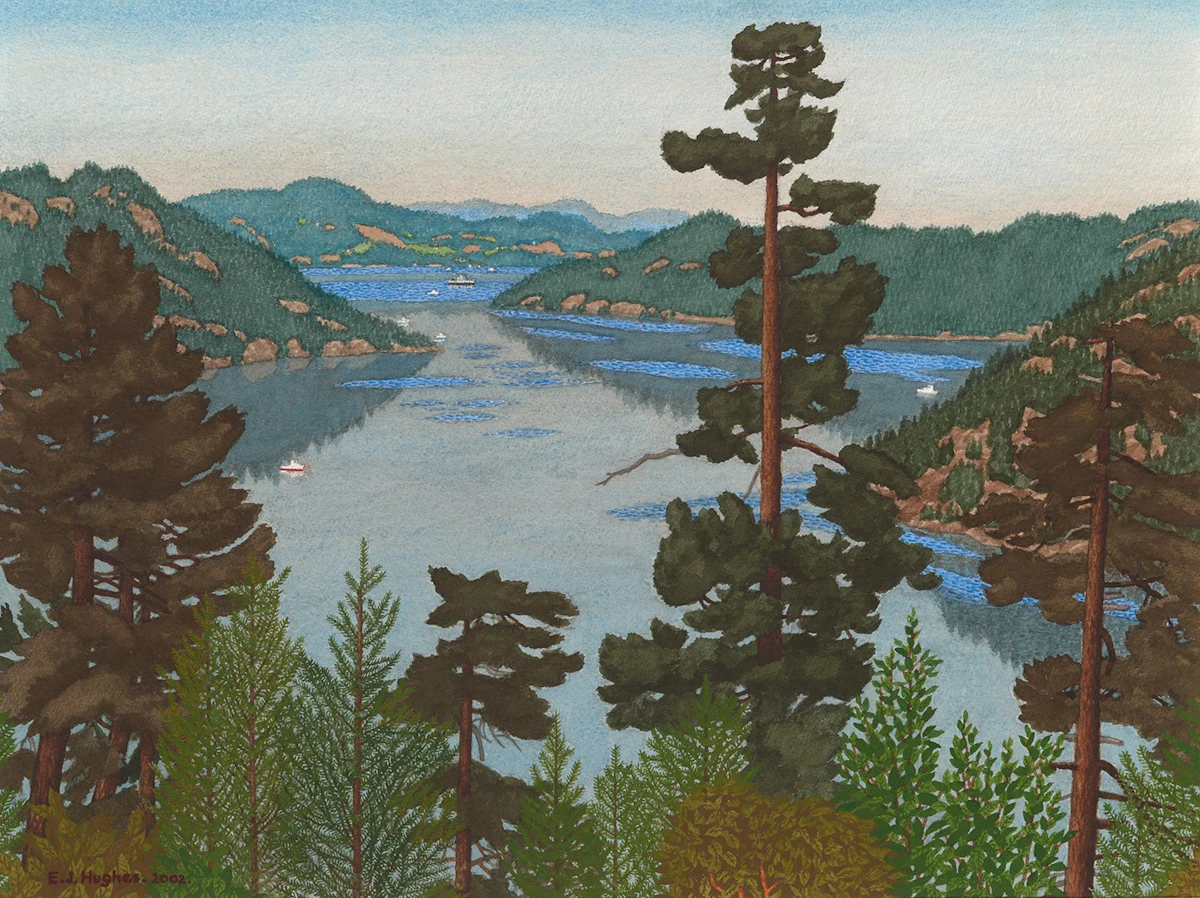
signed and dated 2002 lower left; signed, titled and dated on the reverse
18 × 24 in (45.7 × 61.0 cm) (sheet)
John "Bud" Ross Lee, British Columbia
Jane Young, E.J. Hughes 1931-1982: A Retrospective Exhibition, Surrey, 1983, page 43
Ian M. Thom, E.J. Hughes, Vancouver, 2002, pages 99, 210
The E.J. Hughes Album, The Paintings Volume I, 1932-1991, Vancouver, 2011, the 1965 oil entitled Finlayson Arm reproduced page 44, the 1973 oil entitled Looking South over Finlayson Arm reproduced page 61 and the 1983 acrylic entitled Above Finlayson Arm reproduced page 79
E.J. Hughes' work is celebrated for its depictions of the stunning wilderness of British Columbia. As art movements in Canada rapidly evolved into abstraction and minimalism, Hughes maintained a steadfast dedication to realism throughout his long career. Unlike the Group of Seven, Hughes did not romanticize the unpeopled wilderness, nor did he celebrate Canada’s industrial development. He simply looked at what was in front of him and did his best to assemble the forms and colours into a work of art. His distinct and nostalgic style consisted of flattened perspective and simplified forms. On the subject of the association between realist art and photography, the artist proclaimed: “If I didn’t have a conviction that a serious painter can portray nature more profoundly than the best colour photography, I’d probably give it all up or go abstract or take up photography.”
In July 1951, art dealer Max Stern came to western Canada to find a successor to Emily Carr, whose work had been popular at his Dominion Gallery in Montreal. While having lunch with Lawren Harris at the faculty club of the University of British Columbia in Vancouver, Stern noticed a painting by Hughes on loan to the club. From that moment, Stern was determined to find the artist, eventually tracing him to his home at Shawnigan Lake. Arriving unannounced, he took a look at the paintings and told Hughes: “I like your work. I’d like to buy it all.” He then drafted a brief contract by which, for $500, he bought the contents of Hughes’ studio and arranged to buy everything the artist would make in the future. This simple contract was in effect until the Dominion Gallery closed in 2000, and significantly contributed to Hughes’ continued success nationwide.
Hughes could now give his full attention to painting, while he and his wife lived in isolation. In 1956 he made a six-week sketching trip across Canada, travelling by bus. Then, in 1958 Hughes received his first grant from the Canada Council for the Arts which enabled him to set aside three months for sketching in B.C. During the 1950s, the artist approached each painting through a series of drawings, beginning with intricately detailed notes outlining full reference for the picture's theme. Hughes normally completed a detailed graphite drawing known as the “cartoon”, which was then ruled off into squares in order for the composition to be transferred to the canvas. Beginning in 1960, Hughes abandoned the cartoon in favour of a watercolour sketch, in order to speed up the procedure.
In early 1991, nearing the age of eighty, Hughes was finding it increasingly difficult to stand for the long periods of time that painting at his easel required, and decided to turn his full attention to watercolour. He had first used the medium in his art school days and periodically returned to it, finding watercolour less intense and certainly less time-consuming than oils. Hughes produced many watercolours throughout the 1990s and 2000s, including Finlayson Arm, Looking North. Author Ian Thom wrote of this period: “Hughes, in his late 80s, continued to bring incisive vision and visual excitement to his depiction of a landscape that he knows and loves so well.”
This watercolour is related to several works executed by Hughes over the years in this favoured painting location: Overlooking Finlayson Arm, 1963 (graphite), View of Finlayson Arm, 1965 (oil), Looking South over Finlayson Arm, 1973 (oil), Above Finlayson Arm, 1983 (acrylic), Finlayson Arm, near Victoria, B.C., 1986 (graphic), Finlayson Arm, Saanich Inlet, 1997 (watercolour) and A View of Finlayson Arm, 1998 (acrylic). A particularly enchanting detail within this richly layered composition is the presence of pleasure boats scattered across the distant ocean. Hughes’s expansive West Coast vistas evoke a sense of serenity, presenting the relationship between humanity and the natural world as one of quiet harmony. His deep appreciation for the beauty of this landscape is evident throughout the work.
John "Bud" Ross Lee was a fixture of the Cowichan Valley's local business and social scene. He was a well-known entrepreneur who built a lasting community legacy through his long-standing dining and social establishments on Vancouver Island. Bud Lee owned Dog House Restaurant where Hughes regularly enjoyed his main meal of the day.
