signed with initials and dated 1973 lower right; titled on the reverse
29.5 × 36 in (74.9 × 91.4 cm)
The Isaacs Gallery, Toronto, 29 February 1980
Private Collection, Montreal
William Kurelek, Manitoba Diary, 17 July 1967, file 4, vol. 1, William Kurelek Fonds, Library and Archives Canada
William Kurelek, Someone With Me: The Autobiography of William Kurelek, Toronto, 1980, page 139
Tobi Bruce, “The Clarity of Conviction: Kurelek as Journeyman Picture Maker,” William Kurelek: The Messenger, Hamilton, 2011, page 140
William Kurelek is known as a painter of memory. The recollections he rendered—usually his own, sometimes those of others—were varied and constituted what curator Tobi Bruce refers to as “an immense storehouse of memories.” He illuminated his schooldays, painted the visionary dreams of friends, and recalled with minute detail the farming practices of his formative community. In a sense, Kurelek’s creative quest was to track and record the familiar to tell stories about his roots. He focused his narrative efforts, however, not simply on the nostalgic reanimation of the past. Home, after all, is not always a place of unalloyed joy; it can also be commingled with tribulation and sorrow.
Scenes of agrarian life represent a significant portion of Kurelek’s artistic output for good reason. He was born in rural Alberta, east of Edmonton, in 1927 and grew up on a farm north of Winnipeg. His parents, relatives, and many of their friends had either arrived on the Prairies from rural Ukraine over the previous three decades or were themselves second-generation offspring of immigrants. Dmytro Kurelek, the artist’s father, focused initially on dairy production before shifting to wheat. In the late 1940s, just as Kurelek left home to attend the Ontario College of Art in Toronto, the family relocated from Stonewall, Manitoba, to a farm in the hamlet of Vinemount near Stoney Creek, Ontario, on the outskirts of Hamilton.
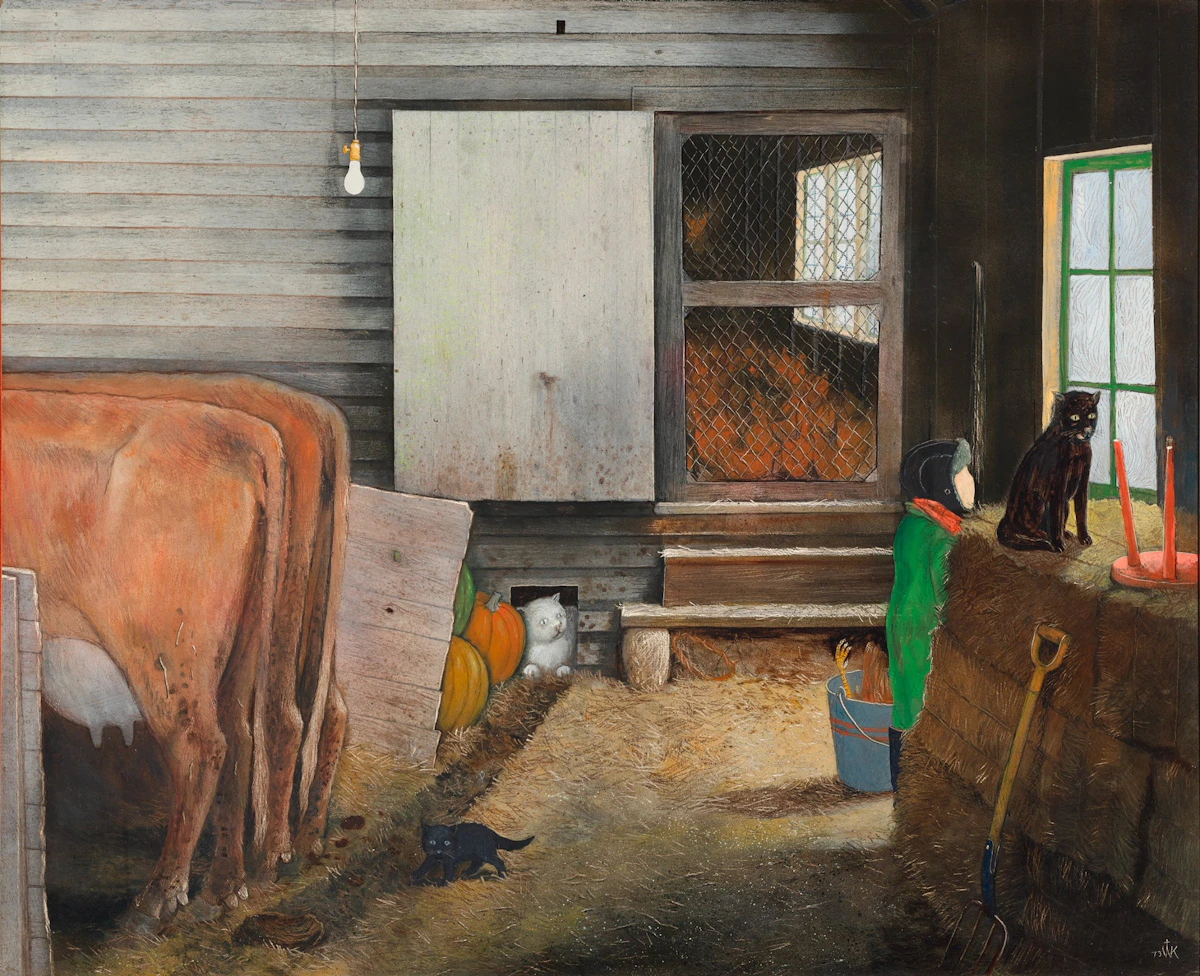
My Father’s Barn at Stoney Creek is deceptive in its simplicity. The central importance afforded to cow rumps and monotonous clapboard seems an overindulgence in the mundane. But this artwork rewards patience. The raking light, skulking, yellow-eyed farm cats, and overall rustic surround lend the vignette a sense of scene design, of stagecraft. Looking closer still, we notice elements that establish not only drama, but a febrile strangeness: caged chickens seething like a fire in the background, a dismembered avian foot poking unceremoniously from its bucket, and a faceless boy gazing out the window. Has he simply turned away, or is there a more unnatural explanation for his lack of countenance? It is the panel’s subtle fever-dream quality, over and above any cogent explanation of its symbolism, that reignites the question: for Kurelek, is this actually a story about home?
One answer is simply no. After all, this is not the barn of Kurelek’s childhood. While “home,” he insists in his travel diaries, “was not Vinemount in my heart or in my dreams,” Vinemount, as the title conveys, became his patriarch's residence—the place of Dmytro's retirement, and therefore the location where he not just lived but would also die. Kurelek’s relationship with his father was deeply formative yet unsettled. Dmytro valued hard work, physical strength, and competence; on the farm, he had little time for his son’s creative sensitivities and artistic proclivities. In his autobiography, published the same year My Father’s Barn at Stoney Creek was produced, Kurelek shares a letter Dmytro wrote him soon after the family arrived in Vinemount: “I do admit I wanted you to be a doctor or anything else as long as you’d not end up cleaning stables.”
Is what we see then in the painting not so much a recollection, as a kind of counterfactual speculation? Is the faceless boy a projected image of Kurelek daydreaming at the window in perpetual youth, trapped in his father’s image of him? Two other details are worth noting: a bare lightbulb suspended from its cord, and a crown of thorns crumpled under the stairs leading to the chicken coop. Together, these symbols of truth and sacrifice—testament to Kurelek’s deep-seated religious convictions—confirm that what My Father’s Barn at Stoney Creek bears witness to is no simple memory. Instead, it is a nuanced meditation on the struggle to find home as an alignment of both a place and an idea. In this relatively late work in the artist’s career, past and future, memory and prophecy, arrive at a single point.
We extend our thanks to Andrew Kear, Canadian art historian and Head of Collections, Exhibitions and Programs at Museum London for contributing the preceding essay. Andrew is the past Chief Curator and Curator of Canadian Art at the Winnipeg Art Gallery, a curator of the 2011-2012 national travelling exhibition William Kurelek: The Messenger and author of the Art Canada’s Institute’s William Kurelek: Life & Work (2017).
