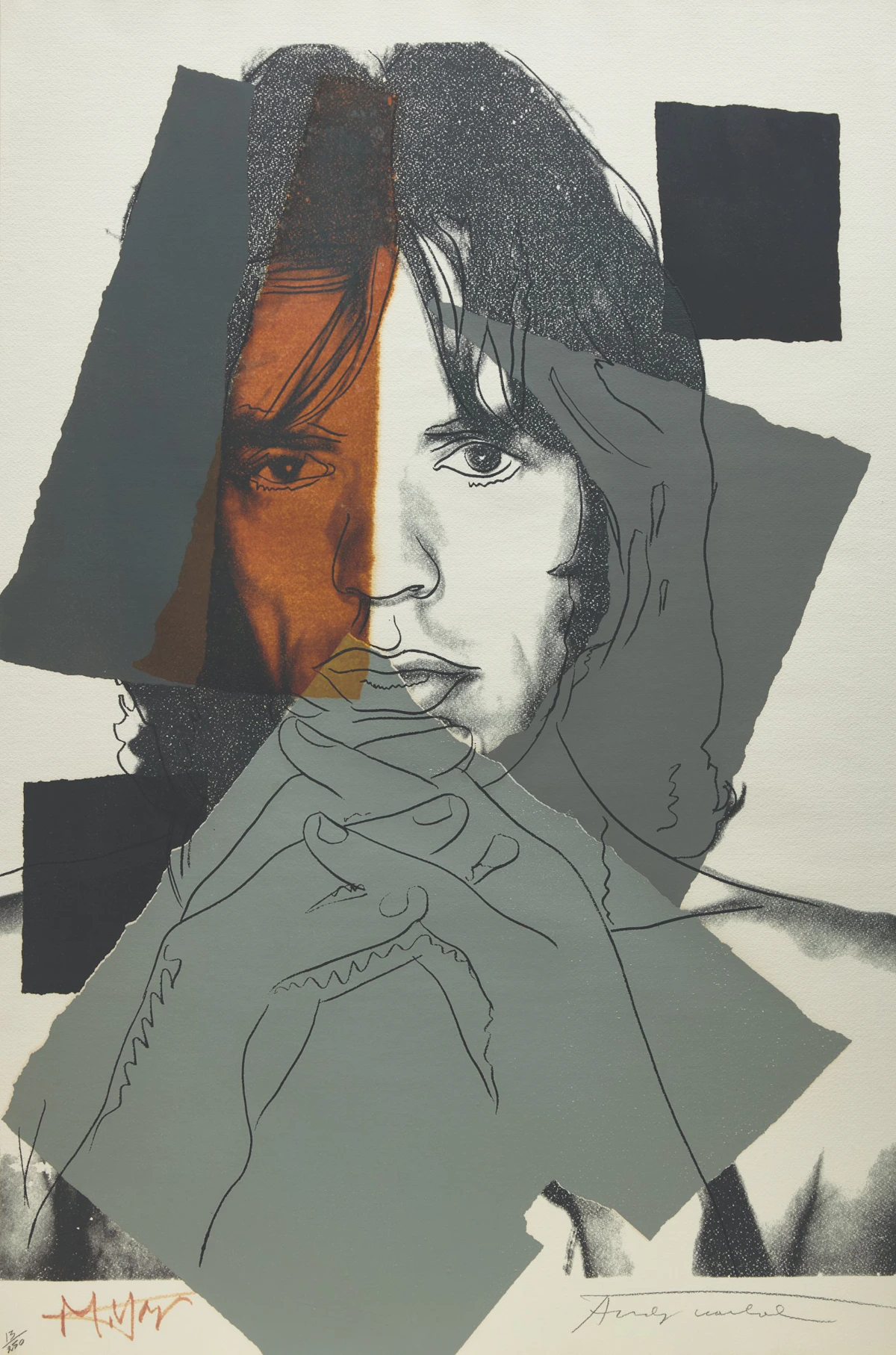
signed by the artist lower right and signed by Mick Jagger and numbered 13/250 lower left. Printed by Alexander Heinrici, New York, and published by Seabird Editions, London, England
43.5 × 29 in (110.5 × 73.7 cm) (sheet)
Private Collection, Toronto, late 1970s
Frayda Feldman and Jörg Schellmann, Andy Warhol Prints: A Catalogue Raisonné 1962-1987, 4th edition, Milan, 2003, reproduced page 93, catalogue no. II.147
Christopher Andersen, Mick: The Wild Life and Mad Genius of Jagger, New York, 2012, page 66
Stuart Lenig, The Many Lives of Andy Warhol, London, 2021, page 91
The pop art sensation Andy Warhol first met the Rolling Stones frontman at “The Mods and Rockers Ball” held at the American photographer and filmmaker Jerry Schatzberg’s Park Avenue South apartment. While Mick was inescapably drawn to this white-blond painter of Campbell’s soup cans, Warhol “was beguiled by Jagger’s unique blend of raw, unschooled talent and gender-bending glamour.” This historic encounter during the vibrant cultural landscape of the 1960s sparked a lasting friendship that endured until Warhol's death over two decades later, ultimately culminating in one of the most celebrated print portfolios of the twentieth century.
The series captures Mick’s sexual charisma in ten poses, with the singer gamely performing for the artist's camera. The work focuses on his pensive expression framed by unruly locks of hair curling around his forehead. His gaze is piercing and unwavering, with the contours of his eyes, nose, and mouth thinly traced, drawing the viewer’s gaze downward towards his interlaced fingers. Covered by dark grey and a shimmery fragment of burnt orange Color-Aid paper, Mick appears almost godlike, with the singer’s idealized persona layered onto the subject’s actual features captured on a Polaroid.
During the 1970s, Warhol regularly attended the party circuit in New York, meeting people of wealth and stature who were all too flattered to have such a famous artist in their midst. Even though he was an inveterate socialite who enjoyed gossiping and having a good time, Warhol also attended these events with a singular purpose: finding the right patrons to commission celebrity portraits.
The artist would then arrange a photo session with the subject, often going through ten rolls of film while snapping informal shots. They would review the day’s work together, choosing the perfect shot, which would be sent to a photo lab to be enlarged to poster size before being delivered to Warhol’s studio. Once received, the artist would “attach it to an easel, dab it with acrylic transparent paint, often in subtle pastel colors that would retain all the elements of the original portrait with a dash of color, and finish the work. The completed standard-sized, portrait poster artwork would be framed, the work packaged and delivered to the customer with an invoice for $25,000 to $40,000.”
Through his celebrity portraits, Warhol reclaims the stars themselves, whether Mick Jagger, Marilyn Monroe, Jackie Kennedy, or Liz Taylor, and replaces the star in the public’s mind. Ultimately, Warhol has preserved the aura of the Rolling Stones frontman in his series of repetitive and glamorous representations, ensuring that Mick Jagger—as both a celebrity to be worshiped and a commodity to be consumed—can live on eternally.
