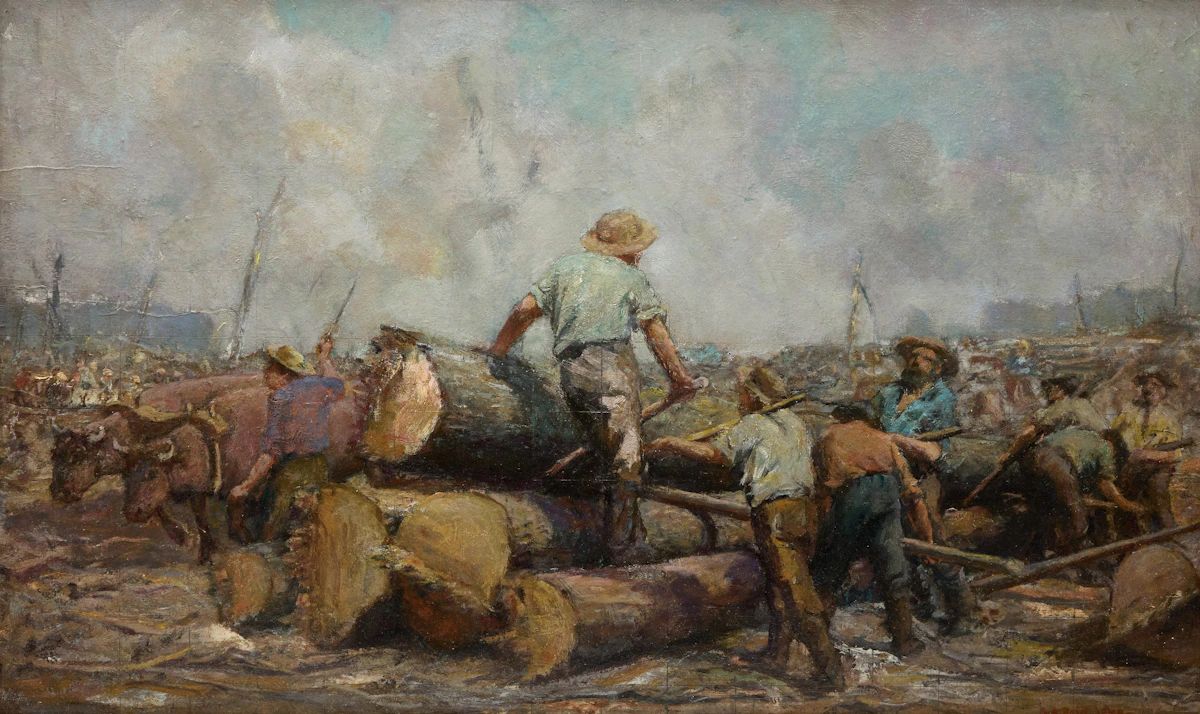
signed and dated 1889 lower right; inscribed "The frame for this painting was hand carved by the artist" on a label on the reverse
33 × 36 in (83.8 × 91.4 cm)
The Copp Clark Company, Toronto, 1941
Private Collection
Muriel Miller Miner, G.A. Reid, Canadian Artist, Toronto, 1946, listed page 201 as Logging, 1889
During the late 1880s and early 1890s, Toronto artist George Agnew Reid produced a series of paintings drawing upon his recollections of rural life in Ontario. Born in 1860 in Wingham, near Goderich on Lake Huron, Reid spent part of his youth working on the recently cleared farmland of his father, Adam Reid, and his maternal uncle, James Agnew. These formative experiences provided him with a firsthand understanding of the labour, traditions, and rhythms of rural life that would later inform his artistic practice.
In 1888, Reid and his wife, fellow artist Mary Hiester Reid, returned to Paris after visiting his family in Wingham. There, he continued his artistic training at the Académie Julian, studying the human figure from life and developing his approach to compositional oil sketches. These preliminary studies allowed him to establish the essential structure of a scene, arranging its principal figures and narrative elements while exploring the relationship between light and shadow.
The present work is a preparatory study for Reid’s larger painting Logging, completed in 1889 and now held in the collection of the National Gallery of Canada. The finished painting was formerly displayed at Canada House in London, having been presented as a memorial to Colonel Sweny by Brigadier Sweny.
In a letter dated October 7, 1943, written at Wychwood Park in Toronto, Reid provided a personal account of the circumstances surrounding the creation of this study and its relationship to the finished painting. His recollections, recorded on the reverse of the work, offer insight into both the painting’s origins and the childhood memories that inspired its subject:
"The picture “Logging” is the study for my painting of the same name now hanging in Canada House, London, the gift of Brig. Gen. Sweeny as a memorial to his father. Col. Sweny of Toronto who purchased it in 1892 . The large painting measures 24 × 72 inches being 4 times the size of the study which measures 22 × 36 inches.
The study and the picture were painted in Paris, France, when my wife, Mary Hiester Reid and myself were working for a year, and finding a log yard near my studio in which were great logs resembling those found in Canada. I seized the opportunity to paint a Canadian picture.
The picture represents a phase of the development of Canada, which in its main aspects ended about 75 years ago in old Ontario, when the forests were cleared by the lumbering outfits. The great and small logs and bark, and the lumber. There was no other way to clear the land as there was no market for the lumber, then came in some places a market for the ashes for making lye and soap.
Groups of men came together for the purpose and "Logging [ ], so called was among the many types of collective labour common in the early days. In my childhood I have only faint memories of this [ ], but the last 10 acre fields of my father's farm to be logged is so distinct in memory that I land on this setting for my painting. I was too young to take part in this work at that time. Later I helped in the logging of corners and small parts of fields by... [ ]. G.A. Reid."
The substantial preparatory canvas, approximately half the size of the completed painting, was acquired by Copp Clark & Co. in 1941. Reid developed the composition using a carefully drawn grid to guide the arrangement of its elements, a technique whose traces remain visible beneath the paint and can be detected through infrared reflectography.
In translating the study into the finished work, Reid expanded the composition horizontally and strengthened the prominence of the triangular arrangement of figures and forms in the foreground. He removed the secondary activity from the right-hand background, shifted the oxen farther into the left background, and used the imposing forms of freshly cut tree trunks to frame the central group. These adjustments brought greater clarity and focus to the scene, transforming the preliminary study into a more unified and visually commanding composition.
