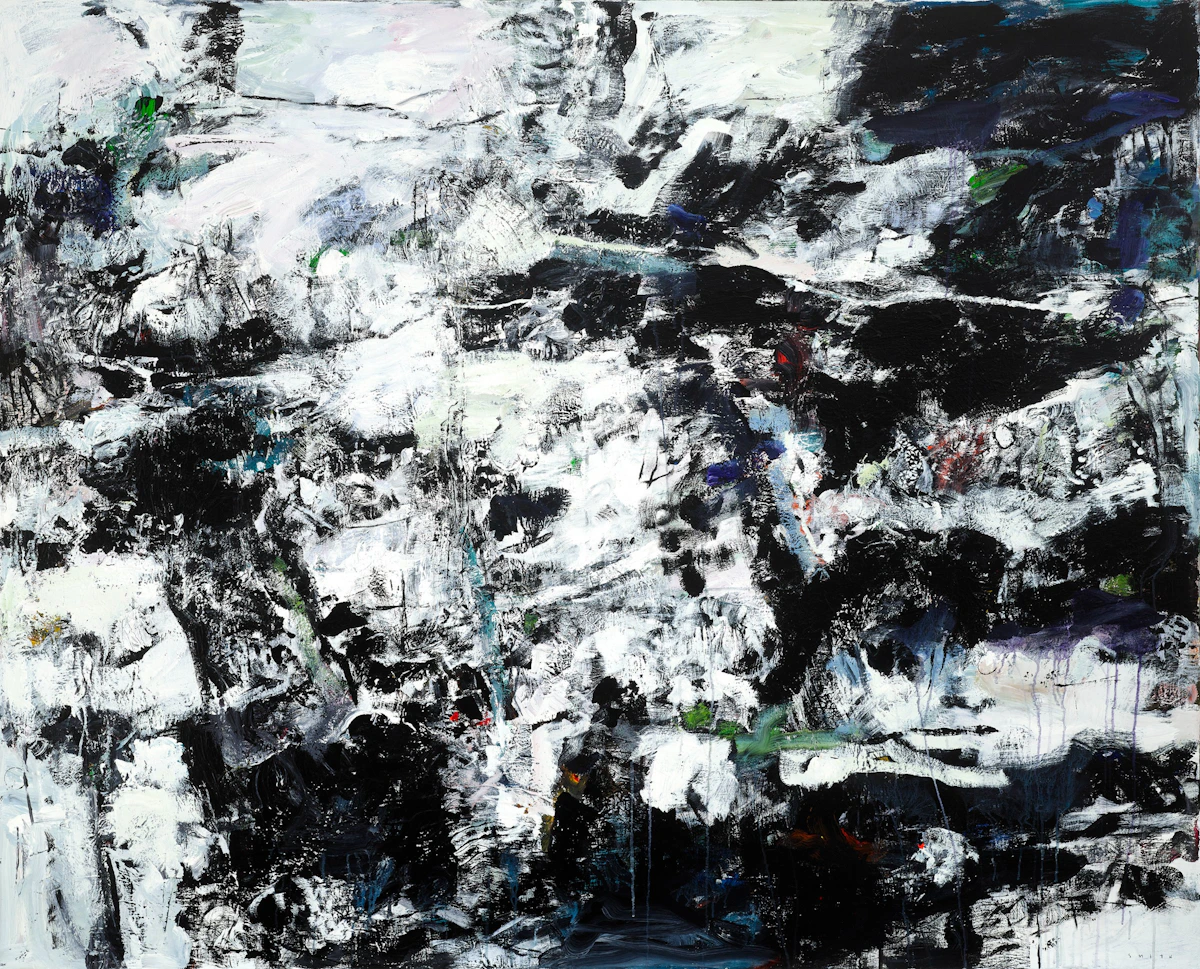
signed lower right; signed, titled and dated 1989 on the reverse
67 × 83 in (170.2 × 210.8 cm)
Bau-Xi Gallery, Vancouver
Private Collection, Toronto
Ian M. Thom and Andrew Hunter, Gordon Smith: The Act of Painting, Vancouver, 1997, page 122
Gordon Appelbe Smith was a significant figure in Canadian art from the 1950s to the 2020s. Born in England in 1919, Smith moved to Winnipeg in 1933 and spent the majority of his career in Vancouver. Prolific and experimental, Smith’s long painting career was marked by a series of creative breakthroughs, creating many distinct shifts in his visual style throughout his career.
Despite the artist’s avoidance of providing explanations of his artwork, Smith’s abstract work is in part self-explanatory, as his style appears to parallel the international post-war movements of the 1950s and 1960s. In 1951, Smith studied with Elmer Bischoff at the California School of Fine Arts. Bischoff helped to introduce him to action painting, encouraging Smith to work spontaneously with large brushes and house paint on wide sheets of canvas laid out on the floor. Smith embraced Abstract Expressionism from the mid-1950s onward. Smith changed his style abruptly in 1960 to bright colours and hard-edge abstraction, influenced by the colour theories of Johannes Itten, Josef Albers and Guido Molinari.
While exploring various modes of abstraction, Smith also returned repeatedly to the influence of the West Coast. Smith’s love of the land remained consistent throughout his life, and the artist continually incorporated the forests and shorelines into his work. In the 1970s, Smith returned to painting semi-abstract paintings of the sea and shore near Vancouver. His visit to the Queen Charlotte Islands in 1984 brought a change to a darker, cooler colour palette and a gestural brushstroke in subsequent paintings of abstracted rock faces, forests and waterfalls.
Art historian Andrew Hunter noted that in the early 1980s, Smith “travelled throughout British Columbia and into the dense forest landscapes of the province… Smith found his new bridge, and he made a breakthrough. Like Emily Carr before him, Smith wandered out into the wilderness and found his voice… Smith was renewed: the vigour and intensity of his painting, the inquisitiveness that marked his first probings into abstraction in the 1950s, returned.”
January II, completed in 1989, demonstrates this shift back to gestural abstraction with a new, dark colour palette. Here, Smith’s loose forms and expressive lines at first resemble melting snow across a rocky, earthy terrain, yet the imagery remains deliberately ambiguous and ultimately non-representational. While January II does not depict a specific natural scene, Smith anchors his use of colour in a familiar sensory experience. Subtle accents of blue, green and deep red are layered across the predominantly black and white composition. Through layered brushwork and tonal shifts, he conjures a sense of space and atmosphere that is rendered through abstraction rather than literal form.
Smith’s experimentation continued into the 1990s; he painted a series based on observations of graffiti in the subways of London, and a series of “black” paintings referring to his war experiences. Landscape returned after a visit to Monet’s home in Giverny, France in 1995, which inspired a long series of forest pool paintings. The artist often described himself as being "one hundred artists deep"-referring to his constant openness to the influence of other painters. Seen within this broader trajectory, January II reflects Smith’s enduring interest in landscape while underscoring his remarkable ability to move between representation and abstraction throughout his career.
