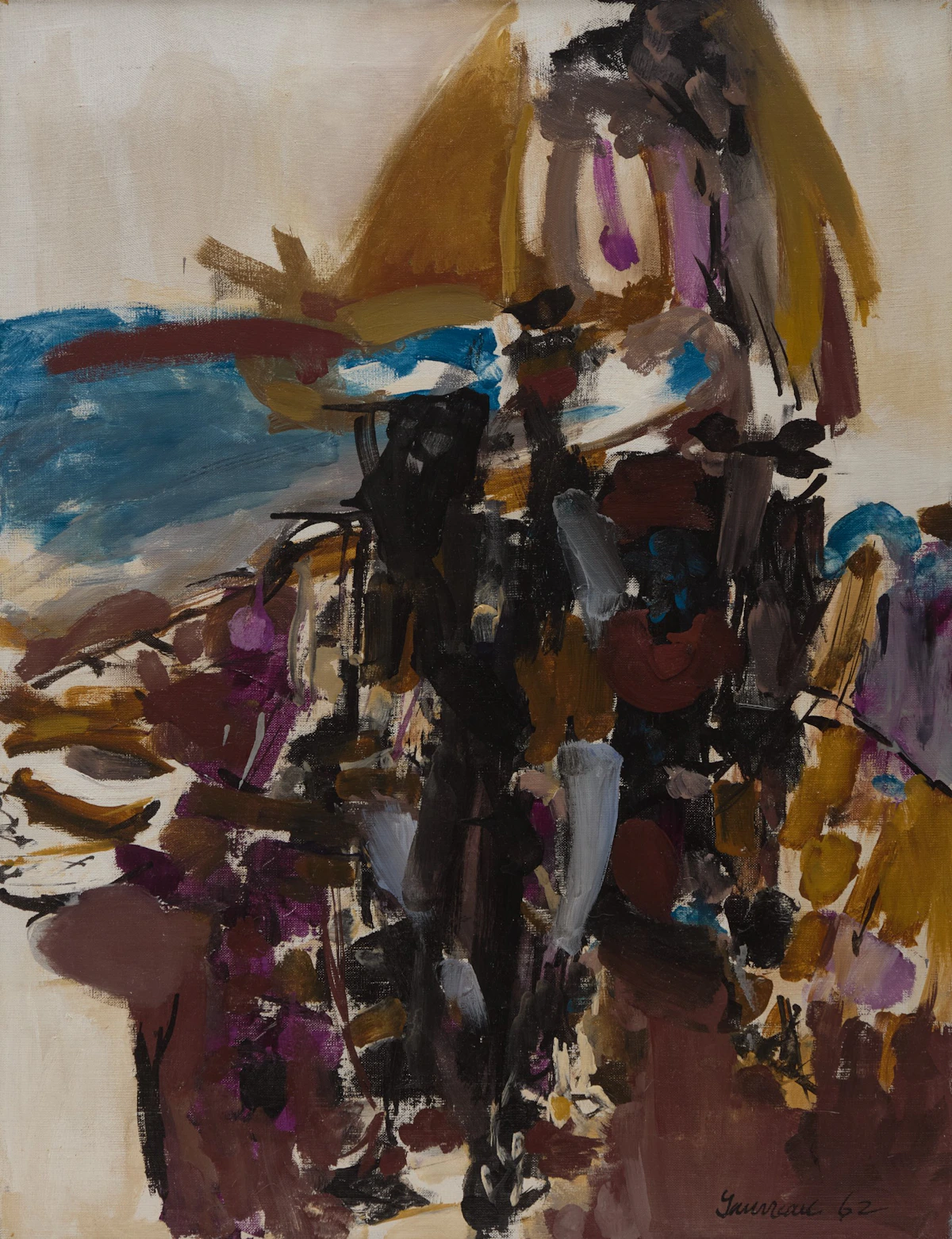
signed and dated 1962 lower right; titled on the stretcher on the reverse
26 × 20 in (66.0 × 50.8 cm)
Collection of Monique Lepage
Gérard Gorce Beaux-Arts, Montreal
Private Collection, Toronto
Private Collection, Montreal
Karen Wilkin, Pierre Gauvreau: The First Decade, Kingston, 1981, pages 29-30
Jeanette Biondi, Le jeune homme en colère : Biographie de Pierre Gauvreau, Montreal, 2003, reproduced page 320 (collection of Monique Lepage)
Ray Ellenwood et al., Échos d’un autre monde. Janine Carreau et Pierre Gauvreau, Montreal, 2009, reproduced page 24
Montreal-born artist Pierre Gauvreau made a significant contribution to Quebec’s cultural legacy. While studying at the École des beaux-arts de Montréal in 1941, Gauvreau came to the attention of Paul-Émile Borduas, then a jury member for a group exhibition at the theatre Le Gésu. Struck by the “singular qualities” of the young artist’s work, the jury awarded him first prize. Two years later, Gauvreau was invited to exhibit with the Société d’art contemporain, bringing him into closer contact with the circle of avant-garde artists who would become the Automatistes. In 1948, the group published Refus global, a landmark manifesto that challenged Québec’s prevailing social and cultural conventions. By the mid-1950s, Gauvreau had begun to move beyond the movement’s influences, exploring a freer, more gestural approach to painting.
As a member of the Automatistes, he participated in several groundbreaking exhibitions that advanced the cause of abstract art in Canada. In 1952, Gauvreau shifted his focus to broadcasting, becoming a newsreader for Radio-Canada before moving into television production. In the early 1960s he set aside his artistic practice to pursue opportunities in the emerging medium of television, establishing himself as an author, screenwriter, television director and film producer. He worked as a director in the network’s youth programming department. In 1961, he also helped establish the Non-Figurative Artists’ Association of Montreal. The Galerie Denyse Delrue presented his recent work in 1961 and 1962, and in the latter year, he participated in the Festival of Two Worlds in Spoleto, Italy.
In 1976 he renewed his artistic career after a break of more than ten years, resuming a visual practice that had evolved alongside his broader contributions to Quebec’s cultural life. As Karen Wilkin shares, "It seems strange that after such passionate commitment to such difficult painting, in such tempestuous times, Gauvreau should have stopped painting, as he did in the early 1960s. Perhaps it had something to do with the dissolution of the Automatistes group in the mid-1950s, which removed both a point of focus and a climate of supportive criticism. Then too, aesthetic issues in Montreal were perhaps less clearly polarized than they had been in the 1940s and early 1950s; many ideas about what painting could be, which had seemed extraordinarily challenging at the time Borduas and his circle came together, were now accepted as commonplace. In any event, Gauvreau says he never made a conscious decision “to stop painting for good” or even ‘until next year’, and it is clear that the years he spent without painting were stimulating and fruitful in other ways. He makes no distinction between different kinds of creativity, and he has, throughout his career, been concerned with many different disciplines. As a young man he even studied modern dance. His years in television, as writer, director and producer, offered him an opportunity to investigate a new kind of visual medium during its pioneer years, and he often speaks of the close connection between this portion of his career and his attitudes towards painting."
Parfait aux raisins was completed in 1962, as Gauvreau balanced his artistic practice with an increasingly demanding career in television.
