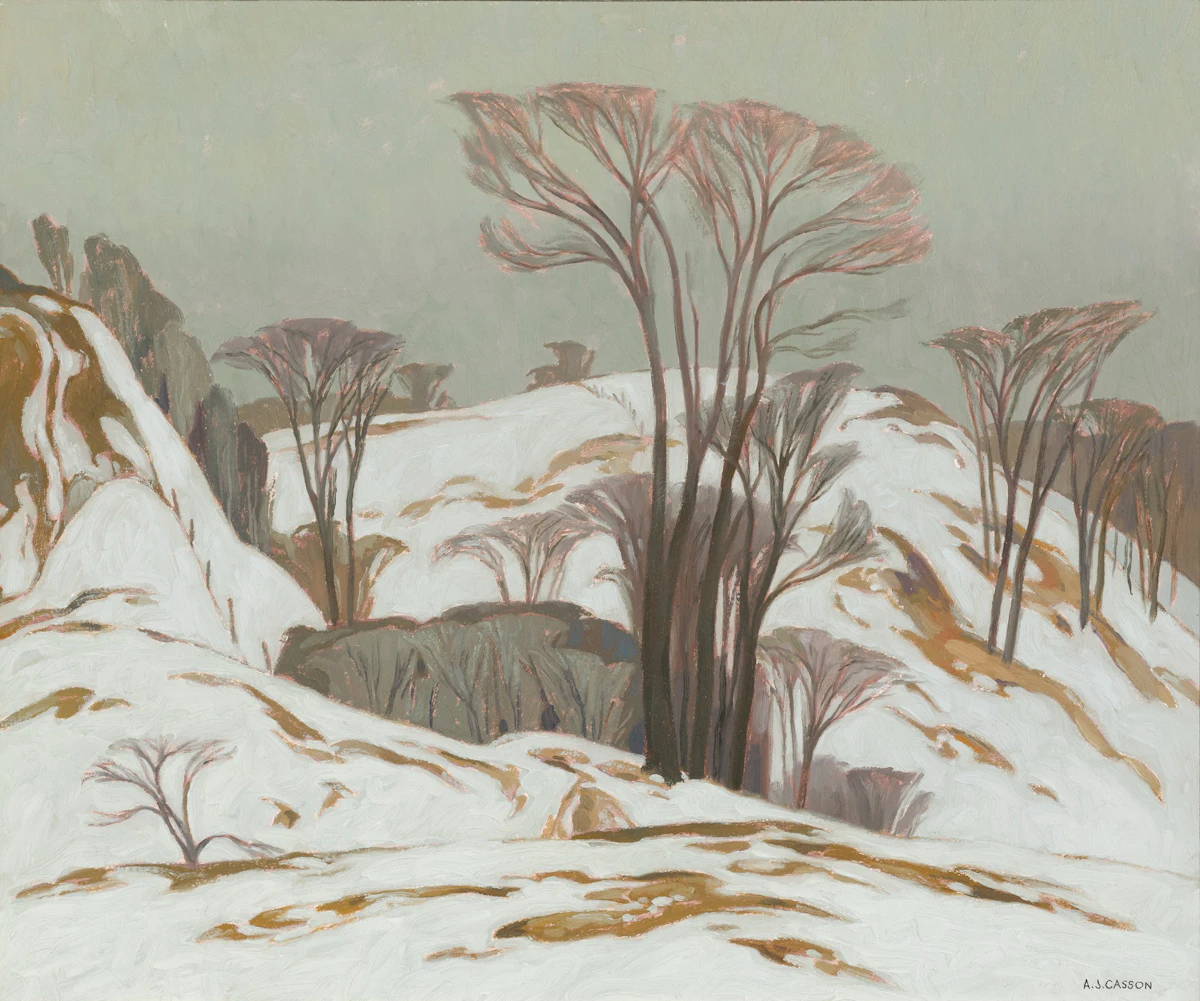
signed lower right; signed, titled and dated 1963 on an artist label on the reverse
20 × 24 in (50.8 × 61.0 cm)
Roberts Gallery, Toronto
Wood Gundy Inc.
Gifted to a Private Collection, Switzerland
Private Collection, Jackson's Point, Ontario
Margaret Gray, Margaret Rand and Lois Steen, A.J. Casson, Agincourt, Ontario, 1976, page 50
A.J. Casson preferred to paint winter scenes, drawn to the strong patterning created by the stripped-down landscape. However, winter subjects are a relatively scarce subject in Casson’s market. Most of the artist’s works depicting winter are from the period following his retirement from Sampson Matthews Limited in 1957. Prior to that, most of Casson’s extended sketching trips were taken in the summer due to work demands.
The painting features rolling, snow-covered hills textured with strokes of exposed earth, dried golden grasses, and rocky outcrops. A grouping of stark, dark deciduous trees stands bare in the center, their elegant branches fanning upward into the sky. Smaller, scattered trees are spread across the ridges, adding a sense of depth and scale to the undulating terrain. Above the hilly horizon line sits a flat, green-grey sky, evoking the overcast, heavy atmosphere of a day in late winter. Casson, like his fellow members of the Group of Seven, was drawn to the dramatic transformation of the Canadian seasons, capturing the fleeting moment where winter’s heavy snow yields to the exposed earth of early spring.
In Winter in the Albion Hills, Casson uses his design-oriented approach to the composition, limiting his palette and reducing the landscape to simplified forms to capture the atmosphere of a cloudy winter day in Ontario. As the artist stated, “One day I saw a Velasquez painting of Phillip IV of Spain. The only discernible colours were brown, black, silver and rose. That started me on simple, restricted colour schemes.” Casson also attributed his restricted colour palette to his thirty-year career as a graphic designer, where the specifications of each project challenged him to employ colour selectively and resourcefully.
