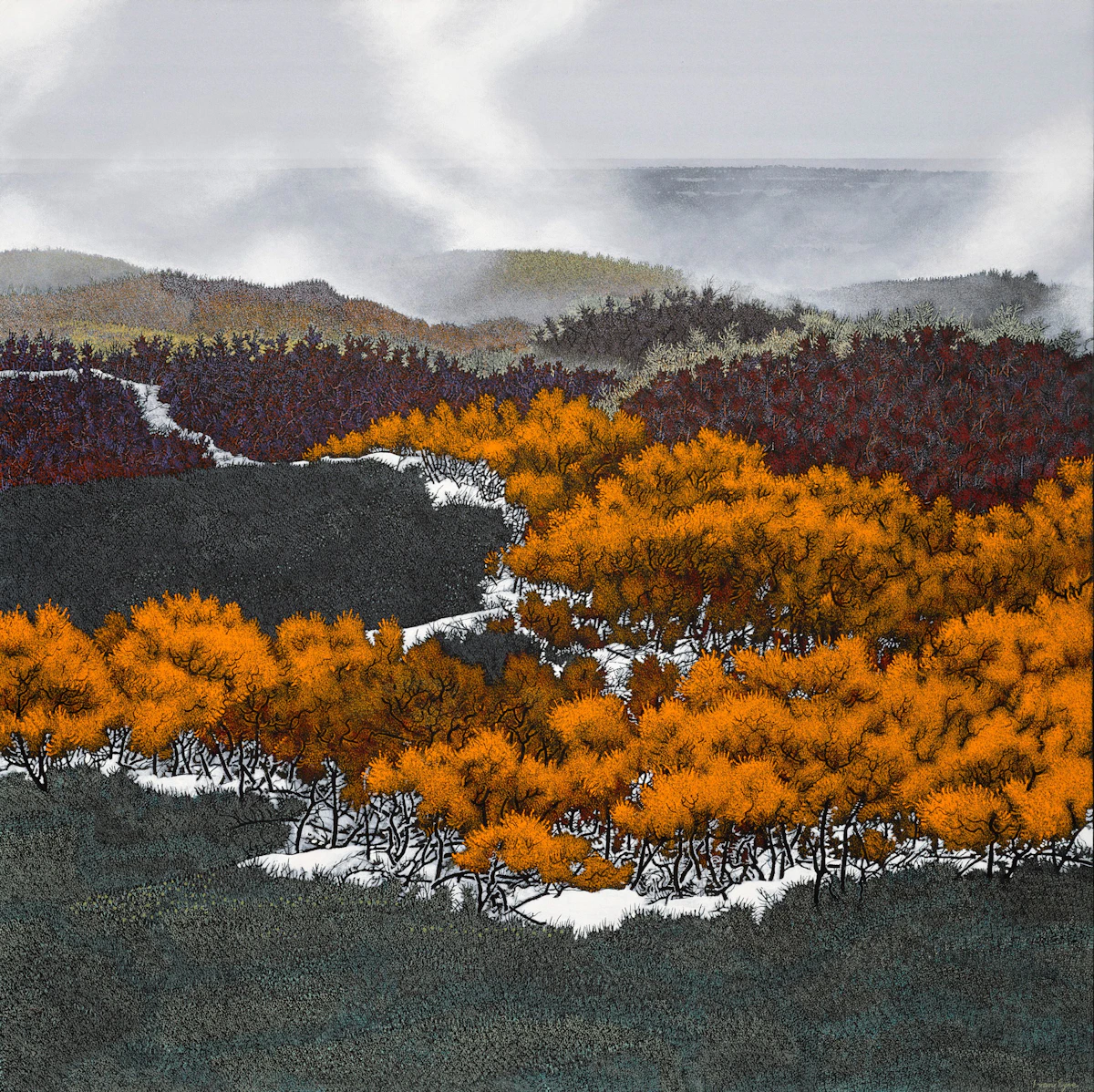
signed lower right; titled and dated 1990 on a gallery label on the reverse
48 × 48 in (121.9 × 121.9 cm)
Mira Godard Gallery, Toronto
Private Collection
Ivan on Eyre: The Paintings, Winnipeg, 2004, page 278, reproduced page 279, fig. 34
Denis Cooley, Amy Karlinsky and Mary Reid, Figure Ground: The Paintings and Drawings of Ivan Eyre, Winnipeg, 2005, page 19
In 1969 Ivan Eyre established a studio in a spacious room within Winnipeg’s old warehouse district. Through its expansive windows, the western sky offered a compelling and ever-changing presence that would become integral to many of his compositions. Throughout his career, the landscapes of Saskatchewan and Manitoba remained a recurring source of inspiration, reimagined through Eyre’s distinctive vision and imbued with personal meaning. For the artist, landscape offered boundless possibilities for creative expression, as he reflected: “The subject is inexhaustible. Infinite possibilities exist. It's still possible to make of a landscape a very personal statement—even a radical one, different from anything previous.”
White Amber Mist is a prime example of one of Eyre’s later large-scale landscapes. In this masterwork, Eyre draws us into the composition, along an ambiguous white path up into the misty mountains in the distance. The painting has an engrossing effect on the viewer; Eyre achieves this by including multiple perspectives, guiding the eye to various points in the upper portion of the landscape. Author Nancy Hermann speaks to this strategy of Eyre’s, and describes the viewer’s immersive experience with large landscapes such as White Amber Mist: “The artist offers no single ledge on which the observer may stand and fully take in all aspects of a work. The viewer must enter into a painting’s theatre by travelling across it and into it, and thus interact with the work, rather than studying it from a fixed distance.”
Each area of the painting is approached with a fine attention to detail, from the texture of the grass and foliage to the lower branches of the shrubbery. Art historian Pat Bovey comments on this quality of Eyre’s landscapes, stating: “Eyre’s keen sense of composition has enabled him to treat in the same work both the macro space of the prairie and the micro-detail of the grasses, leaves, trees and individuals in that expanse. Some details are magnified, others reduced in size.” Interestingly, Eyre notes that these landscapes are never done on location, and does not proclaim the scenes or even perspectives to be realistic. White Amber Mist and his other lush landscapes of river banks, fields and mountains are instead generated to induce associations of home and familiarity.
In his own writings, Eyre commented on White Amber Mist:
“The year before this, I had suffered a heart attack and had undergone a coronary bypass. By 1990 I was well recovered and looking forward to my painting. Landscape has always allowed me a special freedom– a way of losing myself in my work. I poured myself into my painting, completing a dozen major landscapes. One work led to another. I vicariously moved through the land. Each offered me a different painting experience and satisfied me in a special way.
As I’ve said elsewhere, my landscape subjects are all invented, built entirely from the imagination and without specific outside references. I’d much rather find my motivation after I’ve completed a work than feel obliged to represent a scene before me. I’m more able to express my vision by constructing my own subjects, and I enjoy being surprised by the outcome. I don’t know, until the last stroke, exactly how my landscape will turn out. That sense of anticipation adds a continual element of intrigue and requires that I give all the options a good chance. It means standing back and mulling over all the possibilities. I feel as if I’m operating as a landscape creator, able to shape my world as I wish.
In my travels, I’ve come upon places where everything seemed perfect– whether a high mountain pass in Austria, olive-tree-covered-hills in Spain, or a Mediterranean beach in France. They were places where I felt a sense of peace, bliss, and awe. A similar yearning underlies these paintings, but without illustrating locales in a literal, one-viewpoint manner– as in photography. The mist in this painting, as in many others, is placed near the top of the work so as not to suffocate the bulk of the colouring. The contrasting soft texture is a way of emphasizing the clarity of the lower bush.”
