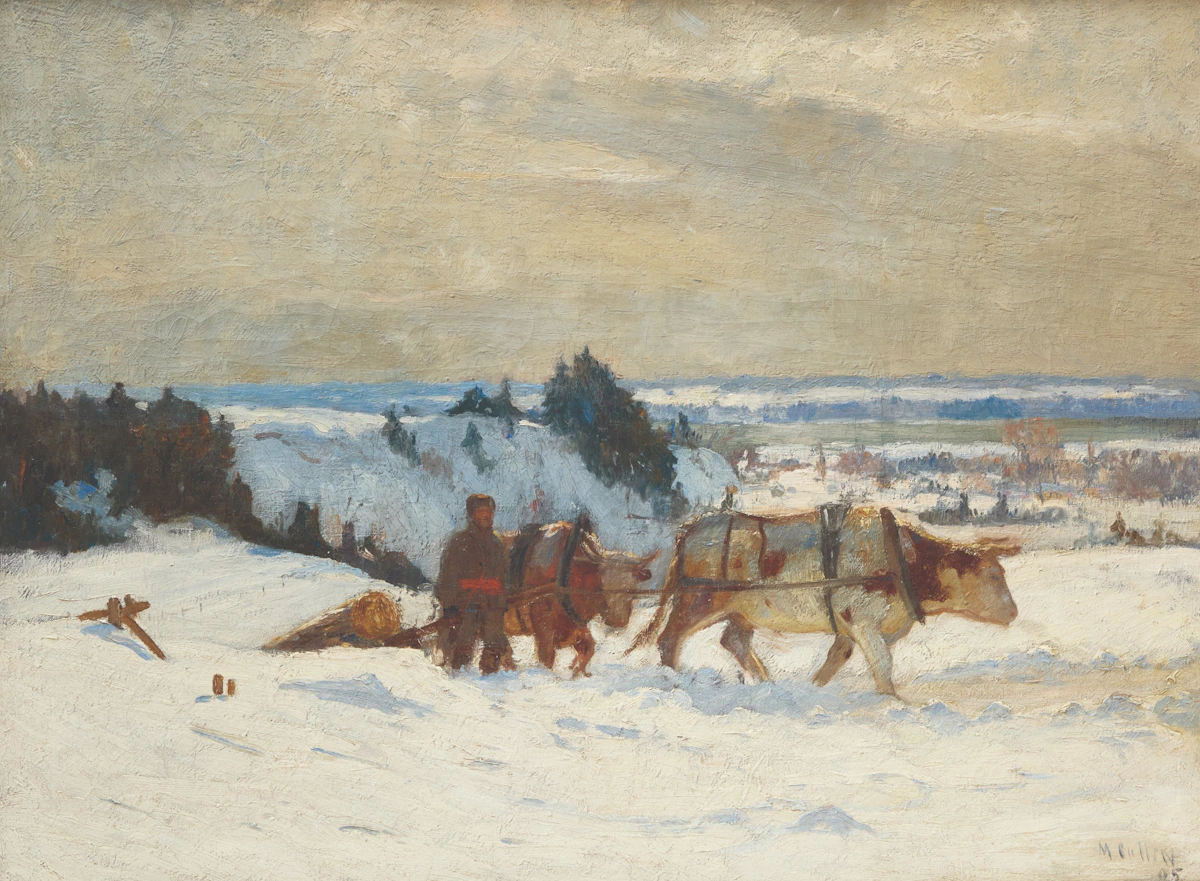
signed and dated 1905 lower right; titled on the gallery invoice; Cullen inventory no. 1037
29 × 36.5 in (73.7 × 92.7 cm)
Continental Galleries of Fine Art, Montreal
Private Collection, Montreal, acquired in 1951
By descent to the present Private Collection
Possibly Four Canadian Artists Exhibition, John Hammond, Laura Muntz, William Brymner, Maurice Cullen, Art Association of Montreal, 15 December 1905-5 January 1906, no. 1 as Logging
R.W. Pilot, Maurice Cullen, 1866-1934, Ottawa, 1956, page 5
Hugues de Jouvancourt, Maurice Cullen, Montreal, 1978, reproduced page 15 as Oxen Pulling Logs, 1905 (Private Collection)
Sylvia Antoniou, Maurice Cullen, 1866-1934, Kingston, 1982, page 11
A.K. Prakash, Impressionism in Canada: A Journey of Rediscovery, Stuttgart, 2015, page 321
Renowned Canadian Impressionist Maurice Cullen began studying fine art sometime between 1884 and 1887. By November 1888, he was in Paris, where he audited the classes of Léon Gérôme at the École des Beaux-Arts while also studying at the Académie Colarossi under Gustave Courtois and J. A. Rixens. Additionally, he also attended the Académie Julian, a popular destination for expatriate students and artists, where he joined fellow Canadians, including George Agnew Reid, Edmund Morris, Robert Harris, and William Brymner. A number of Québec artists had formed a small group known as La Boucane, which met monthly at a café in the Latin Quarter to exchange news and maintain connections with home.
Cullen returned to Canada in 1895, perhaps homesick or eager to establish himself as an artist in his native Montreal. On December 1, 1896, the Montreal Herald reported Cullen’s exhibition “of summer work done on the Lower St. Lawrence” at 258 St. James Street. The following day, the Gazette reported that some of the works had been painted in France the previous year and that the Canadian paintings were the result of an eight-month stay near Ste-Anne-de-Beaupré. This rural region is located along the north shore of the St. Lawrence River north-east of Quebec City, and would become one of Cullen’s favourite and most prized subjects, as depicted in the masterwork Logging Near Beaupré, on the Lower St Lawrence Below Quebec, 1905.
We know from a letter that in January and February of 1897, Maurice Cullen and James Wilson Morrice had been painting together at Beaupré. During this painting expedition, Cullen and Morrice worked outside, en plein air. Morrice described it as follows: “we have had a very cold weather 30 below zero. Difficult to work out of doors-paint gets stiff.” Cullen was interested in creating an impression of luminosity and space evocative of a Canadian winter. Modifying the technique of the French Impressionists, Cullen used the palette range but ignored the fractured brushstroke and fragmentation of colour. He preferred a more solid paint application which did not allow light and colour to disintegrate form. The titles of works exhibited at the Royal Canadian Academy, the Artists Association of Montreal Spring Exhibition and at Chapman's Bookstore in 1897 suggest a concentration of subjects from the Quebec City area, including Beaupré. Cullen’s Quebec paintings were praised by all the Montreal English newspapers. However, it took the public several years to recognize his groundbreaking vision.
In the spring of 1899, Cullen was elected an Associate Member of the Royal Canadian Academy. This honour may have enticed Montreal collectors to purchase three of the five Cullen paintings hung at the Academy exhibition. Cullen spent the summer painting in Beaupré, and, in December, he contributed fourteen works to a group show sponsored by the Art Association of Montreal. Among the exhibitors were William Brymner and Edmont Dyonnet who had been in Beaupré with Cullen.
In June 1900, Cullen returned to Paris, and then travelled to Brittany for the winter. The following summer, he travelled to Venice with Brymner and Morrice, returning again in the summer of 1902. During this period, Cullen exhibited his work at the Paris Salon in 1902, renewing his ties in Europe. He returned to Montreal in the fall of that year and established a studio at 100 rue Saint-François-Xavier, just two doors from the studio he had occupied three years earlier. In the spring of 1903, he exhibited his European landscapes at the Art Association of Montreal.
Cullen’s decision to remain in Canada may have been influenced by the positive reception of his works. Upon his return from Europe in 1902, Cullen settled into a familiar rhythm, beginning a period of intensive study of the effects of light on snow, with its intricate interplay of complementary colours and reflections. Working year after year at Quebec, then further afield at Beaupré and Les Éboulements, he followed the brilliant autumn to gleaming winter. He also traced the hours of the day to record the transitory play of light. “At some hour of the day”, he observed, “the commonest subject is beautiful”.
Cullen created a completely new vision of the Canadian wilderness, which influenced the next generation of landscape artists including the Group of Seven. Logging Near Beaupré, on the Lower St Lawrence, Below Quebec demonstrates the quintessential Canadian Impressionist style that established him as a pioneer of the movement. A farmer in heavy winter clothes guides a pair of yoked oxen pulling a log through deep snow. Only the top of a wooden fence peaks out from the deep snow on the left side of the canvas, offering a subtle visual hint of the immense depth of the winter drifts burying the landscape. The terrain rises into a steep, snow-covered bank lined with evergreens, overlooking a vast frozen plain and distant village. A low horizon gives way to a heavy, overcast sky of softly textured clouds. A.Y. Jackson praised these winter scenes, remarking: “To us [Cullen] was a hero. His paintings of Quebec City, from Lévis and along the river are among the most distinguished works produced in Canada.”
Completed in 1905, this painting dates to an important and successful period in Cullen’s career, when his style had matured and he had adapted the Impressionist technique to paint distinctly Quebec subjects with confidence. It was a period of artistic accomplishment that preceded World War One. In 1918, Cullen was commissioned alongside several other Canadian artists to travel overseas and document scenes of the Western Front for the Canadian War Memorials.
