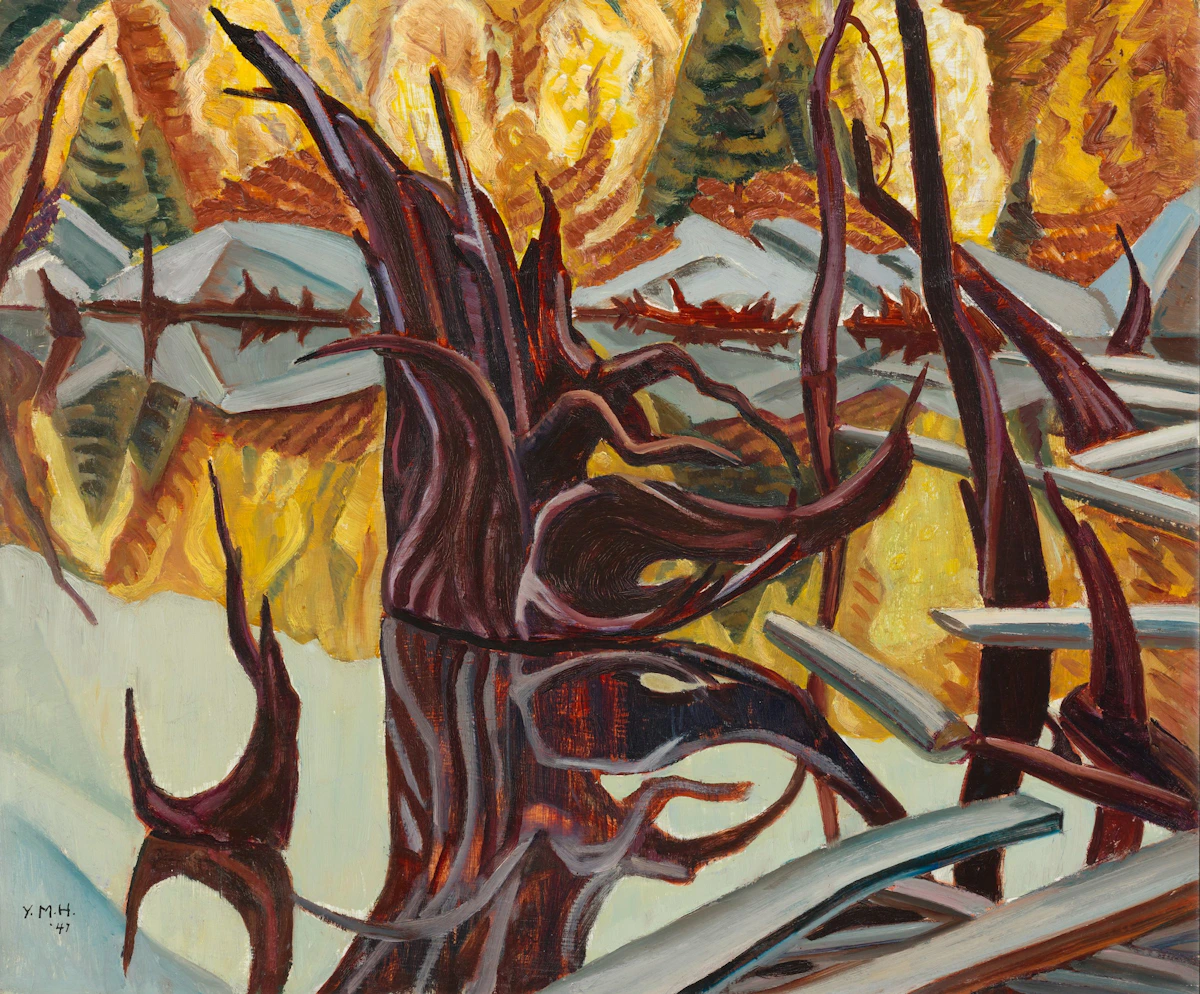
signed with initials and dated 1947 lower left; titled on a gallery label on the reverse
20 × 24 in (50.8 × 61.0 cm)
Collection of the Artist
Wedding Gift of the Artist to Kim Ondaatje, Ontario, 1964
Purchased from the above by the present Private Collection, Toronto
Four Women Who Paint: Exhibition of Works by Rody Kenny Courtice, Bobs Cogill Haworth, Yvonne McKague Housser and Isabel McLaughlin, The Fine Art Galleries, T. Eaton Co., Toronto; travelling to Adelaide House, Oshawa, 22 March-3 April 1948
Paintings and Sculpture for the Purchase Fund Sale (sponsored by the Women's Committee), Art Gallery of Toronto, 30 October-4 November 1948
Little Pictures Exhibition, Ontario Society of Artists, The Fine Art Galleries, T. Eaton Co., Toronto, by 29 January 1949
12th Annual Winter Exhibition, Art Gallery of Hamilton, February 1961, no. 30
"Other Communities Please Copy", Canadian Art 6, no. 3 (Spring 1949), page 122 reproduced
Yvonne McKague Housser was a Canadian Modernist painter and influential art educator whose career spanned more than seven decades. Born in Toronto, she studied at the Ontario College of Art from 1913 to 1918, where she encountered leading Canadian artists including J.W. Beatty and George Agnew Reid. She subsequently taught at the college for many years. In 1921–1922, she studied in Paris at the Académie de la Grande Chaumière, the Académie Colarossi and the Académie Ranson. She later studied in Vienna with Franz Čižek, whose approach to children's art influenced her interest in creative expression and formal experimentation. Housser exhibited with the Group of Seven in 1928, 1930 and 1931. She was not a formal member, but shared its interest in developing a distinctly Canadian approach to landscape painting. In 1933, she became a founding member of the Canadian Group of Painters, which brought together artists working in a range of modernist styles. Housser continued to experiment throughout her career. In 1939, she travelled to Taos, New Mexico, with fellow artist Isabel McLaughlin to study Dynamic Symmetry with Emil Bisttram.
By 1947, Yvonne McKague Housser had developed a distinctive approach to the Canadian landscape, combining recognizable natural forms with an increasingly modernist treatment of colour and composition. In this rare double-sided semi-abstract autumn scene, the landscape is simplified into expressive shapes and areas of colour, capturing the seasonal character of the setting while moving beyond literal representation. Housser painted reflections of the shoreline and leafless branches in the still water, emphasizing the abstract quality of the work. The verso depicts a completely different autumnal scene, with a vivid orange tree placed in front of a geometric rocky ledge and highly stylized body of water.
Autumn Gold was included in multiple exhibitions after its completion in 1947, including the notable 1948 show Four Women Who Paint held at T. Eaton Co. in Toronto and Adelaide House in Oshawa. Fellow exhibitors were Isabel McLaughlin, Bobs Cogill Haworth and Rody Kenny Courtice. The Oshawa Gazette writer Margaret Luke McLaughlin published an article in anticipation of the show, describing the opening event as including a Q&A period, a screening of a new film “Henri Matisse at Work”, followed by refreshments. McLaughlin states: “An evening such as is being planned on Thursday should be a real help to those in the community who are anxious to acquire a better understanding of what the nationally recognized good artists are striving to accomplish.”
Following the opening of the show, the Oshawa Gazette published another article reviewing the event and the exhibition. Written by Joe Aldwinckle, it mentioned that “Housser was asked at the exhibition opening to give up the secret that lay behind her “abstracts”. She candidly admitted that it was a free experiment in colour and rhythm, that she wanted to try something different in planes and spheres and here it was.” The article then goes on to mention “Autumn Gold by Mrs. Housser” as “memorable.” Aldwinckle concluded with: “It is a most comfortable exhibition – comfortable, but not complacent, far from it. Here is mature, exciting interpretation to catch the fancy of the enlightened. On the other hand, there is nothing to “haunt, startle or waylay” those of timid approach.”
In the following years, Housser studied with Hans Hofmann in Provincetown, Massachusetts. This experience contributed to her growing interest in abstraction. She was elected a member of the Royal Canadian Academy of Arts in 1950.
Housser gave this painting to Kim Ondaatje, her student at the Ontario College of Art, as a wedding present.
