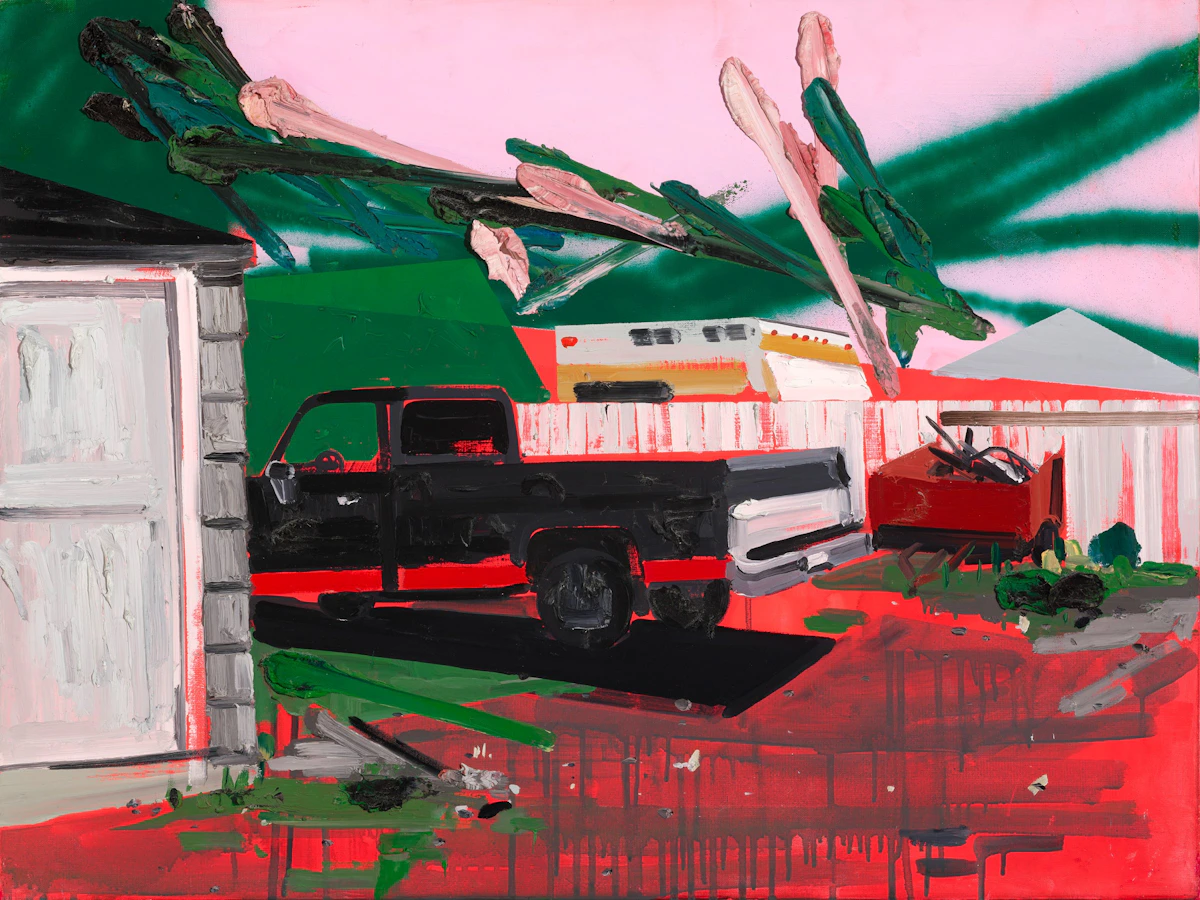
signed, titled and dated 2007 on the reverse; titled and dated to a gallery label on the reverse
24 × 31.5 in (61.0 × 80.0 cm)
Bonelli Arte Contemporanea, Mantova, Italy
Private Collection, Toronto
Kim Dorland, Bonelli Arte Contemporanea, Mantova, Italy, 23 May-25 July 2009
Katerina Atanassova, “You are Here: Kim Dorland and the Return to Painting” in Katerina Atanassova, Robert Enright and Jeffrey Spalding, Kim Dorland, Vancouver/Berkeley and Kleinburg, Ontario, 2014, pages 6, 44
Kim Dorland, Mantova, 2009, reproduced page 48
A native of Wainwright, Alberta, Kim Dorland draws heavily on his tumultuous upbringing to challenge preconceived notions of the Canadian wilderness. Known for his paintings of landscapes, often including figures, Dorland seeks to demystify the idea of terra nullius—the void, pristine, virgin land often idealized by historical Canadian painting and art history. Rather, the artist often incorporates contemporary figures and objects in a rugged environment emphasizing one's place in the landscape. Graffiti, cars, toys and modern infrastructure populate Dorland’s landscapes, making a contemporary comment on the traditionally barren Canadian landscape throughout art history. Dorland works in a variety of media, including neon pigments, spray paint and even inkjet technologies; the artist excels at creating imagery that is both abrasive and attractive.
Alley #4 was painted in 2007, when Dorland was starting to see significant success in the gallery world. In this work, he transforms an ordinary suburban scene into a vibrant, psychologically charged landscape. A black pickup truck in the foreground is surrounded by an abstract setting of a garage, a trailer, a fence, and ambiguous vegetation. Fluorescent pink emerges as negative space between and around the various subjects, while a thin layer of dripping grey paint suggests the pavement beneath. The sky is defined by a striking contrast between thick, tactile strokes of green and pink pigment layered over a spray-painted ground of the same hues.
The scene recalls the gritty, working-class environment Dorland grew up in and often references. Curator Katerina Atanassova remarks that “Dorland’s world - although referencing locales in his native Wainwright, Alberta - is no longer focused on a specific place but rather represents a kind of ‘anywhere’”. In many of Dorland’s works, including Alley #4, the artist has challenged the conventional notion of the romantic Canadian landscape. Jeffrey Spalding remarks on how Dorland’s scenes of Canadian life and terrain are important because they are truthful. He writes: “It may still be plausible to manufacture an encounter with pristine wilderness, but it is not our predominant, day-to-day lived reality. [...] Kim Dorland’s figuration and landscapes sit as a continuity of Canadian art history, not as an anomaly.”
