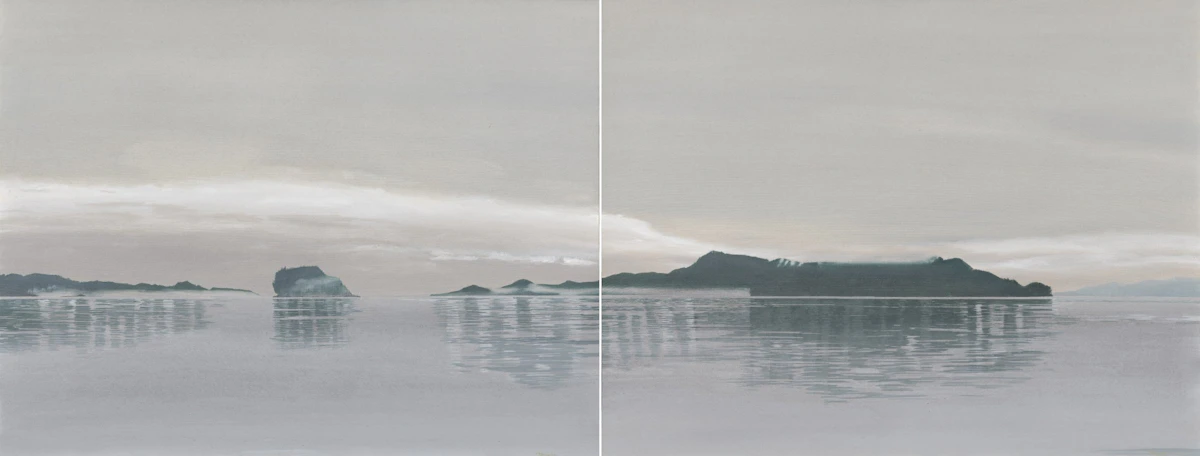
each signed lower right; each signed, titled and dated 1994 on the reverse
42 × 110 in (106.7 × 279.4 cm) (overall)
Private Collection
Maynards, auction, Vancouver, 10 May 2017, lot 49
Private Collection, Vancouver
Ian McNairn, 7 West Coast Painters, Vancouver International Festival Exhibition, The University of British Columbia, 1959, unpaginated
Nancy E. Dillow and Jane Rule, Takao Tanabe, 1972-1976: The Land, University of Regina, Saskatchewan, 1976, page 7
Robin Laurence, “A Landscaper of Many Colours: Tak Tanabe in Profile”, Border Crossings, Volume 16, Number 1, February 1997, page 42
Roger H. Boulet, Takao Tanabe: Wet Coasts and Dry Lands, Kelowna, 2000, pages 9, 13
Acclaimed contemporary painter Takao Tanabe was born in 1926 at Seal Cove, a small Japanese Canadian fishing community near Prince Rupert, British Columbia. His father was a commercial fisherman, and as a boy Tanabe accompanied him on fishing trips along the northern B.C. coast. He studied at the Winnipeg School of Art, and while taking classes from Joseph Plaskett, he furthered his technique of soft, atmospheric painting. In the post-war era of heavy painterly abstraction imbued with aggressive brushstrokes and bold colour, Tanabe favoured a sense of restraint and quietude in both his abstract and landscape works. He pursued the same contemplative quality found in the landscapes of Toronto-based artist Kazuo Nakamura. In 1959, Tanabe visited his ancestral Japan to study traditional Japanese painting and calligraphy, which had a profound impact on his artistic practice. Tanabe developed a technique of layering thin washes of acrylic paint to achieve a “muted, non-textural colour, that did not necessarily attract attention to its painterly qualities but focused the viewer on the overall effect of the minimal landscape forms without distracting detail.” Roger Boulet attributed this technique to Tanabe creating a “zen landscape... convincing as both a landscape and as a modern painting.”
Tanabe was Head of the Art Department at the Banff School of Fine Arts from 1973 to 1980. During his tenure, he was painting dramatic semi-abstract landscapes. Nancy Dillow writes that “Tanabe's paintings of the land are the outcome of intense personal discipline and a search for the subtleties of landscape.” In an interview for Border Crossings, Tanabe remarked on his attachment to the subject: “What I want is this completely unoccupied, pristine land, as though I'm the first person to see it. It's lonely, it's mysterious, it has wonderful appeal to me. I feel great kinship with it.”
The artist’s decisive return to landscape painting came after he moved back to B.C. from Banff in 1980. He had spent much of the 1970s painting the Prairies, but on Vancouver Island he increasingly turned toward the coast. Bates Passage is located on the northern coast of Vancouver Island, British Columbia, in the remote waters between Nigei Island and Hope Island. It connects Goletas Channel with the waters of Queen Charlotte Sound, and this location belongs to the very remote coastal world that became central to Tanabe’s mature practice. The North Coast and the Inside Passage became part of his subject matter through travel by boat. In 1983 he made an excursion to Haida Gwaii that resulted in a group of paintings and prints, and in 1987 he travelled north with his brother, a commercial fisherman, from Vancouver toward Prince Rupert. Tanabe photographed extensively on these journeys, using the photographs as source material for paintings.
Tanabe was fascinated by these remote marine environments: the maze of islands, passages, channels and sheltered waters along northern Vancouver Island and toward Queen Charlotte Sound. Tanabe was not seeking to depict a recognizable landmark in the conventional sense. He was interested in the relationship between land, water, and the atmosphere of the West Coast.
His compositions often reduce the landscape to a few essential elements: a horizontal band of water, a distant island or shoreline, misty atmosphere and a subdued sky. The monumental Goletas, Bates Passage, Nigei Island is the quintessential example of Tanabe’s atmospheric landscapes. Low-lying islands emerge from a calm expanse of water beneath a softly layered sky. Tanabe employs a monochromatic palette of grey, blue and muted green, with delicate horizontal brushstrokes capturing the subtle reflections of the distant landforms. Tanabe deliberately pared away extraneous detail in order to get at the essence of his subjects. Of his West Coast paintings, Tanabe explained “the views I favour are the grey mists, the rain-obscured islands and the clouds that hide the details. However much we desire order and clarity in all the details of our lives, there are always unexpected events that cloud and change our course. Life is ragged. The typical weather of the coast is like that, just enough detail to make it interesting but not so clear as to be banal or overwhelming. It can be a metaphor for life.”
On Tanabe’s technique and style, Robert Boulet writes that “there is no great effusion of self-expression. The paintings are cool, calculated, yet enormously affecting.” Author Ian McNairn explains: “Tanabe’s painting is essentially poetic. Perhaps all painting is poetic but in this case it is lyrical, delicate and hypersensitive. His work shows a refinement of taste and touch which is often lost in the technical process of contemporary painting.”
