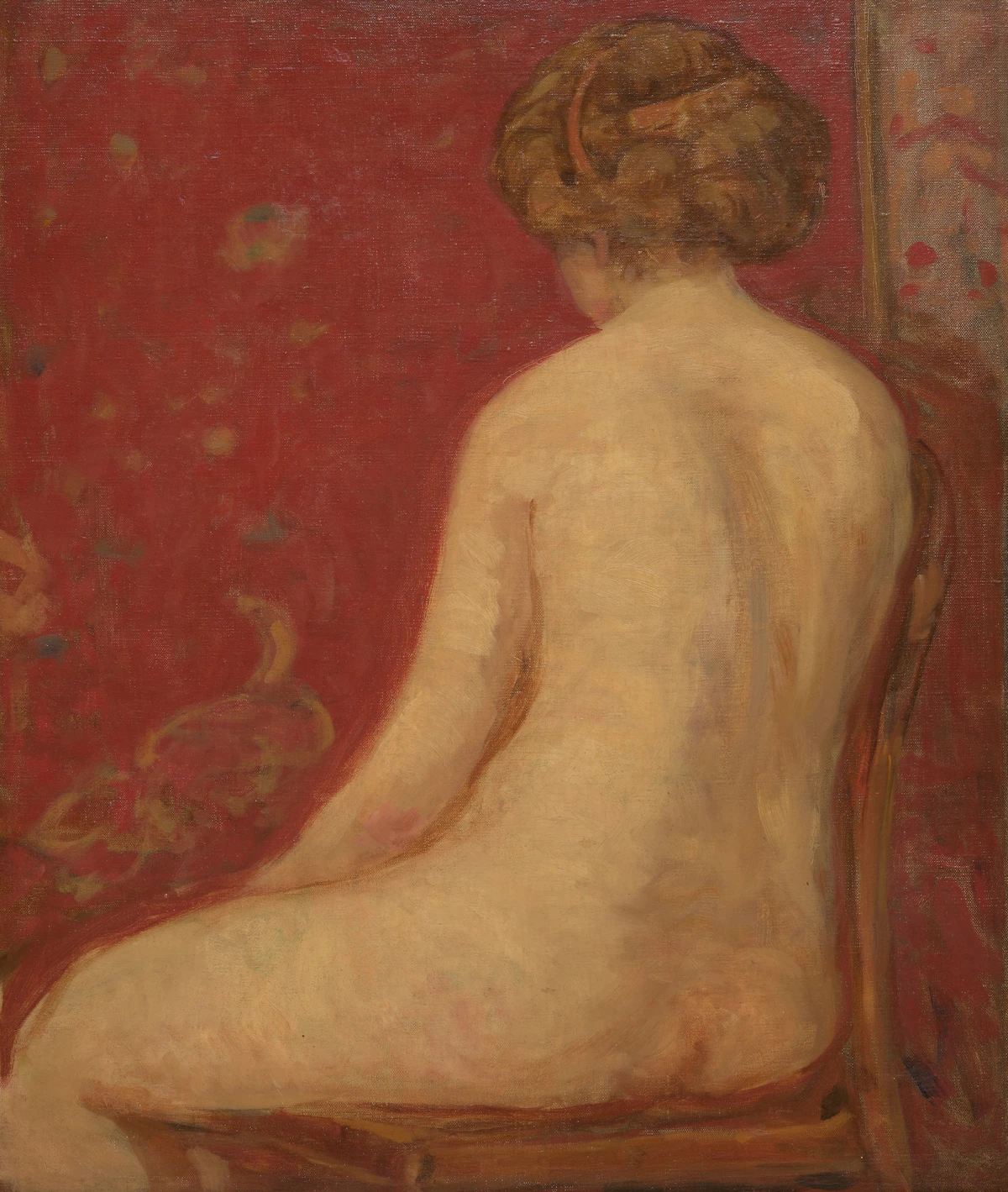
22 × 18.5 in (55.9 × 47.0 cm)
Léa Cadoret, Paris (seen by D.W. Buchanan in 1935)
Acquired by G. Blair Laing from Jacques Dubourg, dealer, Paris, early 1956
Frederick Mendel, Saskatoon, circa February-May 1956
By descent to Eva Mendel Miller
Masters Gallery, Calgary, 1998
Private Collection, Calgary
The Mendel Collection: Selected Works, National Gallery of Canada, Ottawa, travelling to the Montreal Museum of Fine Arts, 17 May-30 June 1956 as Nude Study [Note: not included in previous 1956 venues of the exhibition, Edmonton and Victoria]
The Mendel Collection, David Jones' Art Gallery, Sydney, Brisbane and Adelaide; travelling to George's Art Gallery, Melbourne, September-November 1962, no. 41 as Nude Study
The Mendel Collection, Mendel Art Gallery, Saskatoon, 16 October-13 November, 1964
30 Years of Masters (1976-2006), Masters Gallery, Calgary, 2006, listed and dated 1919 in error
"Catalogue Raisonné" in Donald W. Buchanan, James Wilson Morrice: A Biography, Toronto, 1936, page 181 as Nude Study [Note: "The back of a nude woman. She reclines to the right against a chair. The background is red". (Léa Cadoret posed for this shortly after she had met Morrice- he gave her the picture.) 22 ins x 18 ½ ins. Not signed. / collection: Mlle, Léa Cadoret, Paris.” The (Léa) comment better applies to Nude Reclining at the National Gallery of Canada; Buchanan did not see his error, and listed Nude Study before 1900, which is impossible.]
“Mendel Collection Presents Variety”, The Gazette (Montreal), 16 June 1956, page 26 [Note: Mentions all the works in the exhibition, including “a good nude study”.]
“A Selected List of Paintings” in Kathleen Daly Pepper, James Wilson Morrice, Toronto & Vancouver, 1966, page 97 [Note: all undated, at the end.]
Sylvain Allaire, Les artistes canadiens aux Salons de Paris de 1870 à 1914, M.A. Thesis, Université de Montréal, 1985, pages 121, 204 [Note: Allaire wrongly identified Étude in the 1911 Salon d’Automne, described by some reviewers as “a nude seen from the back”, with this one (more probably the AGO’s Standing Nude, from the Back, unknown to Allaire).]
Charles C. Hill, Morrice: A Gift to the Nation, The G. Blair Laing Collection, Ottawa, 1992, page 140, note 5 [Note: In the text for Blanche Baume, he mentions “at least eight paintings of women, including nudes, that have several internal cross-references (similar backgrounds or textiles, or identical models)... from about 1911 to 1914.” Note 5: “There is... a nude formerly in The Mendel Collection: Opening Exhibition”..., page 6". Same in the French edition of this catalogue.]
Kiriko Watanabe, Kathryn Bridge & al., Emily Carr: Fresh Seeing – French Modernism and the West Coast, Whistler, 2019, page 154 note 8 [Note: Titles of works by Canadians at Salon d'Automne 1911 (Source: probably Allaire, 1985 thesis).]
“65 paintings personally selected by Mr. Mendel for the opening of the Mendel Art Gallery, Saskatoon, Canada,” The Mendel Collection, Saskatoon, 1965, reproduced page 6 as Nude Study
30 Years of Masters (1976-2006), Masters Gallery, Calgary, 2006, unpaginated, reproduced, dated 1919 in error
Lucie Dorais, “Morrice et la figure humaine / Morrice and the Human Figure”, in Nicole Cloutier, James Wilson Morrice, 1865-1924, Montreal, 1985, page 69
Best known as a landscape painter, James Wilson Morrice also aspired to establish himself as a portraitist. Nude Study is one of the few portraits and very few nudes the artist completed during his lifetime. His interest in the human figure evolved gradually, and then further following his move to Europe. Portraits of family and friends are notably absent from Morrice's early years in Toronto and from his studies at the Académie Julian. The artist met Maurice B. Prendergast while in Paris in the 1890s; during this time Morrice filled his sketchbooks with scenes of Parisian life that bore resemblance to Prendergast’s watercolours. Morrice also met American artist Robert Henri around the same time, and it was through Henri that Morrice came to know the work of Manet. The technique and harmonious palette of Morrice's nudes from this period reflect the influence of Manet's celebrated Olympia.
Morrice painted his mistress Léa Cadoret, his friend Robert Henri, (likely) Henri Matisse and William Brymner in the mid-to-late 1890s, all in small format oil sketches, which are more spontaneous than large, carefully planned canvases. Numerous sketches of female models fill his sketchbooks from 1895 to 1898. Robert Henri wrote to his family that Morrice had painted several very beautiful portraits of models during the autumn of 1898. Around the turn of the twentieth century, Morrice appears to have shifted his focus away from the human figure as an independent subject. However, his landscapes and city scenes became increasingly animated with human activity.
The artist revived the subject of nude and clothed models around 1908, when Morrice presented one at the Salon d’automne of that year. His brighter palette of his portraits of the following years were likely influenced by the colourful work of Pierre Bonnard and Henri Matisse. A depiction of his companion, Léa Cadoret, this intimate nude reflects Morrice's embrace of the decorative modernism that emerged in the years preceding the First World War. Painted circa 1912-1914, the composition suggests the influence of Matisse and Bonnard, with its richly coloured red interior and emphasis on pattern and harmonious colour. The deep crimson background dominates the composition, creating an enveloping tapestry-like effect.
Author Lucie Dorais has remarked on the link between the artist’s figural work and his own character, writing: “All of Morrice’s portraits, whether they represent friends or professional models, bear the stamp of his reserved disposition. The models are almost always seen from a distance, sometimes in profile, and most of the nudes have their back to the spectator. The artist, who was extremely shy, perhaps wished in this way to avoid any interference from the subject, so that he could concentrate on his aesthetic preoccupations, especially the harmony of colour tones.”
Around 1912–1914, Morrice was at the height of his artistic maturity. His pre-war paintings are distinguished by small, jewel-like compositions, subtle harmonies of colour, and brushwork that conveys both confidence and restraint. Rather than focusing on narrative, he captured fleeting effects of light, atmosphere, and mood. During this time, the artist produced a number of similar figural works to Nude Study, often with colourful textiles filling the background. Morrice gave this painting to Léa Cadoret and it was later part of the collection of Frederick Mendel, a businessman and art collector who established Intercontinental Packers Limited in Saskatoon in 1940. Mendel's immense contribution to the arts in Saskatchewan included the inception of the Mendel Art Gallery (now the Remai Modern) in the 1960s.
We extend our thanks to Lucie Dorais, Canadian art historian and author of J.W. Morrice (National Gallery of Canada, 1985), for her assistance in researching this artwork.
