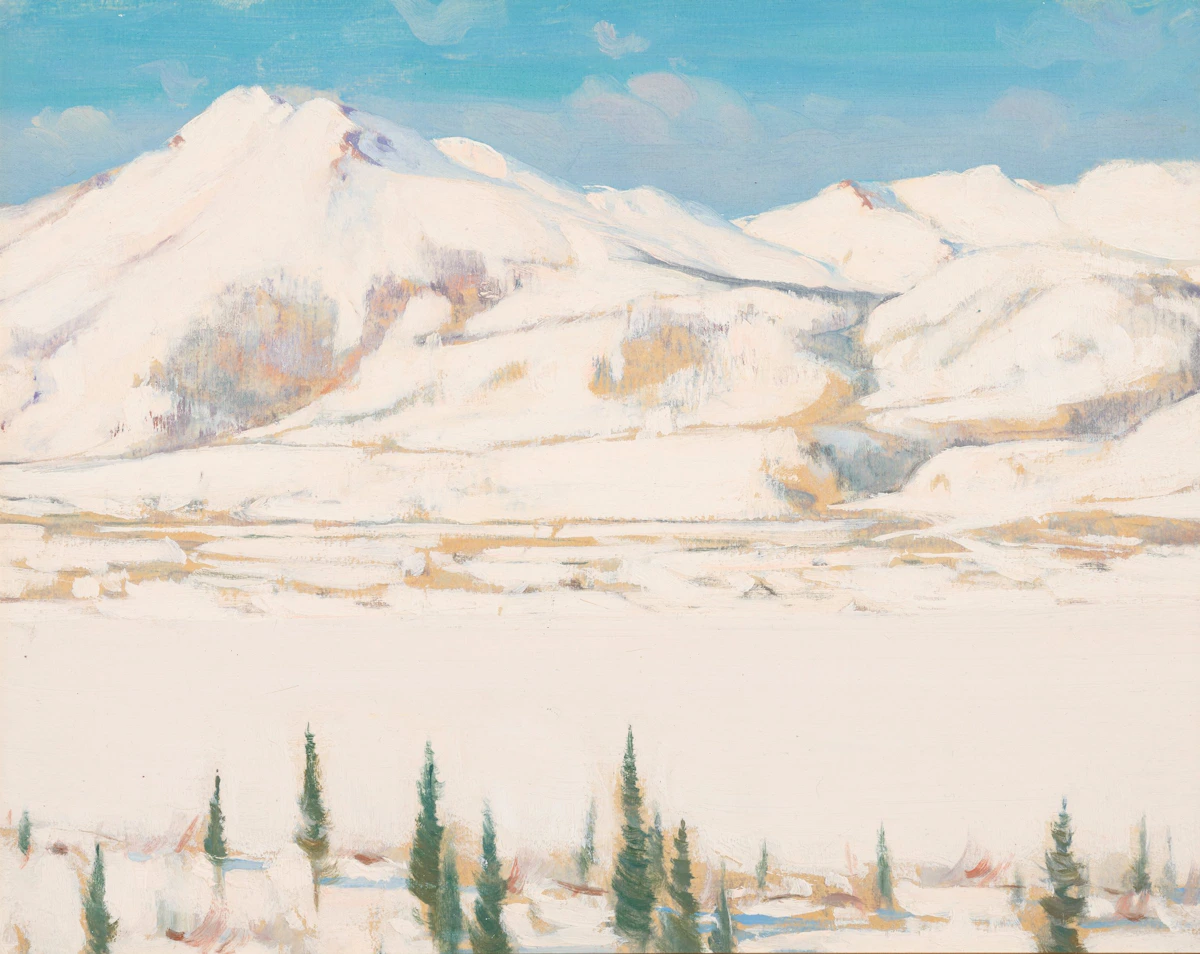
titled and certified by Lucile Rodier Gagnon (no. 511) on a label on the reverse
7.75 × 9.75 in (19.7 × 24.8 cm)
Canadiana House, Calgary
Hodgins, auction, Calgary, 27 November 2017, lot 70
Private Collection, Toronto
Clarence Gagnon, National Gallery of Canada Collections, https://www.gallery.ca/collection/artist/clarence-gagnon, accessed 10 October 2026
Although French-Canadian painter Clarence Gagnon spent many years working in Europe, he remained deeply connected to his native Quebec, a lasting attachment reflected in both his choice of subject matter and his exhibition history. Gagnon took his first trip to France in 1904, and he was soon recognized at the Salon of the Society of French Artists for his etchings in 1906. Yet the artist quickly abandoned the fashionable seaside subjects in favour of Baie-Saint-Paul landscapes.
Back in Paris in November and December 1913, Gagnon convinced the Parisian dealer Adrien M. Reitlinger to curate a special exhibition, Paysages d’hiver dans les montagnes des Laurentides au Canada. Following the First World War, Gagnon moved to Baie-Saint-Paul with his second wife, Lucile Rodier, in 1919. Marking a short but prolific period for the artist, the rural region offered the artist infinite seasonal landscapes to capture. From 1919 to 1924, before moving to France, Gagnon took advantage of the newly accessible area, thanks in part to the newly constructed rail line connecting Montreal and Quebec City to Baie-Saint-Paul, and produced numerous sketches, paintings and print works of the area. During this time, A.Y. Jackson, Albert Henry Robinson, Edwin Holgate, Mabel May and Lilias Torrance visited him at various times to join in sketching trips across the region.
Between 1924 and 1936 Clarence Gagnon lived in Europe, based primarily in France and embarked on road trips during the summer months. He made brief returns to Canada throughout these years, and in 1927, Gagnon’s works were included in exhibitions at the National Gallery of Canada, Ottawa; the Musée du Jeu de Paume, Paris; the Château Frontenac, Quebec City; and the Art Association of Montreal. In 1931, the artist wrote: “It was not the over-sensitivity of the misunderstood that made me move to Paris....Over there, I paint only Canadian subjects, I dream only of Canada. The motif remains fixed in my mind, and I don’t allow myself to be captivated by the charms of a new landscape. In Switzerland, Scandinavia - everywhere, I recall my French Canada.”
