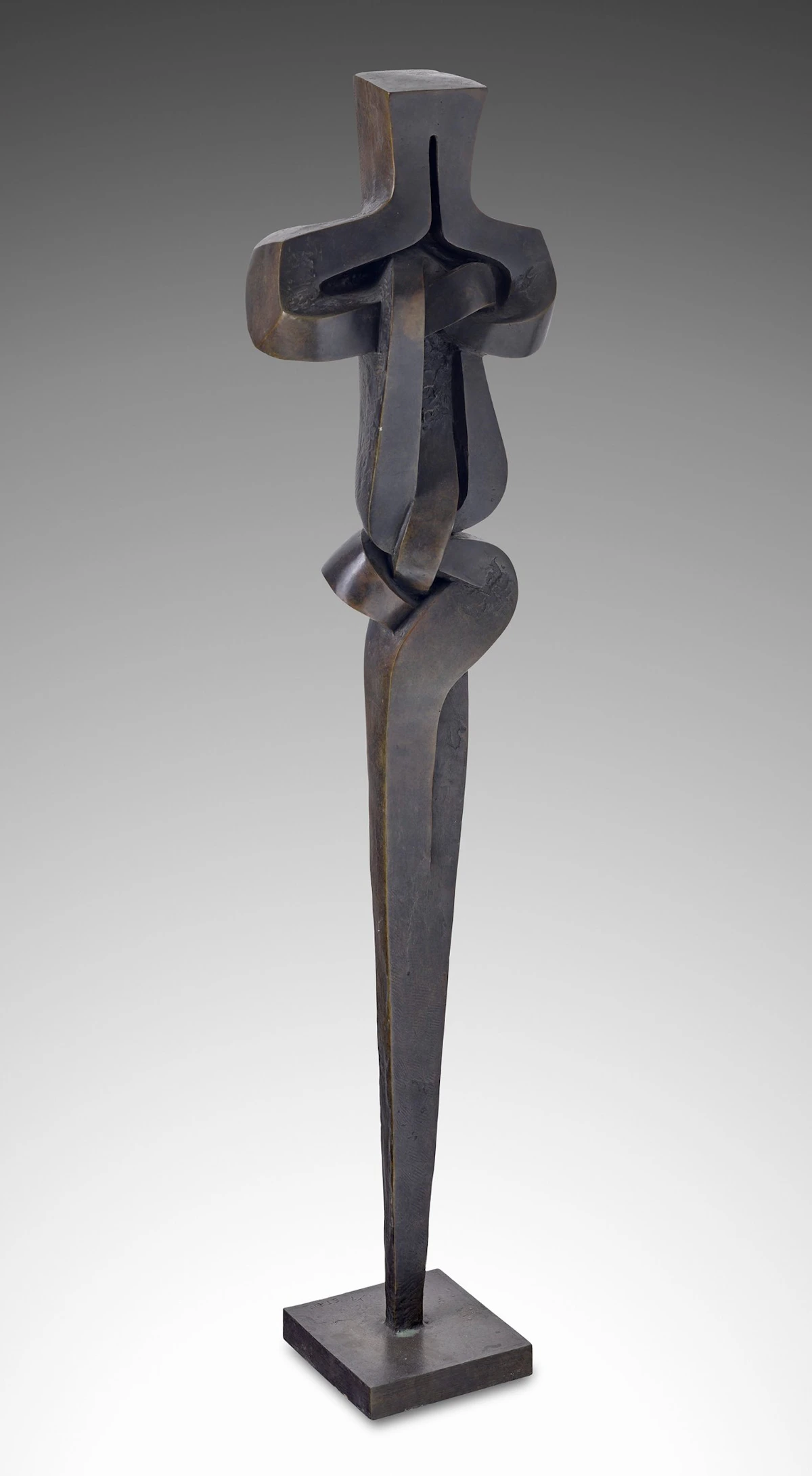
stamped signature and numbered 1/7 on the base
48.5 × 12 × 7 in (123.2 × 30.5 × 17.8 cm) (overall)
Hokin Gallery Inc., Palm Beach, 1982
Estate of Florence Morris, Palm Beach, Florida
Palm Beach Modern Auctions, Florida, 2 May 2020, lot 183
Private Collection, Florida
By descent to the present Private Collection, United States
Carlo L. Ragghianti, Sorel Etrog, Florence, 1968, unpaginated, reproduced as Knotted Figure, 1962-1964
Pierre Restany, Sorel Etrog, Munich/London/New York, 2001, reproduced page 14
Sorel Etrog’s sculpture from 1962–1964 belongs to his early biomorphic period, when he was developing the organic, elongated forms that first established his reputation internationally. Compared with his later hinge-based works of the 1970s, these sculptures tend to be more fluid and lyrical, often suggesting human figures, plants or other living forms.
Etrog drew inspiration from African, pre-Columbian and Oceanic art, which he encountered at the Brooklyn Museum, as well as from modern sculptors such as Constantin Brâncuși, Henry Moore and Barbara Hepworth. He was particularly interested in how simplified forms could convey movement and vitality, even in a static medium like bronze. Abstracted bodies and relationships emerge from the interplay of solid masses, slender stems and sculptural openings. Etrog captures his new form of anatomy in Knotted Figure. The elongated, tapering form loosely evokes the human figure, with the twisting, interlocking curves suggesting a torso and limbs in motion. The dark bronze surface and contrasting curves create a sense of tension between the rigid, pointed base and the more fluid forms above.
The early 1960s were a period of growing international recognition for the artist. The Museum of Modern Art in New York acquired Ritual Dancer in 1963, and Etrog’s sculpture Flight (1963–1964) was later presented at Expo 67 in Montreal.
