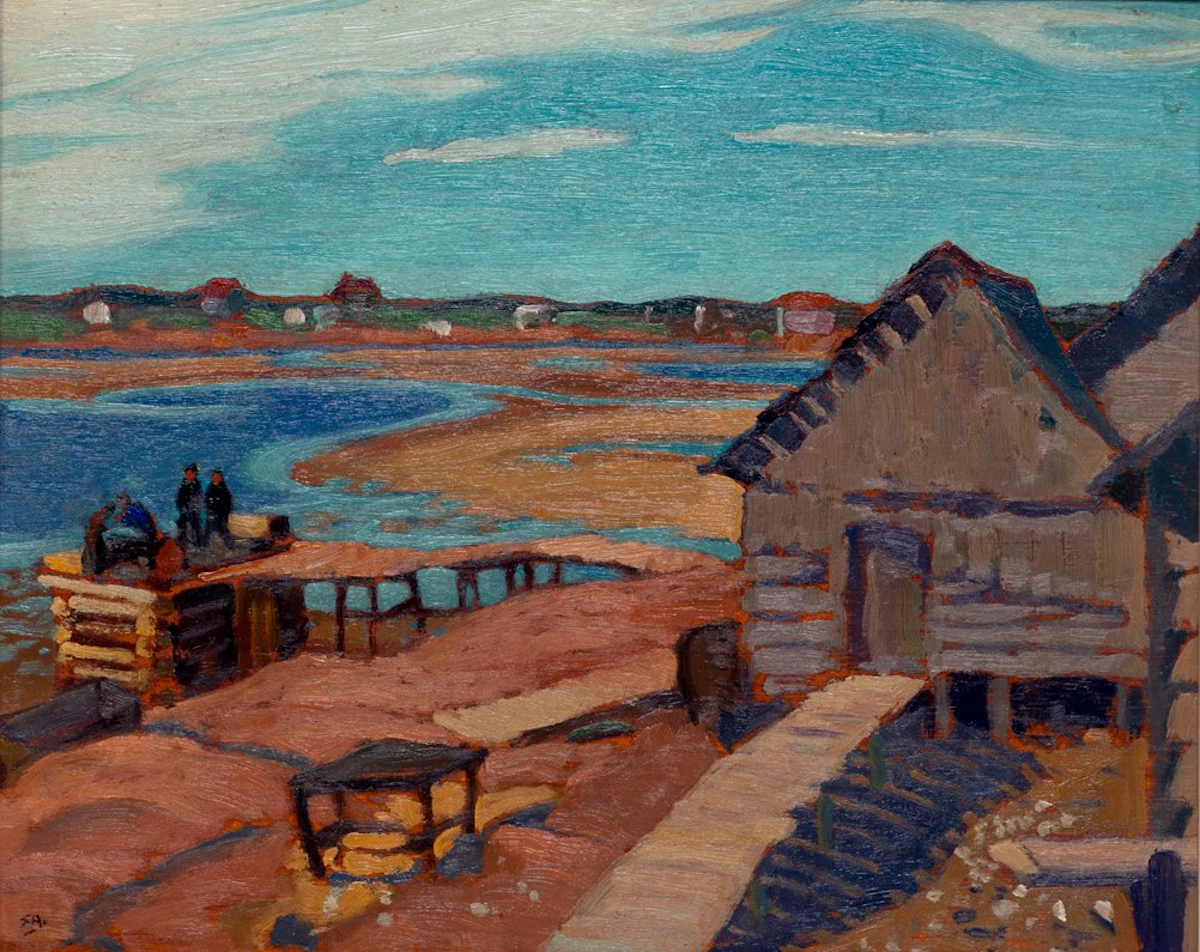
signed with initials lower left; titled and dated 1930 on labels on the reverse
8.5 × 10.5 in (21.6 × 26.7 cm)
Galerie Eric Klinkhoff, Montreal
Private Collection, Calgary
In the 1920s and 1930s, Edwin Holgate took a strong interest in the literature and iconography of the French-Canadian rural tradition. “Rural literature” developed as a genre in French Canada, and it was a source of inspiration for a number of painters—among them Marc-Aurèle de Foy Suzor-Coté and Clarence Gagnon, both of whom illustrated Louis Hémon’s book Maria Chapdelaine, and Ozias Leduc, who created the drawings for the novel Claude paysan by Dr. Ernest Choquette. The genre had its source in an intellectual approach that the historian Michel Brunet labelled as “agriculturist”. Faced with growing industrialization and urbanization, religious leaders and intellectuals became increasingly concerned about the future of French-Canadian Catholic society. They feared that, by abandoning long-standing traditions and moving toward urban centres, French Canadians risked losing their distinct identity.
This ideology emerged in response to the rapid pace of urbanization and the resulting shifts in population. The survival of French Canada appeared to be under threat. Since French-Canadian society had endured largely through the perseverance of its rural communities, the agrarian population came to be seen as a kind of bulwark against these changes.
Holgate became interested in the iconography of French-Canadian rural life. Holgate made a series of woodcuts to illustrate rural subjects in the English translation of Vieilles choses, vieilles gens, a book by Georges Bouchard in 1928. Subjects included farmers, ploughs, blacksmiths, and others. Holgate also made several images—both prints and paintings—of French Canadian interiors, not only to show human figures in their habitual setting, but as ends in themselves.
In 1930, the artist embarked on a trip to Labrador, stopping at the Acadian fishing village Natashquan along the way. Located on Quebec’s north shore of the Gulf of St. Lawrence, the municipality inspired the artist to paint numerous interior scenes of fishing cabins, as well as beach scenes and this charming oil painting of a fishing station, called magasins du Galet. Holgate’s interest in rural Quebec and its traditional ways of life is particularly evident in Low Tide–North Shore, Natashquan. The weathered cabin, docks, and fishing equipment evoke a way of life closely tied to the land and water, offering a glimpse of the rural traditions that were increasingly threatened by industrialization and urbanization.
