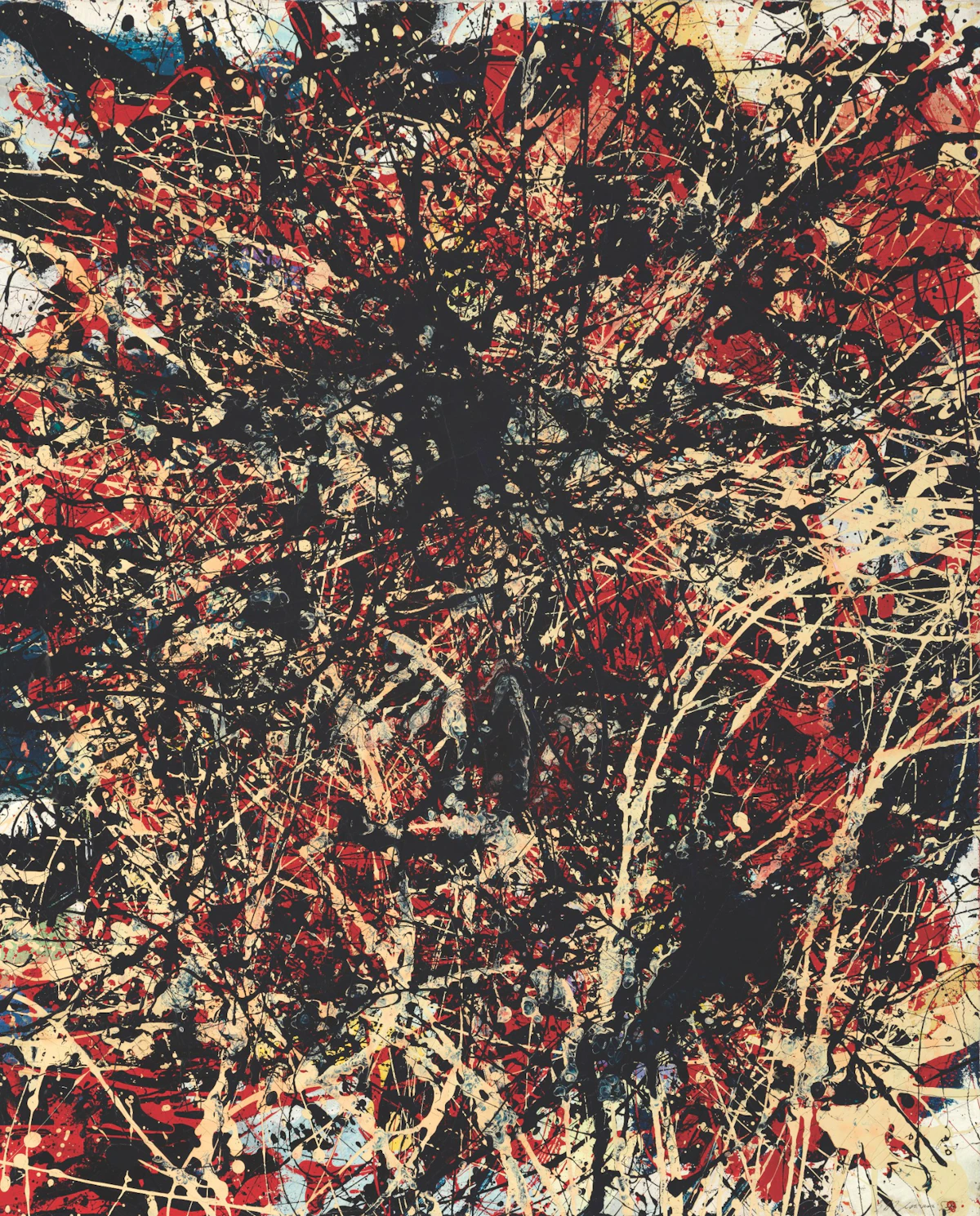
signed and dated 1956 lower right; unframed
31.5 × 25.5 in (80.0 × 64.8 cm)
Acquired directly from the Artist, Montreal, late 1950s
Private Collection, New York
Pierre Théberge, Guido Molinari, Ottawa, 1976, pages 16, 17
Before establishing his signature plasticien style of crisp, solid bands of colour, Guido Molinari passed through a brief but important and comparatively little-known phase of drip painting. Molinari’s first solo exhibition was held in December 1954 at L’Échourie, a restaurant located at 45 Pine Avenue West in Montreal, where he also served as director of exhibitions. The artist was twenty-one years old, and he exhibited more than twenty ink drawings. In January 1955, he made his first trip to New York. Molinari was overwhelmed by the colour and the lyricism of Kandinsky’s paintings at the Guggenheim Museum. He was also equally inspired by Mondrian’s paintings at MoMA. “The powerful sparseness of Mondrian’s works confirmed Molinari’s belief that he could enrich the meaning of his own pictorial language by reducing its number of elements.”
Upon his return from New York, Molinari participated in Espace 55, an exhibition of drawings held at the Montreal Museum of Fine Arts in February. This show led to a disagreement between Paul-Émile Borduas and Fernand Leduc over the viability and the originality of painting practices in Montreal circles. Molinari soon published an article “Tachist space or the situation of Automatism” in which he discussed Automatism in Canada in relation to the United States. Molinari saw Canadian Automatists continuing to use stylistic devices traditionally linked to the illusion of three-dimensional space. These devices had already been abandoned by Jackson Pollock, following the example set by Mondrian, who used the notion of a “dynamic plane in which colour rediscovers all its potential energy.” Molinari’s article ended with an appeal for the creation of a new painting approach whose spatial structure would be original, concluding with “In short, we must stop redoing the painting which has already been overly redone.”
On May 28th, 1955, Molinari and Fernande Saint-Martin opened L’Actuelle Gallery at 278 Sherbrooke Street West in Montreal, exhibiting only non-figurative artists and serving as a meeting place for young artists of the post-Automatist generation. That November, Molinari participated in L’exposition de peinture canadienne, held at the École des Hautes Études Commerciales. The exhibition featured seventy-one Quebec painters and forty-five artists from other provinces. Molinari exhibited two drip paintings, which combined the technical experiments of Jackson Pollock with his own explorations in calligraphy and spatial relationships in black-and-white drawings.
This rare untitled drip painting dates to this brief but formative period in Molinari’s early career. This work is part of a very small corpus of works, approximately eight, that Molinari produced in 1955-1956 after his first trip to New York in January 1955, during which he saw works by Pollock, De Kooning and Kline. The influence of Pollock is quite evident in this corpus. Molinari used Duco—paint used for cars—for this corpus of drippings. Molinari continued to experiment with this type of paint in 1956 in another very structural series in black and white. The layers of splattered yellow, red, black and blue pigments attest to the direct influence of Jackson Pollock. During the winter of 1956, Molinari shifted away from painting for a year to make calligraphies. He continued exhibiting with the Association des artistes non-figuratifs de Montréal, including its second annual exhibition at the MMFA in February–March of 1957. He also had a final exhibition at L’Actuelle with Claude Tousignant in May 1957, just before he closed the gallery, having presented about thirty exhibitions.
This painting was acquired directly from Molinari in the late 1950s in Montreal. The private collector became friends with Molinari, Marcel Barbeau, Jean Paul Mousseau and other celebrated artists of Quebec, visiting frequently from New York to meet at a bar and discuss art.
We extend our thanks to the Molinari Foundation for their assistance in researching this artwork.
