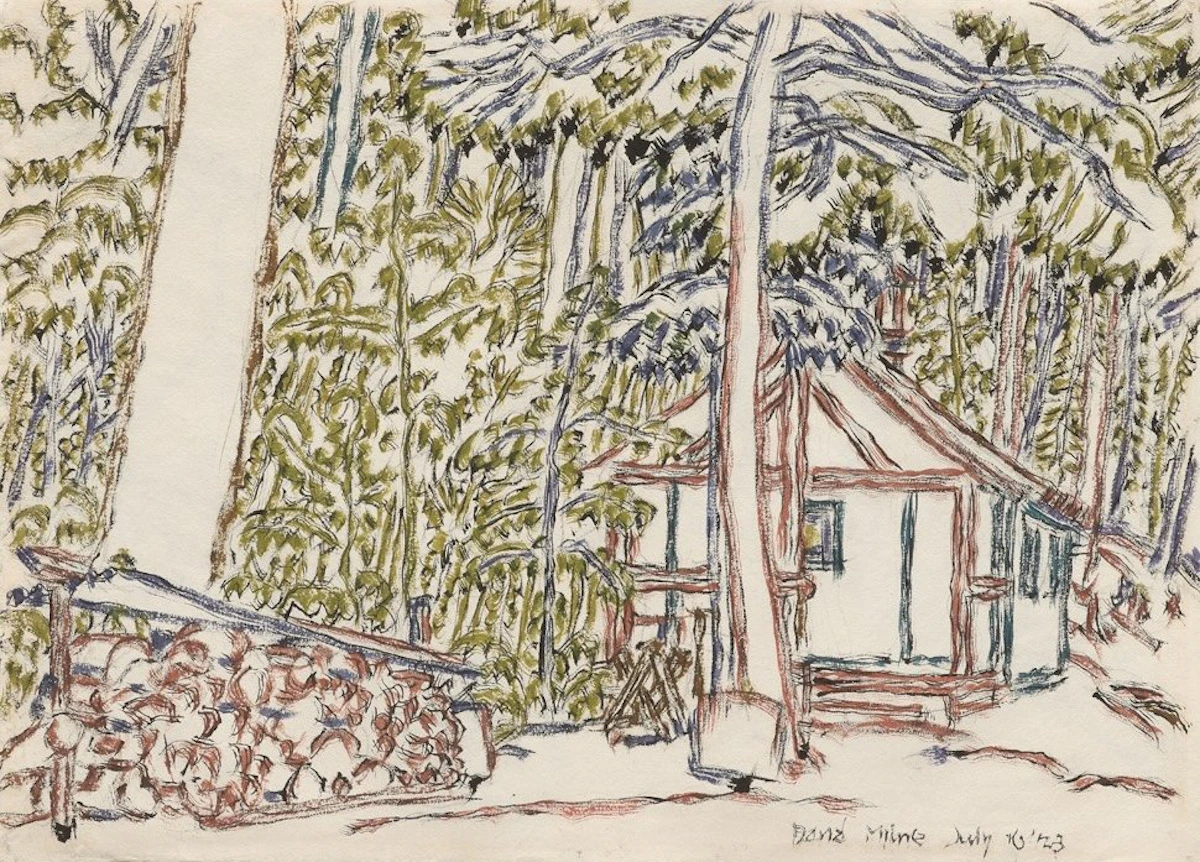
signed and dated "10 July 1923" lower right; titled on two gallery labels on the reverse, catalogue raisonné no. 205.2; with an unfinished, cancelled watercolour of a storage shed, post and cabin on the reverse
11 × 15.5 in (27.9 × 39.4 cm) (sheet)
Douglas Duncan, Toronto
H.J. Allen Jr., Toronto, circa 1960
Christopher Varley, Toronto, 1984
Equinox Gallery, Vancouver, 1984
Hon. J.R. Longstaffe, Vancouver, 1985
Ohler Fine Arts, Vancouver, 1992
Masters Gallery, Calgary, 1992
Private Collection, Calgary
Possibly 41st Annual Exhibition, Art Association of Montreal, 27 March-28 April 1924, as Bungalow, no. 71
Possibly David Milne, Arts Club, Montreal, January-February 1924
David Milne Paintings, Masters Gallery, Calgary, 4-7 December 1996
Sight and Site: Location and the work of David B. Milne, The Nickle Arts Museum, Calgary, 8 August-2 November 1997
David Milne Jr. and David P. Silcox, David B. Milne: Catalogue Raisonné of the Paintings, Volume 1: 1882 – 1928, Toronto, 1998, page 380, no. 205.2
One of Canada’s pioneers of modern art, David Milne moved from Burgoyne, Ontario, to work and study in New York City in 1903. In 1916, he and his wife Patsy left the city to embrace a more rural life where Milne could afford to paint full-time with few responsibilities or distractions. They first settled in Boston Corners, a village of ninety-six inhabitants at the edge of the Taconic Range, where New York meets Massachusetts and Connecticut. He had been searching for a location that was a reasonable distance from the city and suitable for painting.
The artist enjoyed the peace and solitude of a rural life in Boston Corners. However, in late 1917 Milne joined the Canadian Army, training in Toronto and Quebec, before arriving in Europe just prior to the end of World War I. In 1919, he worked as a war artist, painting camp and training facilities scenes in England as well as in the deserted battlefields in France and Belgium. He returned to New York State later that year and resumed painting full time.
Milne found all his Boston Corners watercolour subjects within a few miles of his house. They were painted en plein air, often with a graphite stencil beneath the pigment, and Milne claimed not to alter them once they were done. These works, such as Fireweed and Cabin, are distinguished by an expressive linear vocabulary, with sinuous drybrush contrasting with the white paper. Here, a rustic house is nestled in a forest of tall trees; the woodpile in the foreground adding a sign of human activity. Milne employed a very reduced colour palette, repeating the same shades of green, brown and grey throughout the composition.
This work was completed on 10 July 1923 in Big Moose Lake, Adirondacks, N.Y., shortly before the artist made an attempt to re-establish himself in Canada. Milne moved to Ottawa in the fall of that year, where he sketched and painted numerous buildings throughout the city in his signature linear approach. Milne was inspired by international avant-garde modern art and was unlikely to have appealed widely to the more conservative tastes of Ottawa, but he continued to exhibit there until 1927. Ultimately his income was insufficient to sustain him, and he missed his wife, who was living in Montreal. Milne soon moved back to upper New York State, where he would remain until 1929.
