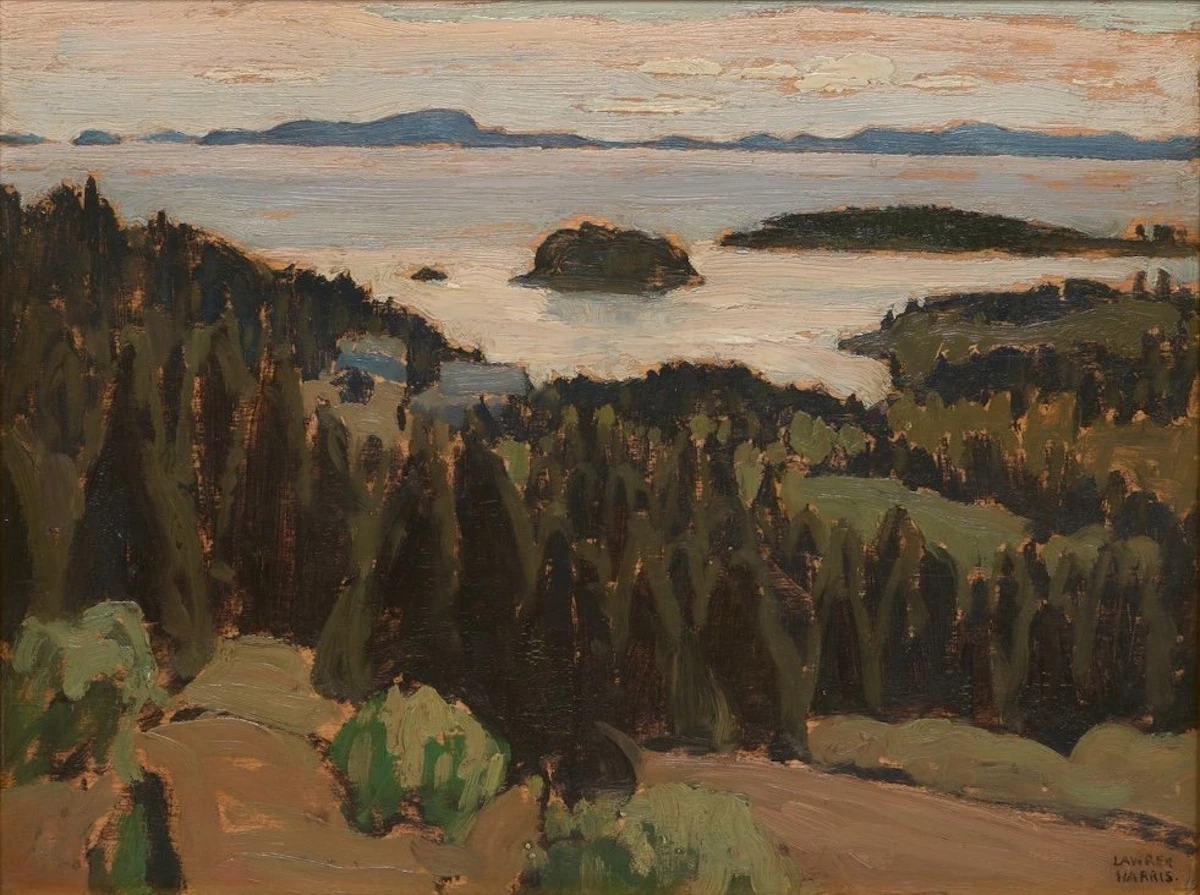
signed lower right; "Jack & Liel from Lawren" inscribed on the reverse
10.5 × 13.75 in (26.7 × 34.9 cm)
Gift of the Artist to a Private Collection, Ontario
Masters Gallery, Calgary
Private Collection, Calgary
Lawren Harris: Urban Scenes and Wilderness Landscapes, 1906-1930, Art Gallery of Ontario, Toronto, 14 January-26 February 1978, no. 110
Lawren Harris, Works from Private Collections, Masters Gallery, Calgary, 22 October-1 November 2016
Jeremy Adamson, Lawren Harris: Urban Scenes and Wilderness Landscapes, 1906-1930, Toronto, 1978, listed page 227 as no. 110
From the streets of Toronto and the Laurentian hills to Algoma, the North Shore of Lake Superior, the Rocky Mountains and the Arctic, Lawren Harris continually sought out new landscapes across Canada, transforming their distinctive forms into a modern visual language that reflected an evolving sense of Canadian identity.
Harris first encountered J.E.H. MacDonald’s work at the Arts and Letters Club in 1911, and the two soon became close friends and artistic collaborators. They travelled together to sketch in Mattawa and Timiskaming in 1912 and the Laurentians in 1913, while Harris also met many of Toronto’s leading artists through the club. In 1914, Harris and Dr. James MacCallum established the Studio Building on Severn Street, creating affordable studios where Canadian artists could devote themselves to painting rather than commercial work. The building became an important gathering place for the artists who would go on to form the Group of Seven.
Harris first travelled to Algoma in the spring of 1918, accompanying MacCallum aboard the Algoma Central Railway from Sault Ste. Marie. The region would become a foundational landscape for the Group of Seven, offering the rugged terrain, rocky hills, windswept pines and countless lakes that they sought as an alternative to the academic traditions of Canadian landscape painting. The railway provided access deep into the wilderness, allowing the artists to camp and paint directly in the landscape. Harris returned to Algoma in September 1919 with Frank Hans Johnston, J.E.H. MacDonald and A.Y. Jackson, as the artists prepared for their inaugural exhibition in Toronto the following spring.
In May 1920, Harris and the six other founding members of the Group of Seven exhibited together for the first time at the Art Gallery of Toronto. The exhibition featured 121 works, including the Algoma landscapes that had become central to the group’s emerging vision of Canadian modernism. The artists’ bold and highly individual approach to the northern landscape marked a departure from the academic traditions that had long dominated Canadian art.
Harris and A.Y. Jackson first painted on Lake Superior in October 1921 when they sketched briefly around Rossport and Schreiber. Harris would return to paint and draw on the north shore of Lake Superior almost every October until 1928. His Lake Superior paintings range from depictions of the rocks, hills, bays and interior lakes during early years, to dramatic visions of the light over the vast body of water in later years. Distant View Over Lake Superior was completed during Harris’s initial visit to the North Shore in October 1921. Earlier that year, he had painted in Algoma in May before returning in September with A.Y. Jackson and Arthur Lismer, working around Sand Lake and the Sand River. Jackson wrote on September 25th that he and Harris planned to remain at Sand Lake for several weeks before continuing to the North Shore of Lake Superior. Here, the lake is viewed from an elevated vantage point, framed by foreground trees rendered in varying shades of green. The dark, dense forest contrasts with the shimmering expanse of water and sky, which Harris captures with loose, expressive brushstrokes. Harris frequently returned to the same sites, reinterpreting similar subjects in new pictorial languages. Distant View Over Lake Superior marks an important transition in Harris’s practice, retaining the rich, painterly approach of his Algoma works while pointing toward the more stylized lines and simplified forms that would define his Lake Superior paintings.
