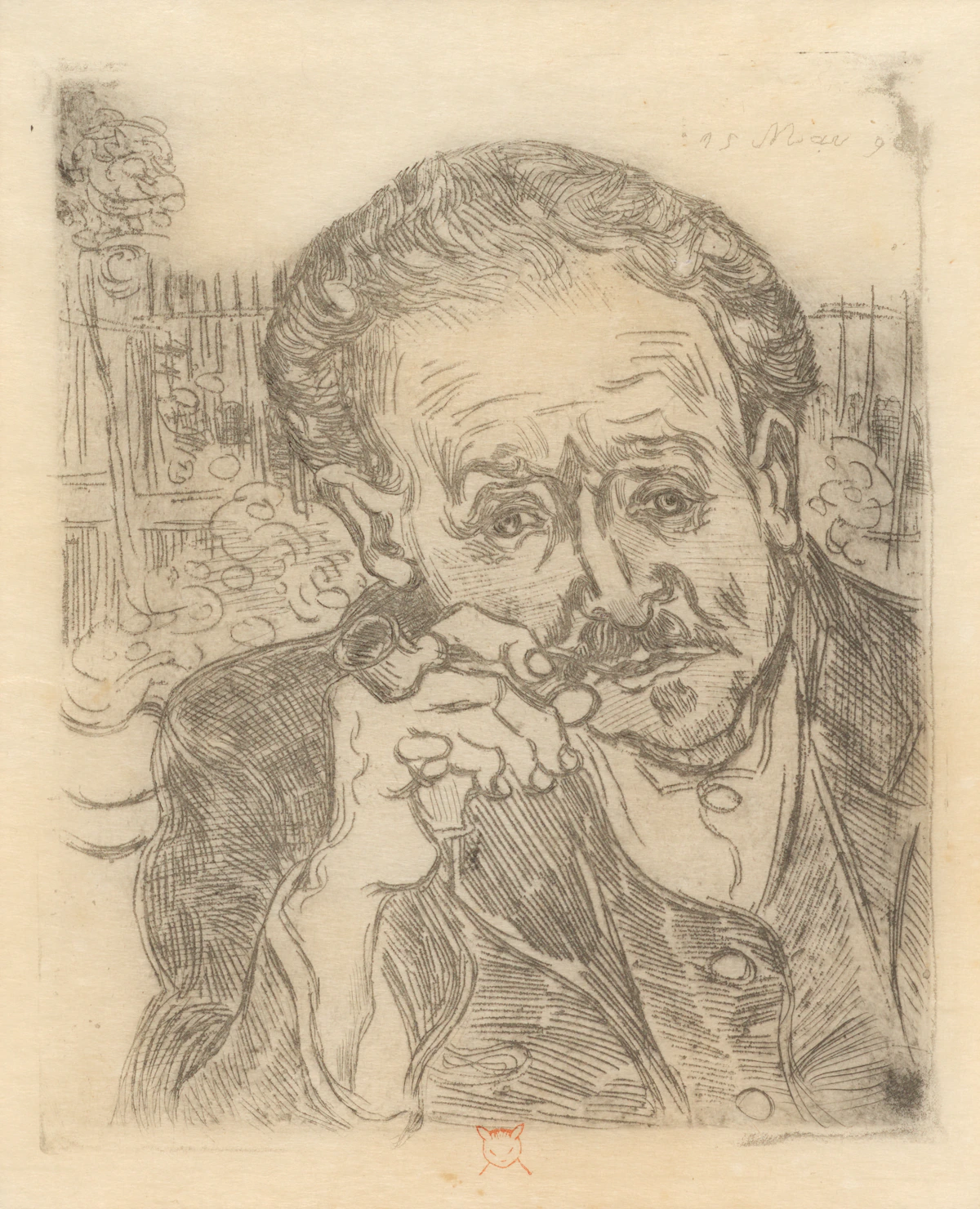
with the red Gachet stamp
7 × 5.75 in (17.8 × 14.6 cm)
(including Buyer's Premium)
Paul Ferdinand Gachet (Lugt 2807c)
Christopher-Clark Fine Art, San Francisco
Private Collection, La Jolla
Bonhams, auction, Los Angeles, 3 October 2023, lot 152
Private Collection, Canada
Vincent Van Gogh, Letter to Paul Gauguin: Around 17 June 1890. RM23
Nienke Bakker, Emmanuel Coquery, Teio Meedendorp and Louis van Tilborgh, eds., Van Gogh in Auvers-sur-Oise, New York, 2023, pages 44, 97, 120, 182, similar works illustrated 119, 178
H. Anna Suh, ed., Vincent van Gogh: A Self-Portrait in Art and Letters, New York, 2006, page 296
Homme à la Pipe: Portrait du Docteur Gachet occupies a unique and significant place in the history of printmaking and within Vincent van Gogh’s graphic oeuvre. It is the only etching the artist ever produced. This etching, executed at Auvers-sur-Oise in the spring of 1890, marks a departure in medium and was completed in the final weeks of Van Gogh’s life. The work is imbued with emotional and biographical significance that few works on paper can rival.
The circumstances surrounding the creation of this work are integral to its interpretation. On May 20th, 1890, after more than a year of confinement at the asylum of Saint-Paul-de-Mausole in Saint-Rémy-de-Provence, following his breakdown in Arles and the self-inflicted wound to his ear, Van Gogh was transferred to Auvers-sur-Oise, a village near Paris known for its artistic community. This arrangement was facilitated by his brother and dealer, Theo, who sought a physician capable of supporting Vincent’s mental health while permitting him to continue his artistic practice. The recommendation came from Camille Pissarro, who suggested Dr. Paul Ferdinand Gachet, a homeopathic physician, dedicated Impressionist collector, and enthusiastic amateur printmaker. Dr. Gachet had previously treated Pissarro and maintained close relationships with artists such as Renoir, Manet, Cézanne, and Courbet.
Gachet played an active role in the development of French modernism. Using the pseudonym Paul van Ryssel, he practiced etching from the 1870s and encouraged Cézanne to create his first prints at Auvers. He established a modest studio with a printing press in the attic of his home, which he made available to visiting artists. In this setting, Van Gogh, within weeks of beginning treatment with Gachet, engaged in intaglio printmaking for the first and only time. Dr. Gachet supplied the materials, while Van Gogh contributed a vision marked by exceptional directness and intensity.
Van Gogh's first and only etching at Gachet’s house on June 15th. The subject chosen was the doctor himself. The composition presents Gachet seated, with furrowed brows and deep-set eyes. He gazes slightly away from the viewer, a pipe between his fingers. The pose closely echoes the two celebrated oil portraits Van Gogh painted of Gachet that same month—one now in the Musée d'Orsay, Paris, the other sold at Christie's New York in May 1990 for $82.5 million, a record-breaking price that confirmed the Portrait of Dr. Gachet as one of the most sought-after images in the history of art.
Rendered on a more intimate scale and executed in the monochrome intaglio technique, the etching conveys a similar psychological atmosphere: a pervasive sense of sorrow and melancholy that reportedly affected both artist and subject. Van Gogh recognized his own existential pain in Gachet’s “deeply sad expression of our time.” This characterization is equally applicable to the etched impression, where the artist’s distinctive, animated linework translates his brushwork into the incised medium of metal. In a letter dated June 12th, 1890, Van Gogh described the painted version as depicting Gachet “with a melancholic expression that may well seem like a grimace… Sad, yet gentle, but clear and intelligent—that’s how many portraits ought to be painted.” This portrait is considered the most personal work Van Gogh produced in Auvers and, in many respects, functions as a form of self-portrait.
The technique employed is notably direct. Paul Louis Gachet, the doctor’s sixteen-year-old son, was present during the creation of the etching and later recounted the process. In the garden, after lunch, both Van Gogh and the doctor smoked their pipes while the artist rapidly drew the portrait onto the prepared copper plate. They printed the etching together in the studio, with Van Gogh experimenting with various colours in this new medium. Van Gogh approached the etching needle in a manner similar to his use of the pen, constructing form through accumulated, energetic strokes rather than employing the graduated cross-hatching characteristic of academic printmaking.
This technique produces a surface of notable vitality, with the coat depicted in dense, closely packed lines and the hair rendered with a more fluid, undulating touch that recalls the artist's late painted style. The impression in the present work is printed on laid Japan paper, a support highly receptive to fine inked lines, which imparts a luminous quality that enhances the delicacy of the image. The date is inscribed in drypoint in the upper right with a stamp in the form of a cat’s face in red ink in the lower margin, which corresponds to impressions bearing Gachet's collector mark (Lugt 2807c), used by both the doctor and his son.
The rarity of this work cannot be overstated. Van Gogh lacked formal training or sustained practice as a printmaker, and this etching was never issued as a commercial edition. The copper plate survives to this day in the collection of the Musée d'Orsay, having been donated to the Musée du Louvre around 1950. Impressions are held in the permanent collections of the world's foremost institutions of prints and drawings, including the Museum of Modern Art in New York, the Metropolitan Museum of Art, the Victoria and Albert Museum in London, and the Museum of Fine Arts in Boston.
Van Gogh's death by suicide on July 29, 1890, less than two months after completing this work at the age of thirty-seven, redefines this etching as both the culmination and the sole testament to a printmaking career that remained unrealized. The acquisition of this work constitutes the possession of an object of exceptional historical significance: a print without precedent or successor in Van Gogh's oeuvre, created in collaboration with one of the nineteenth century's most prominent physician-patrons and directly linked to the sitter.
As a record of one of art history's most notable relationships between an artist and a physician, and as a work of subtle yet compelling expression, Homme à la Pipe: Portrait du Docteur Gachet ranks among the finest prints ever presented at auction.
A letter from the Van Gogh Museum will be provided to the purchaser.
