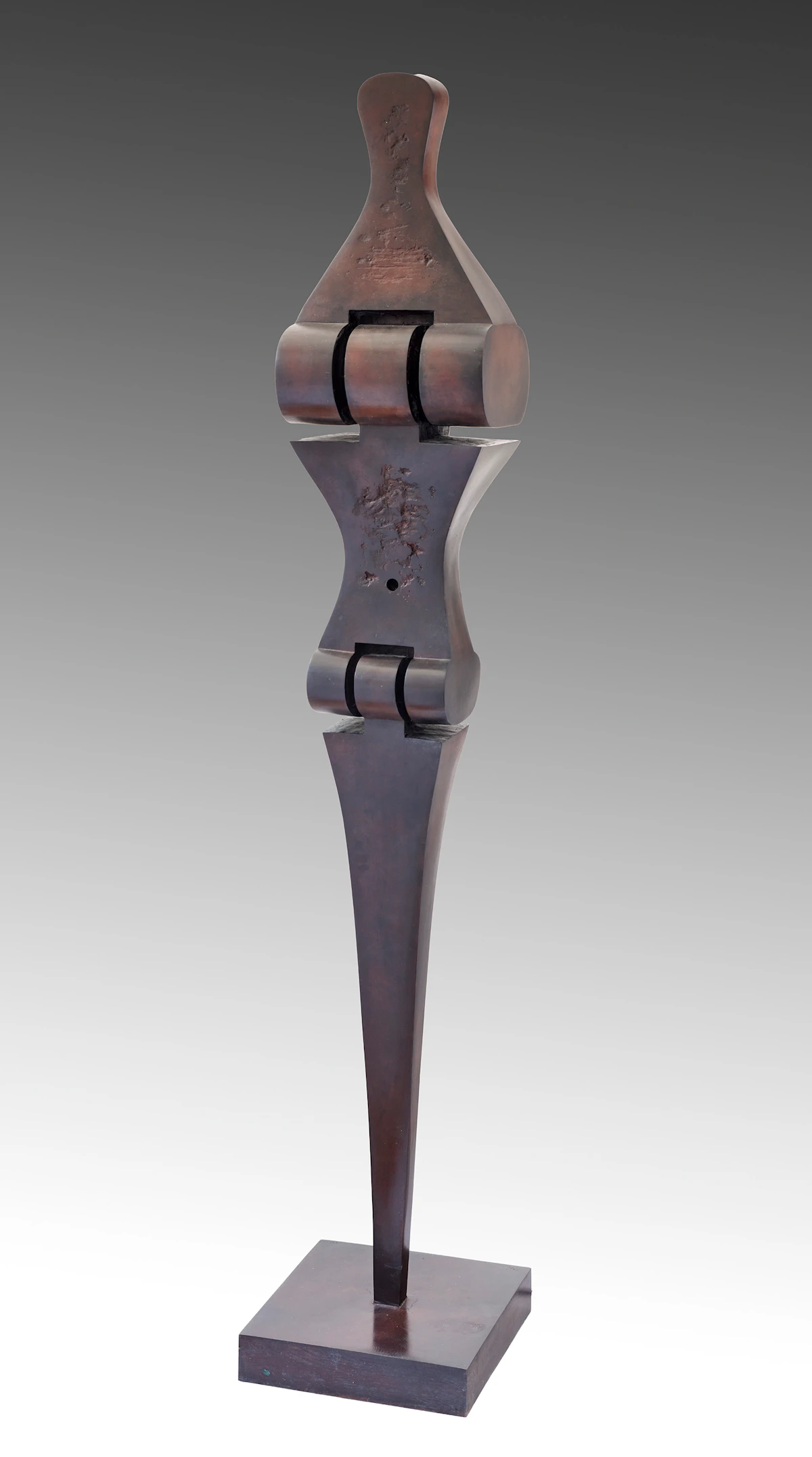
signed (stamped) and numbered 5/7 on the base
69 × 13 × 13 in (175.3 × 33.0 × 33.0 cm)
(including Buyer's Premium)
Acquired directly from the Artist, 1976
Collection of Al Green
By descent to the present Private Collection
Theodore Allen Heinrich, Introduction to Etrog: Painting on Wood/ Sculptures/Drawings, Toronto, 1959, unpaginated
Ihor Holubizky, Sorel Etrog: Five Decades, Art Gallery of Ontario, Toronto, 2013, page 13
The Sorel Etrog Collection at the Hennick Family Wellness Gallery, Toronto, 2016, a similar work illustrated page 50
After the Screw and Bolt series, Sorel Etrog's Hinges period (1973-1979) further simplified the figure, emphasizing its essential geometric forms. Remarking on the inspiration for this new phase in his work, the artist explains: "On a vacation in Israel, visiting my family, I picked up a child's drawing pad and began to draw doodles of flat and organic surfaces connected by hinges. At first, new ideas feel like illegitimate children of the brain. The hinge started to obsess me and so I adopted it." The hinge, writes Ihor Holubizky, functions both as “a tangible link to the European avant-garde between the wars and a hinge to the past, the Mediterranean world of antiquity and non-Western culture; the hinges, metaphorically, bring the past into direct contact with the present." Etrog worked simultaneously in two categories within the Hinges series: Introverts and Extroverts. His Introvert sculptures are geometric abstractions that incorporate hinges. By contract, this lot, "employing hinges as an articulation device" and resembling an active, walking figure "concerned with open space and implied movement", is what he would characterize as an Extrovert.
Standing Figure stands at five feet nine inches tall, with a distinct human-like presence. Its figurative shape makes it a prime example of an Extrovert. A hinge separates the shoulders from the torso, and another hinge separates the hips from the legs. Unlike many of Etrog's Extroverts which appear to be in motion, Standing Figure is an elegant and stoic sculpture, merely suggesting the capability of movement. Describing Etrog's understated yet compelling sculpture, Theodore Allen Heinrich wrote: "[Etrog] has a strong musical sense for rhythms, balances and silence. He has a profound capacity for experiencing and conveying emotion. His work is imbued with poetic fantasy... Above all he has something to say. The adventurous art of Sorel Etrog is centred on increasingly simple but constantly more meaningful form in conjunction with intricately subtle balances of movement, weight and colour."
