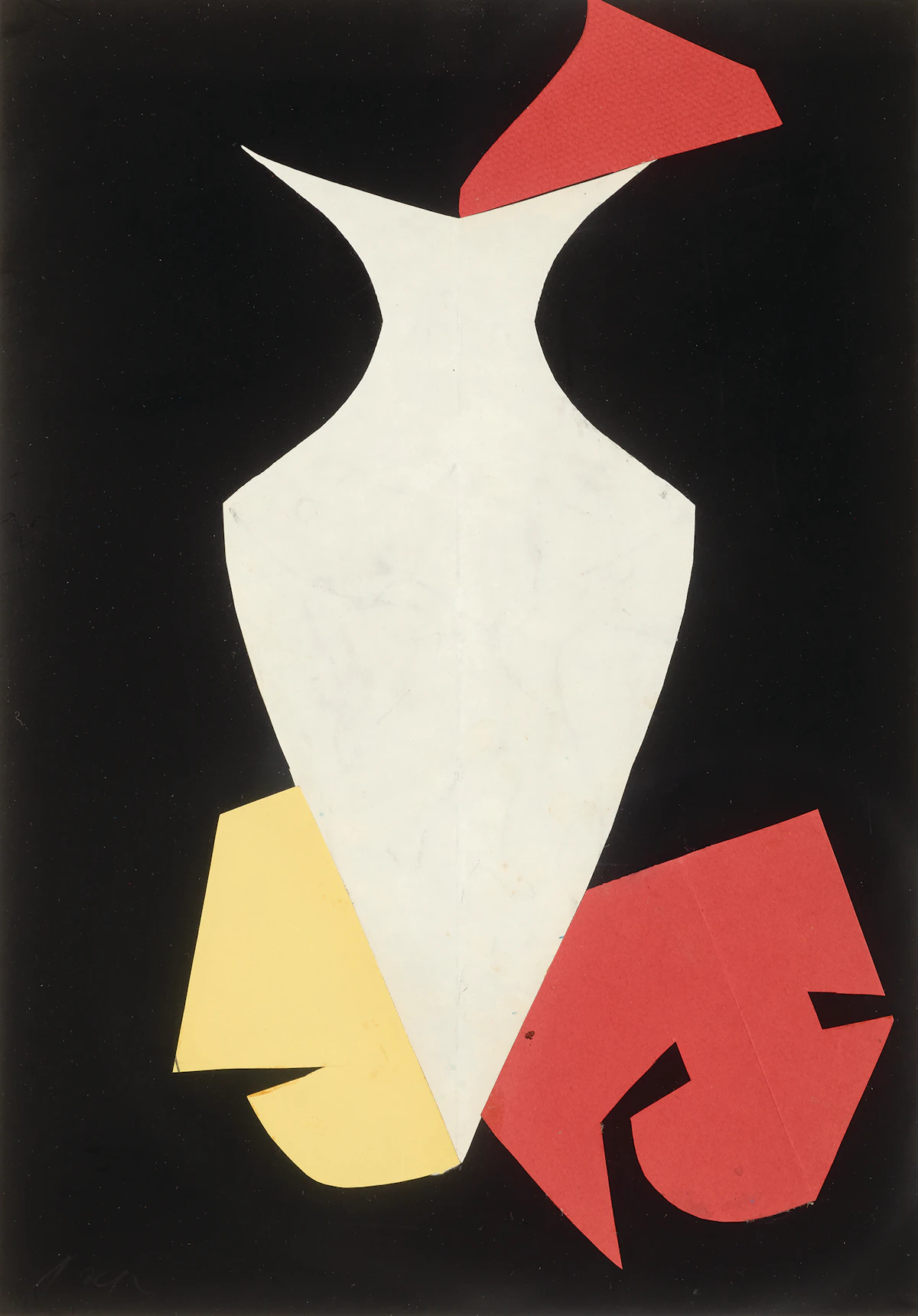
signed lower left; signed, titled and dated 1964 on a label on the reverse
16.25 × 11.25 in (41.3 × 28.6 cm)
(including Buyer's Premium)
Sophie Taeuber-Arp
Harvey Lubitz Fine Art, New York
Elca London Gallery, Montreal
Private Collection, Toronto
Eric Robertson, Arp: Painter, Poet, Sculptor, New Haven and London, 2006, page 74
Jean (Hans) Arp, a founding figure of the Dada movement in Zurich and a pioneer of biomorphic abstraction, transformed twentieth- century art by prioritizing intuition and chance over deliberate design. Throughout his career, he often used collage with cut and torn paper (papiers découpés and papiers déchirés). This method let him eliminate unnecessary detail and create a universal visual language. Amphore et ses ombres reflects the distilled forms of Arp’s mature period and highlights his interest in natural growth and geometric abstraction.
The composition features a central white form, the “amphore,” set against a solid black background. Instead of a literal vase, Arp presents a stylized silhouette that tapers at the base and flares at the top, evoking both anatomical and botanical forms. The white shape interacts with three surrounding elements: a crimson wedge near the upper rim, a muted yellow shape to the left of the base, and a jagged red form with internal cutouts to the right.
Arp’s collages often have a pronounced sculptural quality, both visually and conceptually. Rounded, organic forms suggest volume and physical presence, appearing to extend beyond the picture plane. Rejecting geometric precision, the artist employs smooth, flowing contours reminiscent of eroded stones or abstracted human forms, creating a unique, tactile sense that exceeds flat arrangement.
This sensibility reflects the artist’s broader practice across collage and sculpture, with each medium informing the other. His collages read as configurations of object-like forms, while his sculptures can be seen as material extensions of shapes first explored on paper. Arp’s Amphore et ses ombres bridges two- and three-dimensional art, integrating surface and form while emphasizing balance and organic structure.
The title, Amphore et ses ombres (Amphora and its shadows), encourages a philosophical interpretation. Arp does not depict literal shadows. Instead, he creates conceptual ones—distinct, colourful forms with their own presence. Using flat colour and sharp edges, he explores the relationship between solid and empty space. The black background becomes an active part of the composition and emphasizes the contours of the paper forms.
This collage demonstrates Arp’s ongoing commitment to “concrete art,” which creates new realities rather than imitating the external world. It evokes André Breton’s notions of “objets vides” and “intervalles pleins” while also anticipating what Roland Barthes described as “the infinite withdrawal of the signified.”
This work is from the collection of Sophie Taeuber-Arp, Arp's wife and pioneer of Constructivist art. They met after she attended his 1915 exhibition, and they began a creative partnership that lasted nearly thirty years.
We are grateful to the Fondation Arp for confirming the authenticity of this work.
