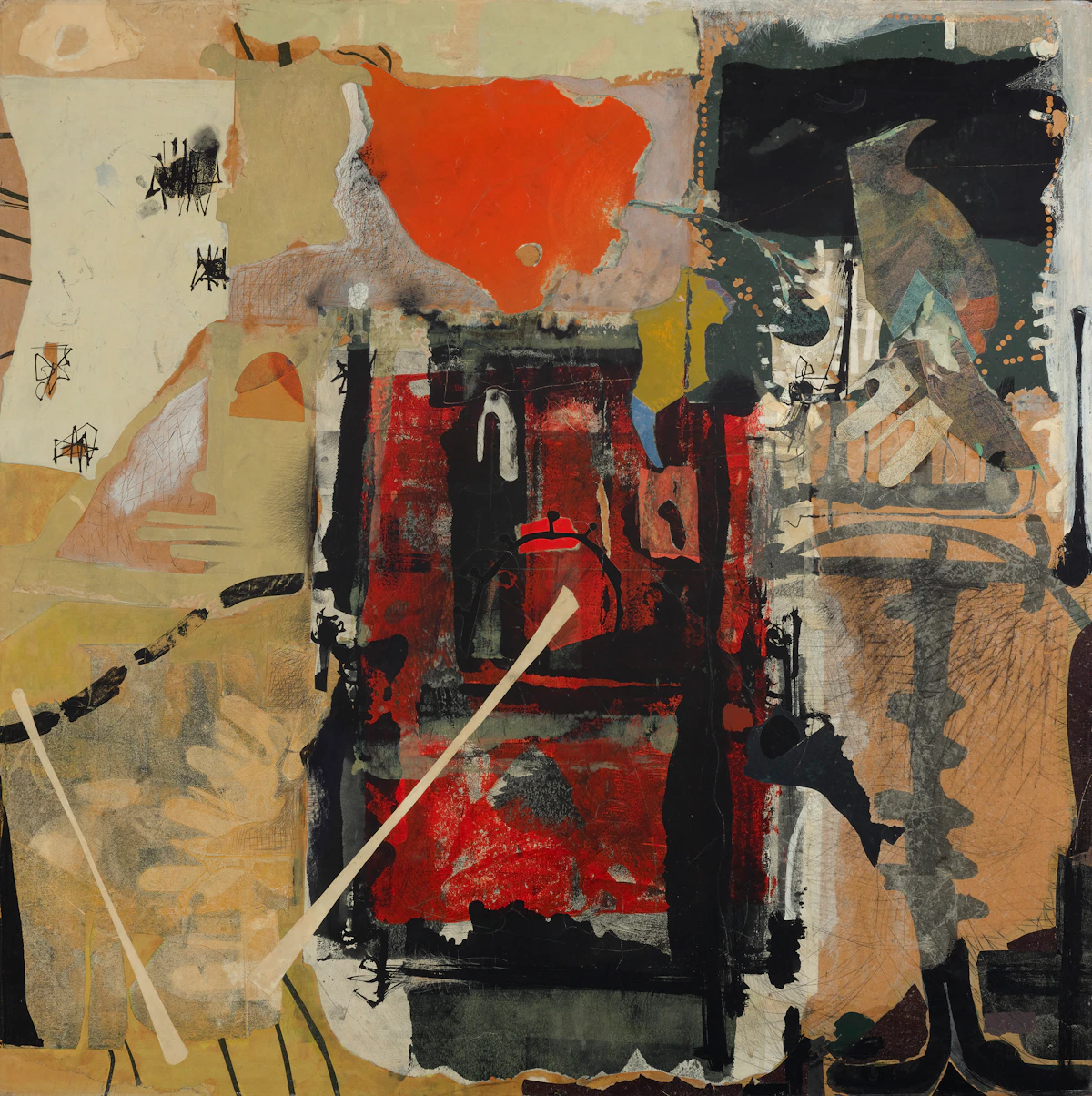
signed and dated "6 24 1957" upper left; signed, titled and dated 1957 on the reverse
49 × 49 in (124.5 × 124.5 cm)
(including Buyer's Premium)
Estate of the Artist, Toronto
Iris Nowell, Toronto
Private Collection, Toronto
The National Gallery Presents: 1958-1959, Painters Eleven, Park Gallery, Toronto, travelling to l’École des beaux-arts, Montreal and the National Gallery of Canada, Ottawa, 1958-1959, no. 25
Fifteen Canadian Artists, Museum of Modern Art, New York, travelling to the Hunter Gallery of Art, Tennessee; Currier Gallery of Art, New Hampshire; Phillips Exeter Academy, New Hampshire; University of Texas, Austin; Washington Gallery of Modern Art, D.C.; Mercer University, Georgia; Columbus Gallery of Fine Arts; Colorado Springs Fine Arts Center; San Francisco Museum of Art; City Art Museum, Saint Louis and Minneapolis Institute of Arts, 1963-7 September 1964, no. 1
Evan H. Turner and William Withrow, Fifteen Canadian Artists, New York, 1964, unpaginated, reproduced, no. 1
The National Gallery Presents: 1958-1959, Painters Eleven, Ottawa, 1959, unpaginated, listed no. 25 as Garden for Sotatsu at $600
Iris Nowell, Painters Eleven: The Wild Ones of Canadian Art, Vancouver, 2010, reproduced page 180 as Garden for Sotastso, 24 June 1957
A compelling early example of Harold Town’s exploration of mixed media abstraction, this 1957 work reflects a pivotal moment in the artist’s career and in the development of postwar Canadian painting. Harold Town came to prominence in the late 1950s. Prolific and inventive, he achieved international recognition while remaining rooted in Toronto. A founding member of Painters Eleven, Town was instrumental in advancing abstraction in Canada, and by the mid-1950s he had begun integrating collage techniques and printmaking processes into his work. Around 1956–57, Town began his famous ‘automatic drawings.’ These works were improvisational and energetic, showing influence of Surrealist automatism but also anticipating the graphic complexity that would define much of his later work.
In Garden for Sotatso, a richly layered surface combines torn and overpainted elements with gestural calligraphic forms. A dominant central structure rendered in deep reds and black suggests an architectural or mechanical presence, set against a field of ochres, creams, and dark tonal contrasts. Town has created a dynamic tension between order and spontaneity, rugged and smooth, opaque and transparent. Garden for Sotatso marks a pivotal moment in Town’s practice, as he begins to shift both his sources of inspiration and his engagement with new media.
