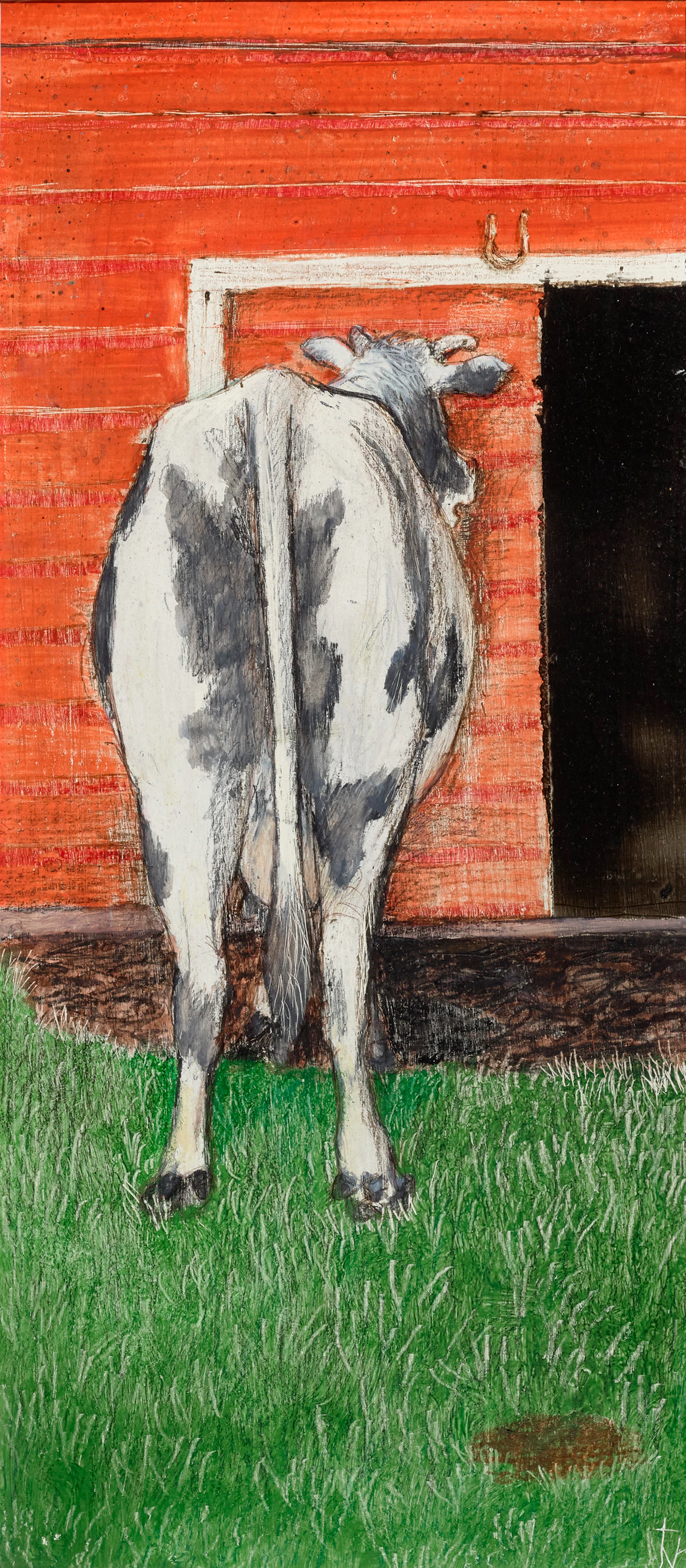
signed with initials lower right; titled on the reverse
12.5 × 5.75 in (31.8 × 14.6 cm)
(including Buyer's Premium)
Acquired directly from the Artist, 1974
By descent to the present Private Collection, Toronto
Andrew Kear, William Kurelek: Life & Work [online publication], Art Canada Institute, Toronto, 2017, page 3
Raised in the rural farming community of Stonewall, Manitoba, during the Depression-when his family depended on dairy farming for survival-William Kurelek developed an intimate familiarity with livestock, especially cattle, that would reappear throughout his work as both subject and symbol. These animals are rarely sentimentalized. Instead, they occupy a complex position within what Andrew Kear describes as the artist's dual vision of "Eden and Hell," where nostalgia and suffering coexist.
In Barbara Bawling for Her Baby, circa 1974, the central image of a cow seen from behind isolated before a darkened barn doorway embodies this tension. The animal is rendered with careful naturalism-complete with cow dung underfoot-yet its posture conveys a palpable emotional weight. The stark red barn and void-like doorway heighten the sense of unease, suggesting abandonment or existential dread rather than pastoral comfort. Kurelek's title introduces the viewer to the subject-a mother cow named Barbara-and casts her distress over the loss of her calf as a deeply felt, almost human sorrow. The removal of newborn calves from their mothers, typically within hours or days of birth, is standard practice in the dairy industry and can cause significant distress to both animals. Kurelek's use of the term “bawling" echoes this natural behaviour, referring to the loud, repeated cries that mother cows make when separated from their young sounds he would have experienced firsthand during his upbringing.
Drawing on memory and lived experience, the scene is an unsentimental portrayal of the harsh realities of farm life, where care, labour, and loss are inseparably bound. Rather than idealizing the rural trade, Kurelek foregrounds the emotional and physical demands of dairy farming, from the routine separation of mother and calf to the ongoing pressures of sustaining agricultural life. In its measured realism, Kurelek neither romanticizes nor overtly condemns but instead offers viewers a clear-eyed view of farm life marked by both necessity and hardship.
