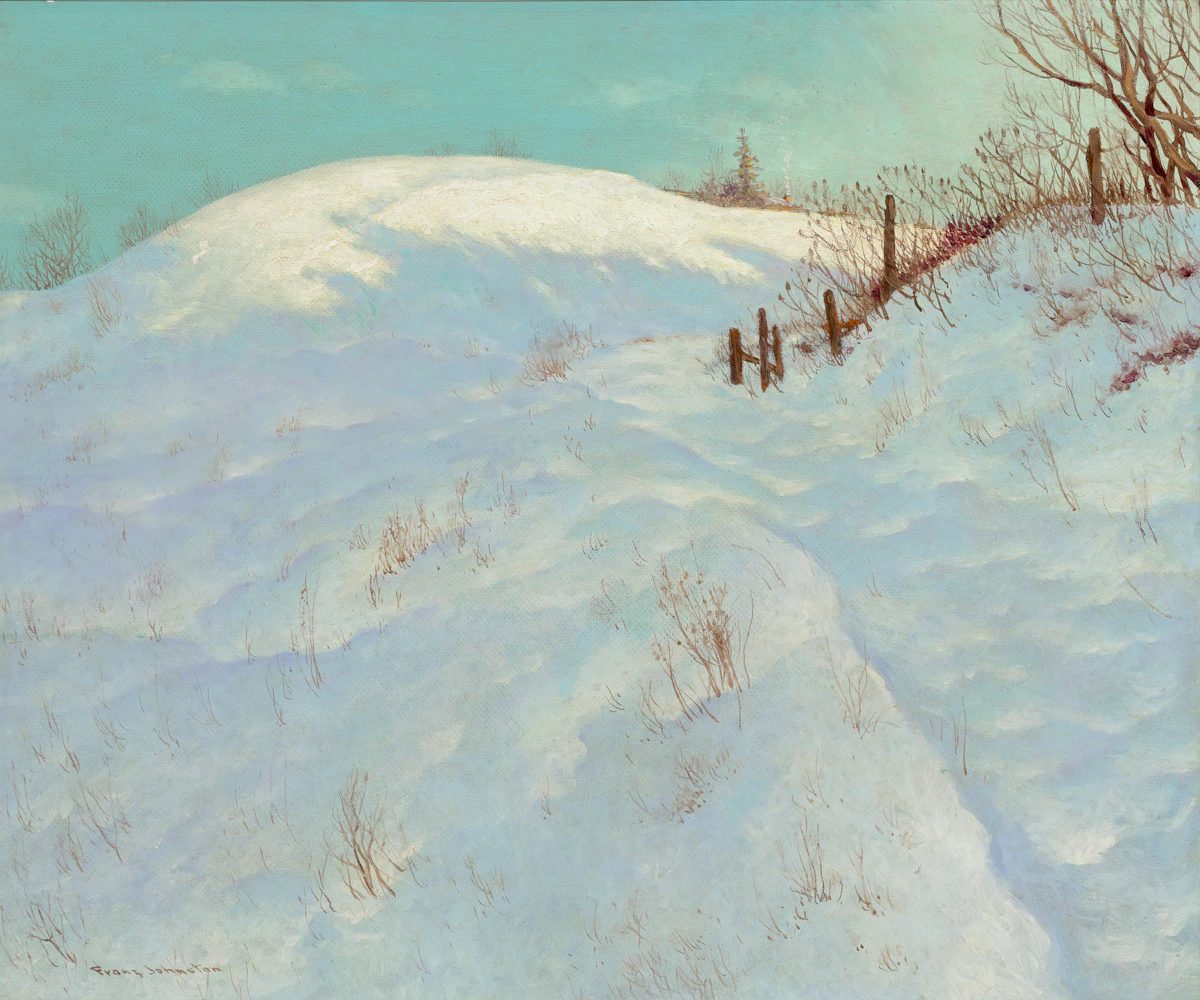
signed lower left; signed, titled and inscribed "an Ontario Hillside" on the reverse
20 × 24 in (50.8 × 61.0 cm)
(including Buyer's Premium)
H. Hutchinson
Mr. and Mrs. F. Benisch
Kaspar Gallery, Toronto
Private Collection, Vancouver, October 1979
By descent to the present Private Collection, Kingston
Group of 7 and Their Contemporaries, Kaspar Gallery, Toronto, October 1979
Frank Johnston’s landscapes, more atmospheric and decorative than those of his fellow Group of Seven members, reflect turn-of-the-20th-century training. This stylistic difference may explain why he participated only in the Group’s first 1920 show. In 1921, he left Toronto to become principal of the Winnipeg School of Art and formally broke with the Group in 1922. As his career evolved, Johnston’s landscapes increasingly reflected his interest in turn-of-the- century ideals, displaying much greater atmospheric and decorative qualities than his fellow Group of Seven members. The Golden Dome is a strong example of the artist's ability to capture the interplay of light, colour and pattern in nature. The setting of a snow-covered hillside lends itself especially well to Johnston’s decorative interpretation of the landscape, due to the effect of shadows and shimmering light reflections.
Johnston was praised for his talent in capturing contrasts between sunlit colour and depths of shade. The Golden Dome showcases the artist’s ability to transform the ordinary into the ornate, as a thick blanket of soft snow envelops the field, with only sparse vegetation emerging through its surface. The only sign of human life appears along the crest of the hill, where a small building sends a plume of smoke from its chimney. The painting’s restrained blue palette is particularly striking, articulating delicate variations in light in the land and sky. Johnston’s romanticization of his subjects continued throughout his career. Even his titles, such as The Golden Dome, lean toward the poetic rather than the literal.
