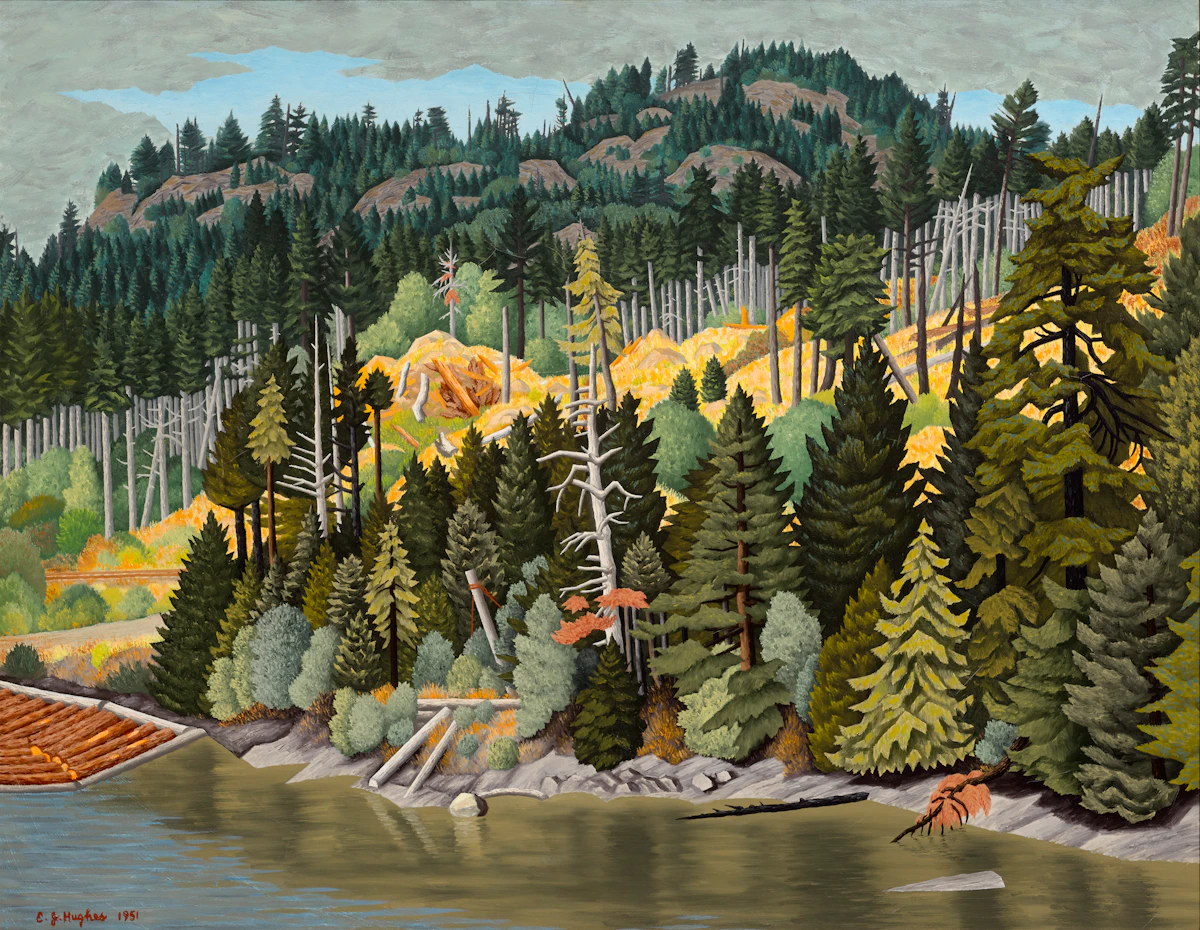
signed and dated 1951 lower left; signed, titled and dated on the stretcher on the reverse; titled "Sooke Harbour" on a gallery label on the reverse; catalogue raisonné no. 0573
25 × 32 in (63.5 × 81.3 cm)
(including Buyer's Premium)
Dominion Gallery, Montreal
Private Collection, Montreal
Gift of Carl Hildebrand, 16 February 1952 to the present Corporate Collection
Letter from Max Stern to E.J. Hughes, 18 September 1952
Joan Lowndes, Vancouver Province (October 6, 1967)
Doris Shadbolt, E. J. Hughes: A Retrospective, Vancouver, 1967, unpaginated
Sooke Harbour Landscape of 1951 is an exciting discovery among the paintings of Edward John Hughes. Created in his early period immediately after his discovery by Dr. Max Stern of the Dominion Gallery, it was soon sold and has remained essentially unknown in a corporate collection ever since.
Max Stern wrote to E.J. Hughes on September 18, l952: “P.S. [I should]mention that [a company] has acquired one of your paintings for one of their buildings... in Montreal. Also the Tower Company has acquired a painting for their office in Montreal. SOOKE HARBOUR, B.C. was sold to the Department of Foreign Affairs.”
The image comes from a period in Hughes’ life which has never been properly described. Lawren Harris was an executor of Emily Carr’s estate after her death in 1945. Many of Carr’s paintings, which were not given to the people of the Province of British Columbia, were sold through the Dominion Gallery in Montreal. The proceeds were used to create the Emily Carr Trust, a scholarship for British Columbia artists. Joseph Plaskett was given the first award in 1946 but, as soon as Hughes was demobilized after his work as a war artist, he was granted the next $1,200 award.
In the spring of 1947 Hughes used some of that money to travel up the B.C. coast to Prince Rupert on the CPR ship Princess Adelaide. The trip resulted in some useful sketches but Hughes found that travelling on a ship was not satisfactory for his purposes. The ship rarely stopped long enough for him to sketch, and he found the presence of the other passengers intrusive. Additionally, he was seasick.
In May of 1948 Hughes and his wife Fern moved to a small house at 1341 Vining Street in the Fernwood area of Victoria. As soon as they were settled, the artist took off on a two-week expedition to Sooke, a small community 35 kilometres west of Victoria along the Strait of Juan de Fuca. Every day a Vancouver Island Coach Lines bus made a round trip to Jordan River, beyond Sooke along the southern coast of the island. It was a gravel road at the time, and provided access for the logging operations and other construction projects which were active in the region. This trip was to be a test for Hughes, to see how he would get along travelling by bus and setting up for a week or two in a single location. This was the only time he sketched at Sooke.
Hughes was in the Sooke Harbour area for about two weeks, staying at the Sunny Shores Auto Court at Saseenos. Remarkably, five tiny cabins dating from 1942 when the campground was established, are still standing at the water’s edge. Since the artist had no car, he walked from there to all his sketching sites. From Sunny Shores, Hughes could hike along the rail line which curved around the Sooke Basin, and a range of prospects opened to him from positions above the shoreline. These days the rail line is gone, and the right-of-way has become part of the Galloping Goose bicycle trail. Access is easy, but as the trees have grown up the sightlines are no longer clear.
In 2015, Robert Amos, the official biographer of E.J. Hughes, visited the waterfront of Sooke and Saseenos in the company of Elida Peers, the founding director of the Sooke Regional Museum. With her deep knowledge of the area, Elida helped locate the sites of almost all the sketches Hughes did there, and the subsequent paintings. At least thirteen pencil sketches resulted, from which he painted oils and watercolours for years to come. At this time he also created three small oils on wooden panels on location, following the tradition of A. Y. Jackson and the Group of Seven. It is reasonable to conclude that he was encouraged to do this by Lawren Harris, who had worked that way himself, and was the driving force behind the Emily Carr Scholarship, which was providing Hughes with backing for the trip.
Subsequent paintings from these sketches in Sooke include:
- A Windy Day at Sooke Harbour, n.d., oil on panel (Private Collection, CR0425.1)
- Above Coopers Cove, n.d., oil (Gifted by E.J. Hughes to his mother, the Barbeau Owen Foundation, CR046)
- Above Coopers Cove 2, n.d., oil (Private Collection, CR0608 )
- Sooke Harbour, B.C., 1951, oil (Collection of the Department of Foreign Affairs, CR0585)
- Sooke Harbour Landscape, 1951, oil (Corporate Collection, CR0573)
- Coopers Cove, Saseenos, 1952, oil (Barbeau Owen Foundation, CR0615)
- Late Afternoon, Coopers Cove, 1953, oil (University of Lethbridge, CR0649)
- Beach at Saseenos, 1955, watercolour (Private Collection, CR0730)
- Coopers Cove, Sooke Harbour, 1962, watercolour (Private Collection, CR0896)
- Above Sooke Harbour, 1962, watercolour (Sir George Williams University, CR0908)
- Looking South over Sooke Harbour, 1966, oil (Private Collection; formerly Torben V. Kristiansen Collection, CR0978 )
Like Sooke Harbour Landscape, the majority of Hughes’ sketches and paintings made during his two weeks in Sooke focus on Coopers Cove, a quiet basin close at hand to Sunny Shores. It was named by members of the Royal Navy survey, which sailed these waters in 1846. This little bay had seen a great deal of industry in the previous century. A plaque along the railway right-of-way explains that The Flowline, a huge project to bring water from the Sooke Reservoir to the city of Victoria in 1912, was centred on this bay. It was also for many years the site of Munn’s Mill, and the shores still held traces of the log dump structures down which the logs and poles from the Sooke Hills were slid. When they hit the water they were gathered in the log booms, which filled the Cove at the time when Hughes sketched it.
The painting Sooke Harbour Landscape shows a log boom on the left. What appears to be a few fallen logs on the shore were identified by Mrs. Peers as the Phillips log dump, “probably not in use in 1948”. Above the shore on the left is the railway line and on the hillside above is a slash pile of leftovers from the logging operation. Rising in the distance are the hills of Mount Manuel Quimper.
Unlike the Group of Seven, Hughes did not romanticize the unpeopled wilderness, nor did he celebrate the industrial might of Canada’s development. He simply looked at what was in front of him and did his best to assemble the forms and colours into a work of art. The rhythmic disposition of the shapes and the beautiful harmonies of tone and colour have come together in Sooke Harbour Landscape to create a deeply satisfying painting of the west coast shoreline.
Well-respected local critic Joan Lowndes reviewed Hughes’ first retrospective show in the Vancouver Province: “Suddenly as you step into the large Emily Carr gallery, you are overwhelmed by the strength of the artist’s forms, by the supernatural quality of his light, and by the intensely personal nature of his vision. That Geiger-counter sensibility which art lovers develop starts to tick furiously. Here is a painter whom we must revalue upwards”.
Curator of that show, Doris Shadbolt, wrote in the catalogue: “There is from the beginning his feeling for clarity, order and precision. And from the beginning the possibility of the hallucinatory super-reality of things which have been held long and hard by the unblinking eye… It is when he takes up his position in the open, painting ‘scenes’ – settings with or without figures and with the action taking place at a distance – that the formal style which we identify with Hughes appears. The hard-edged stone by stone, wavelet by wavelet, blade by blade of grass form of realism, with its pattern distributed rhythmically and equal across the canvas, the carefully balanced sharp contrasts of tone, the flattening areas of unmodulated dense colour, the rather isometric handling of space which causes a shipping dock or a road bed to rear up and spread to its full extent: these are the continuing components of his style… “to make art out of picturesque and popular subjects” he has stated as his intention; or even more modestly “in a matter of fact way to organize nature as well as possible in the rectangle provided.” Hughes knows that in staying so close to nature in its detail and its picturesque habits he is courting banality. But his success lies precisely in not skirting the banal, but in pushing his own inner vision of reality through it. In the resulting tension lies his characteristic quality… it is a particular part of the coast world he chooses; not untouched primeval nature nor nature a subdued backdrop for man’s activities. It is man (as individual) and nature still in vital and meaningful confrontation. They get along together but in a state of mutual resilience.”
After his two-week stay at Sooke, Hughes looked forward to his summer of sketching with confidence. In June he made day trips to Sidney, north of Victoria, and then planned a major adventure travelling up the east coast of Vancouver Island as far north as Courtenay. The drawings which he made on that trip were the foundation of his future career.
We extend our thanks Robert Amos for contributing the preceding essay. Robert is the offical biographer of E.J. Hughes and is compiling the catalogue raisonné of this artist's work.
