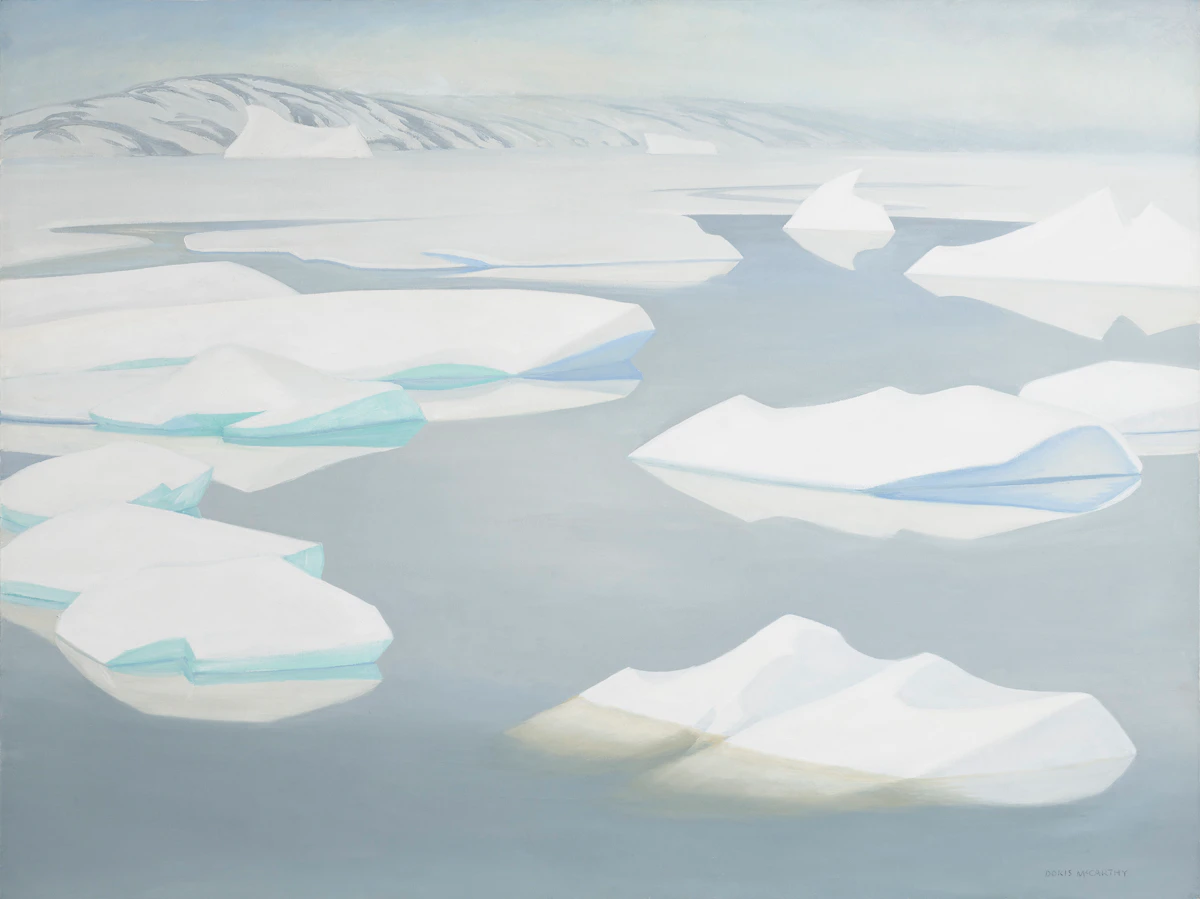
signed lower right; dated "810731" (31 July 1981) on the reverse; titled and dated to a gallery label on the reverse
36 × 48 in (91.4 × 121.9 cm)
(including Buyer's Premium)
Aggregation Gallery, Toronto
Private Collection, Toronto
Doris McCarthy, Doris McCarthy: Ninety Years Wise, Toronto, 2004, page 63
Doris McCarthy’s Grey Fog Arctic belongs to a mature phase of the artist’s career, when decades of travel and observation culminated in a refined and personal vision of the Canadian landscape. Throughout her life, McCarthy was driven by a desire to paint the varied regions of Canada, developing a style responsive to each environment she encountered. The Arctic proved especially transformative.
Beginning in 1972, McCarthy returned repeatedly to the north, travelling over five consecutive years to Cape Dorset, Frobisher Bay, Pangnirtung, Resolute Bay, Arctic Bay, and Pond Inlet. These expeditions continued through the 1980s and 1990s, extending across the Yukon and Arctic regions to Greenland, Inuvik, Holman Island, Paulatuk, and Sacks Harbour, sharpening her sensitivity to the north’s quiet luminosity and the elusive tonal shifts of ice and atmosphere.
The composition unfolds in a broad horizontal field, with icebergs dispersed across a calm, fog-laden sea. The ice floes drift along the canvas as gently contoured, sculptural forms—pared down to their essential geometry. Their surfaces seem to absorb and release light, articulated through a spectrum of soft greys, veiled whites, and glacial blues. These subtle tones evoke both the density and translucency of ice, allowing it to appear at once solid and dissolving. Unlike the monumental Arctic visions of Lawren Harris, McCarthy’s approach is intimate and atmospheric. The fog flattens depth and softens edges, producing a quiet, suspended space that resists dramatic interpretation. This restraint reflects the artist’s departure from the heroic nationalism of earlier Canadian landscape painting, toward a contemplative rendering of the natural world.
Although McCarthy’s landscapes are not overtly religious, they are deeply imbued with a sense of reverence. A devout Christian, McCarthy often described her engagement with nature as a way of encountering the divine: “The mystery of creation convinced me that God was immanent as well as transcendent in the rocks, the trees, the animals and me—still creating but not exercising the authority I had once believed.” The absence of human presence shifts the focus to stillness and quiet, transforming this Arctic scene into a space for meditation. The fog plays a particularly important role in this regard. Rather than presenting the Arctic as a place of stark clarity, McCarthy renders it as elusive and transient, where perception slows, forms soften, and meaning emerges through careful looking.
In its quiet restraint and atmospheric subtlety, Grey Fog Arctic aligns with McCarthy’s broader artistic goal of conveying the lived experience of a place—its shifting light, weather, and mood—transforming the Arctic landscape from merely observed terrain into a contemplative space imbued with presence, humility, and wonder.
