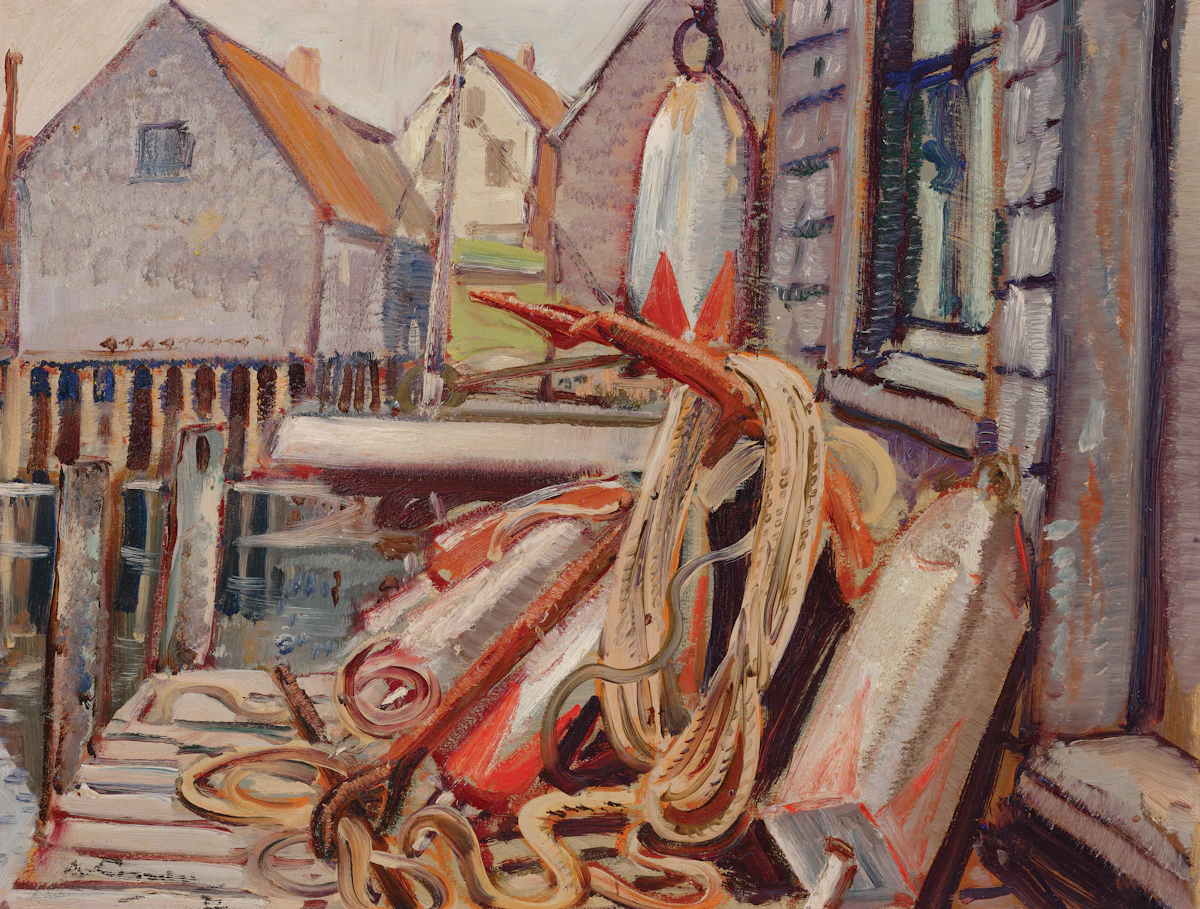
signed and dated indistinctly lower left; signed, titled and dated indistinctly 193[?] on the reverse
12 × 15 in (30.5 × 38.1 cm)
(including Buyer's Premium)
Alex Fraser Galleries, Vancouver
A Distinguished Private Collection, Vancouver
Heffel, auction, Toronto, 31 October 2024, lot 515
Private Collection, Calgary
During the 1930s, Arthur Lismer travelled along Canada’s eastern seaboard, sketching harbours, fishing communities, and maritime industries. In Lismer’s Seal Cove, Grand Manan, N.B., the clustered wooden buildings, wharves, and fishing gear evoke a site that, around 1930, was at the height of its economic activity, with structures and labour practices closely integrated into the coastal landscape.
Seal Cove on Grand Manan, an island in the Bay of Fundy, is a small community historically known for its smoked herring fishery. By the late nineteenth and early twentieth centuries, the island had become one of the world’s major producers of smoked herring, and the shoreline at Seal Cove was lined with dozens of small smokehouses used to cure and export fish to markets in the United States, the Caribbean, and Europe. Many of these buildings stood densely arranged along the tidal inlet on wooden stilts, accommodating the dramatic rise and fall of the Fundy tides. At the industry’s peak, entire families participated in the work: fishermen harvested herring offshore, while women and children split, salted, and strung the fish.
Lismer’s choice of subject aligns with a broader Canadian modernist interest in regional identity, but here the emphasis shifts from untouched nature to a vernacular, working environment shaped by human hands. Rather than rendering the scene with photographic clarity, Lismer simplifies and distorts shapes—boats, ropes, and buildings twist into rhythmic, almost animated lines. Thick, directional brushwork and an earthy palette—punctuated by "ashes of red and ochre—create a sense of tactile immediacy, suggesting both the materiality of the fishing equipment and the hard labour that shaped this small coastal community.
Through its expressive distortions and emphasis on the rugged vitality of maritime life, Seal Cove, Grand Manan, N.B., transforms a specific maritime locale into a broader meditation on environment, labour, and national identity in early twentieth-century Canadian art.
