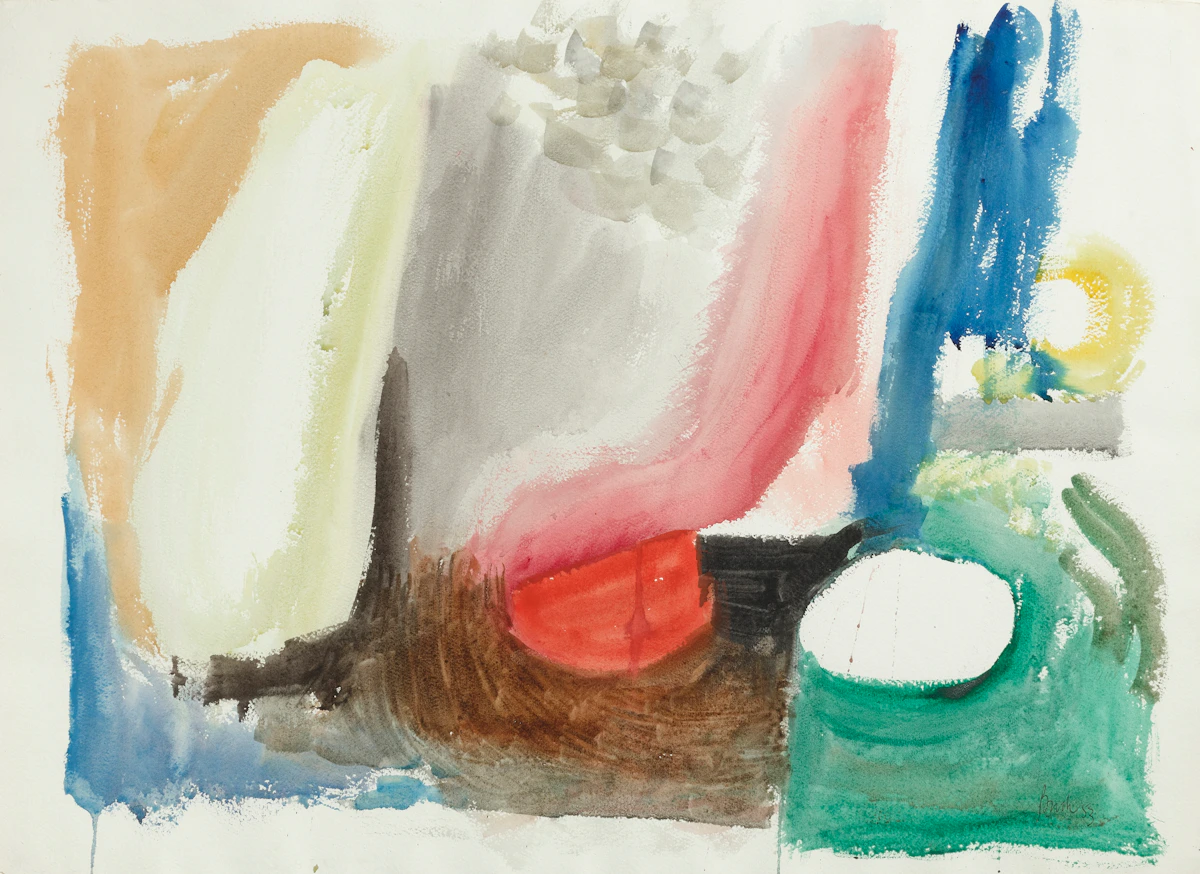
signed and dated 1953 lower right; titled, dated and inscribed “Lake of Bays” on a label on the reverse of the frame; titled on two gallery labels on the reverse of the frame; catalogue raisonné no. 1.190.1953.195
22.75 × 31.25 in (57.8 × 79.4 cm)
(including Buyer's Premium)
The Artist (April 1953-1974)
Estate of Jack Bush
Grace Borgenicht Gallery, New York
William McWillie Chambers III, New York
R. David and Annette Raddock, Colorado
Heffel, auction, Toronto, 25 March 2010, lot 13
Cosmo Barranca
Waddington's, auction, Toronto, 18 November 2019, lot 85
Collection of Joan Murray, Whitby, Ontario
By descent to the Collection of Adam & Shannon Murray, Victoria
Jack Bush, Early Work, Art Gallery of Ontario, Toronto, 1985, no. 65
Jack Bush: Selected Works, 1930-1976, Grace Borgenicht Gallery, New York, 1988
Jack Bush: The Decade of Discovery 1952-1962, Miriam Shiell Fine Art, Toronto, 1996
Modernist Paintings, La Parete Gallery, Toronto, 2011
Christine Boyanoski, Jack Bush: Early Work, Toronto, 1985, pages 27, 28, reproduced pages 24 and 73
Jack Bush: Selected Works, 1930-1976, New York, 1988, unpaginated, reproduced
Jack Bush: The Decade of Discovery 1952-1962, Toronto, 1996, unpaginated, reproduced
Modernist Paintings, Toronto, Fall/Winter 2011, unpaginated, reproduced
“Annette and David Raddock Residence,” The Denver Post, 16 December 2011
Sarah Stanners, Jack Bush Paintings: A Catalogue Raisonné, Volume 1: 1920-1954, Toronto, 2024, reproduced page 439, no. 1.190.1953.195
Jack Bush's striking Pleasant Day, executed in August 1953, is a key in Bush's body of work to his evolution from representational to abstract art. Executed on a breezy day at Lake of Bays, where the Bushes summered in the fifties, this watercolour is rooted in land and seascape, and specifically, spatial depth. Seemingly simple, it is abstractly complex, informing the viewer in oblique ways about the day and about Bush himself.
In her catalogue raisonné of the artist, Dr. Sarah Stanners suggests that the shapes of sailboats appear but gestures, as in his paintings Sailboats and Lake of Bays. Simplified floating forms and colours were becoming increasingly free from the shapes Bush had derived them from. A 1997 survey exhibition organized by the Art Gallery of Algoma, Hymn to the Sun, Early Work (inspired by the title of a painting by Bush), noted the sun motif in the artist's practice. The source of this fascination with the red sun likely came from the hymn, Every Morning the Red Sun. First published in 1848, the sun was used as a metaphor for the human spirit.
From 1947 to 1948, Bush often used the image of the red sun in response to midlife crisis and depression; however, having undergone therapy by 1953, Bush was coming closer as he proceeded towards abstraction, his real red sun. Here, Bush is commenting on his pleasant day or perhaps illustrating here, the essence of a pleasant day as in the weather proverb, "Red sky at night, sailors delight. Red sky in the morning, sailors take warning".
Bush used the medium of watercolour, which he loved, in a number of works on paper to show the influential critic Clement Greenberg who visited his studio in Toronto in 1957. Greenberg admired them and suggested using them "to go towards his strengths." Bush concentrated on applying an all-over coverage of thinly applied bright colour. He began to make large, thinly brushed paintings exploiting enlarged versions of his characteristic "handwriting" his own highly personal colour and so-called "depicted shapes." By 1958, he felt he had achieved his "breakthrough," as he titled one painting of that date which is in the collection of The Robert McLaughlin Gallery, Oshawa. His watercolours, therefore, document his change "towards the light-his later paintings.
Pleasant Day is one of the best illustrations of this transformation and was selected by the Art Gallery of Ontario to illustrate these changes in his work in its publication about his early work in 1985, Jack Bush: Early Work. As Christine Boyanoski wrote, that Bush was already headed toward abstraction is clear. Greenberg "may only have hastened the process by giving Bush the nod and confirming his chosen direction". David and Annette Raddock, who are listed among the distinguished owners and galleries who once owned or handled the work, were collectors of important though modest-scale works, often on paper, by such notable artists as Joan Miró, Milton Avery, Lee Krasner, Joan Mitchell and Antoni Tàpies.
We extend our thanks to Joan Murray, Canadian art historian, for contributing the preceding essay.
