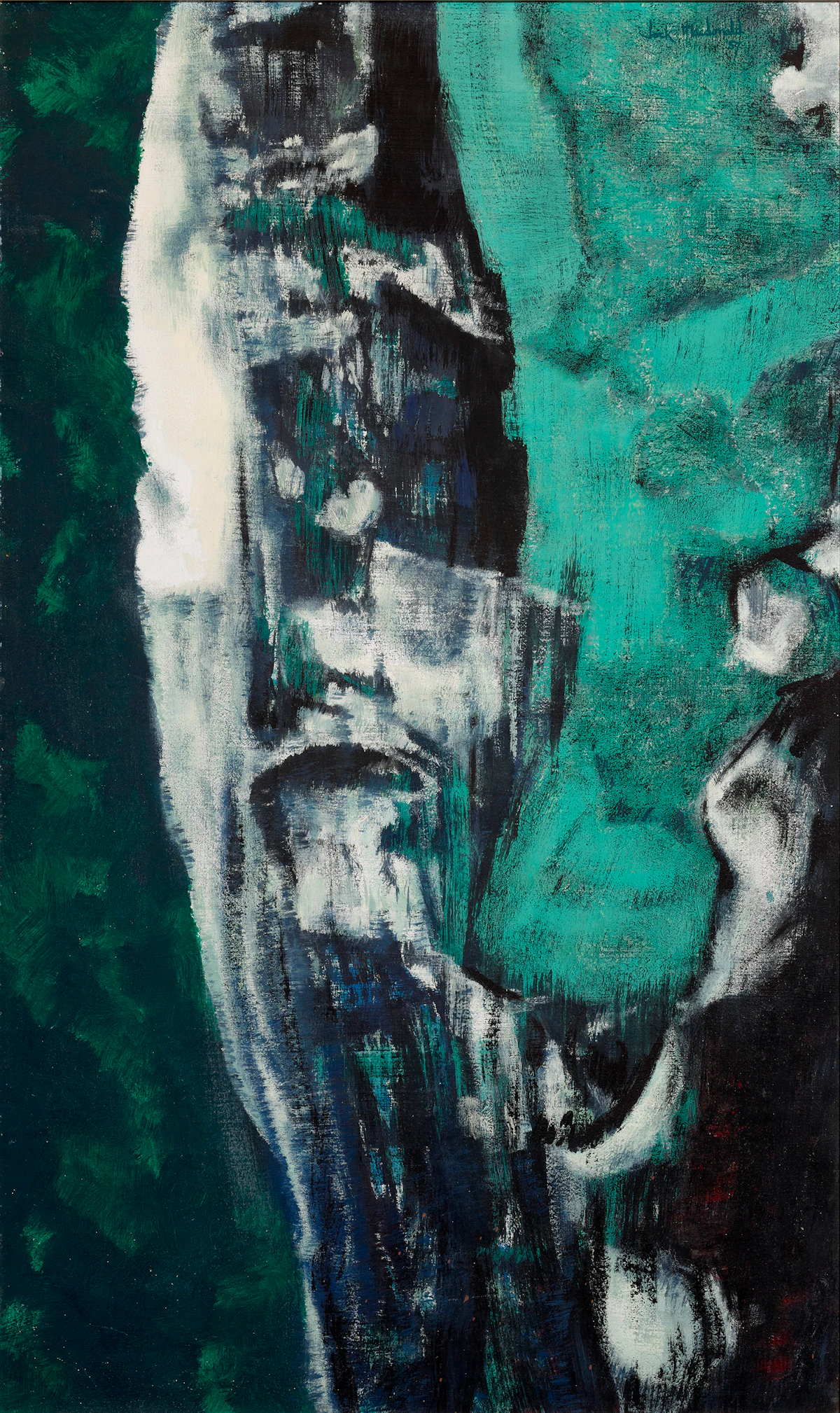
signed and dated 1957 upper right
48 × 29 in (121.9 × 73.7 cm)
(including Buyer's Premium)
The Artist
Mr. and Mrs. Avrom Isaacs, Toronto, 1960
The Isaacs Gallery, Toronto, 1978
Mae and William S. Nurse, Whitby
Collection of Joan Murray, Whitby, 2019
By descent to the Collection of Adam and Shannon Murray
Painters Eleven, The Park Gallery, Toronto, 31 October-16 November 1957, no. 18
Painters Eleven, École des beaux-arts, Montreal, 3-23 May 1958, no.
18
The National Gallery Presents: 1958-1959, Painters Eleven, Park Gallery, Toronto, travelling to l'École des beaux-arts, Montreal and the National Gallery of Canada, Ottawa, 1958-1959, no. 18
Jock W. G. Macdonald: A Retrospective Exhibition, Art Gallery of Toronto, May 1960, no. 25
Painters Eleven in Retrospect, The Robert McLaughlin Gallery, Oshawa, travelling to The Gallery/Stratford; Art Gallery of Windsor; London Regional Art Gallery; Agnes Etherington Art Centre, Queen's University; Hart House Gallery, University of Toronto; Sir George Williams Art Galleries, Concordia University, Montreal; Beaverbrook Art Gallery, Fredericton; Art Gallery of Nova Scotia, Halifax; The Saskatoon Gallery and Conservatory Corporation; Kitchener-Waterloo Art Gallery and Macdonald Stewart Art Centre, University of Guelph, 30 October 1979-30 November 1981, no. 26
Jock Macdonald and F.H. Varley: Friends, The Frederick Horsman Varley Art Gallery, Markham, 1 April-27 June 2004
Abstracts at Home(s), The Robert McLaughlin Gallery, Oshawa, 21 September 2007-21 September 2008
The National Gallery Presents: 1958-1959, Painters Eleven, Ottawa, 1959, unpaginated, listed no. 18 as North Wind at $600
Paul Duval, "Artist's Honor and Challenge," Toronto Telegram (7 May 1960)
Joan Murray, Painters Eleven in Retrospect, Oshawa, 1979, no. 26, reproduced
In North Wind, one of Jock Macdonald's most beautiful works, Macdonald painted what he conceived of as inconceivable: wind which is, after all, an unseen force. North Wind evokes what British astrophysicist Sir James Jeans used as the title of his book, The Mysterious Universe (first published in 1930), the deep mystery of the fundamental substance of the universe, unseen by mortal eyes but powerful.
Macdonald had come to create this work through a long process of experimentation and thought. In 1943, in Vancouver, he had begun experimenting in depth with 'automatism', "by which is intended to express... the real process of thought" (First Surrealist Manifesto), influenced by the British Surrealist artist and psychologist Dr. Grace Pailthorpe, who had arrived in the city that year with her partner, Reuben Mednikoff. Using her methods, he hoped to discover nature's hidden laws and to convey his feelings and intuitive impressions. For these works, usually small, he used the watercolour medium.
In 1947, when he moved to Toronto from Calgary, to teach at the Ontario College of Art, he remained committed to automatic expression. His work began to evolve to larger, bolder watercolours and to oils, but the latter medium did not offer the fluidity he wanted.
Studying with Hans Hofmann in 1948 gave Macdonald a chance to reformulate his thoughts. He gradually developed abstraction in his larger paintings, aided by conversations with Jean Dubuffet in France in 1955 (he told Macdonald to make his paintings more like his watercolours), but it was only in 1957, that Macdonald developed a new and "abstract" interpretation of space in oil.
Harold Town had told him to use Lucite 44 (a new solvent-borne acrylic resin) mixed with oil in his paintings and the medium allowed him to paint with "a flow" more like watercolour, as Macdonald wrote his friend, artist Maxwell Bates. He also gained confidence from a visit to Toronto by the major New York art critic Clement Greenberg, who critiqued his work and that of several other members of Painters Eleven.
Using Lucite, Macdonald created his most important works and he used the new medium along with "straight" oils until his death in 1960. Paintings such as North Wind, Flood Tide, Airy Journey, and Iridescent Journey, all done in 1957, demonstrate the huge change that had taken place in his work. Composed of seemingly shifting planes and interlocking areas of colour, they give an increased effect of freedom. The forms too, as in North Wind, are more imposing, the canvas size much larger.
Macdonald used the oblong shape of North Wind in only a few other paintings that year, most notably in Real as in a Dream, which like North Wind, concentrates on a powerful, central image. The images come alive primarily through colour and through the tension established between the seemingly fluid shapes. The effect suggests growth and life and may refer to one of Macdonald's teaching methods at the Ontario College of Art, where he liked to surprise students with slides of forms under the microscope.
The title, as with many of Macdonald's works of this and later dates, suggests something insubstantial, transitory, and difficult to convey, because in these works, he sought to show the new discoveries of science in his era. He wanted to indicate the exploration of the atom, the cosmos, the analogous patterns between small and large, and the continuity of order throughout the universe.
Thus, he might use the images of the slides taken under the microscope in his work, believing that they corresponded to larger patterns of matter. He made the forms real using mostly muted colour and shape, as in North Wind, here turquoise, white and black.
Critics noted the painting's importance and beauty. In his review of the exhibition in the Toronto Telegram, the notable art critic Paul Duval praised it, along with Slumber Deep (Art Gallery of Ontario), calling them “admirable" pictures.
The work was shown in Macdonald's retrospective at the Art Gallery of Ontario in 1960 and was owned by the prestigious Toronto art dealer Avrom Isaacs and his wife, Norma Renault. Isaacs told curator Joan Murray that he felt it contributed to his decision to be an art dealer and not just a framer. Owning it, he said, made him realize the potential in modern art.
We extend our thanks to Joan Murray, Canadian art historian, for contributing the preceding essay.
