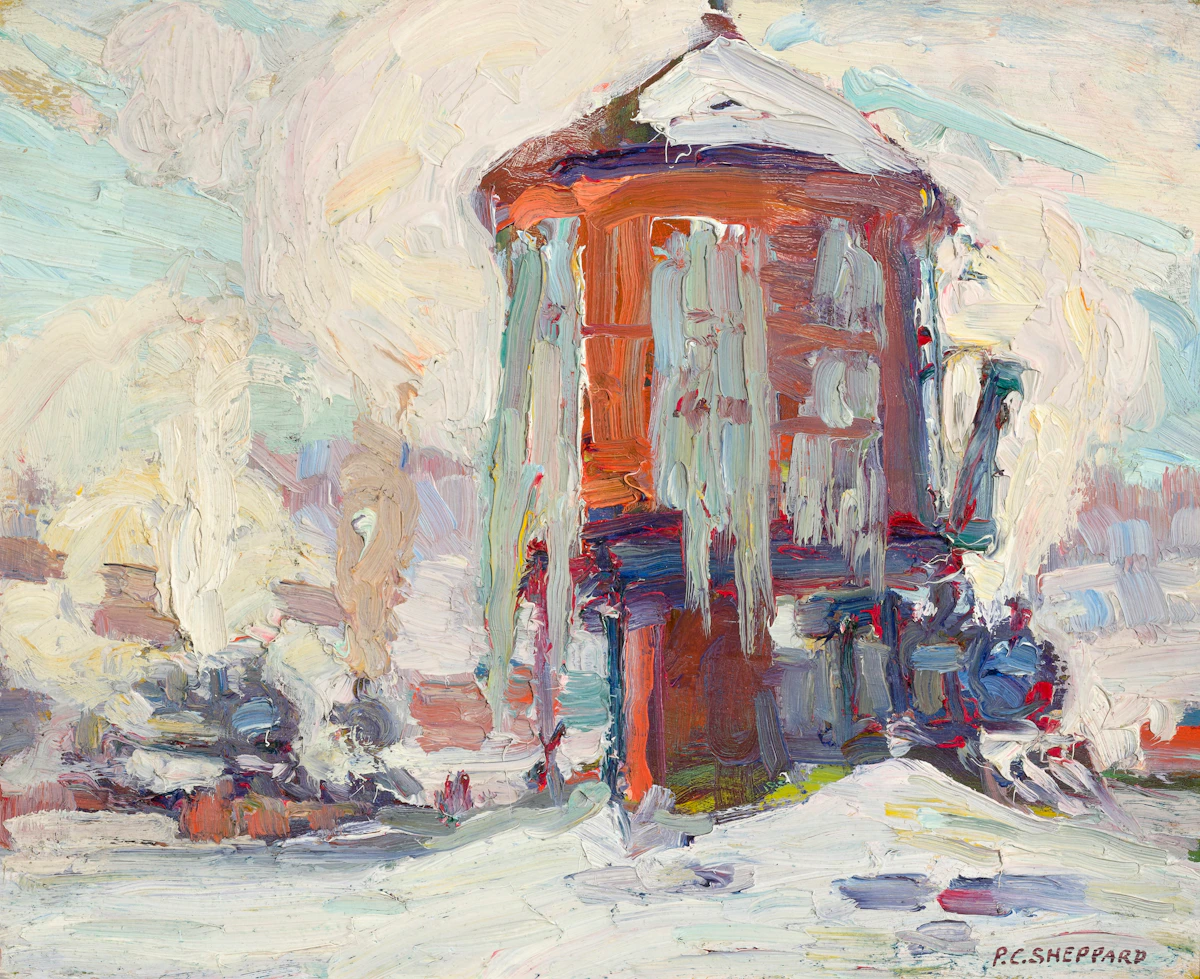
signed lower right; titled and dated 1912 on a label and estate stamp (LG033) on the reverse
8.25 × 10.25 in (21.0 × 26.0 cm)
(including Buyer's Premium)
The Estate of the Artist
Private Collection, Toronto
Defiant Spirits: The Modernist Revolution of the Group of Seven, McMichael Canadian Art Collection, 2 October 2010-30 January 2011
Tom Smart, Peter Clapham Sheppard: His Life and Work, Richmond Hill, 2018, reproduced page 63
In the winter of 1912, Peter Clapham Sheppard ventured to Toronto’s industrial waterfront near the foot of Bathurst Street. Crisscrossed by railway sidings and dominated by the vast cylinders of the Toronto Gas Works, the site was hardly picturesque. Gasometers, lumberyards, foundries and carriage works stood on land recently infilled along Lake Ontario. Yet for a young artist intent on staking a claim to modernity, such motifs offered potent possibilities.
Then thirty-two and trained at the Central Ontario School of Art and Industrial Design, Sheppard belonged to a generation alert to new artistic imperatives. Across Europe and Britain, critics were urging painters to abandon historical reverie in favour of contemporary life. Industrial structures—railway tracks, smokestacks, gasometers— became emblems of a new aesthetic. To set up one’s easel amid steam and coal smoke in 1912, and to treat industry as worthy of artistic contemplation, was to announce oneself a modernist.
The early twentieth century had been a period of explosive growth for Toronto, which more than doubled its population between 1900 and 1912. This transformation, with the construction of skyscrapers, factories and infrastructure projects, became the subject of a small but significant body of painting of which Sheppard would be the leading exponent. In Toronto this aesthetic choice carried an added resonance. Since Confederation, factories and locomotives had been celebrated as engines of national progress. Smoke signified prosperity, while steam implied momentum and ambition. To paint the industrial waterfront was to engage, however obliquely, in a patriotic act.
Sheppard may have been accompanied on this plein air expedition by two other young painters, Lawren Harris and J.E.H. MacDonald, future members of the Group of Seven. Around this same time, they painted their own industrial scenes along this stretch of waterfront: Harris produced The Gas Works; collection of the Art Gallery of Ontario; (setting the massive form beyond a foreground of modest houses) while MacDonald’s Tracks and Traffic (sold by Cowley Abbott, 22 November 2016) featured a dark locomotive crossing the snow- laden yard. Together with Sheppard’s interpretations, these works suggest that, on Toronto’s lakeshore in 1912, a distinctly Canadian modernism was announcing itself.
Rather than depicting the vast telescopic gasometer that dominated the Toronto skyline, Sheppard focused on part of the retort house complex —a cylindrical ventilator drum or small governor holder associated with the production and regulation of coal gas. This was the functional core of the plant, and Sheppard’s choice indicates how he was drawn to the industrious, heat-filled heart of modern manufacture itself.
The painting exemplifies Sheppard’s plein air practice, its surface alive with swift, assertive brushwork and passages of loaded impasto. Form is constructed through abbreviated strokes that privilege sensation over description, capturing the structure’s mass and atmosphere with immediacy rather than topographical precision. Thickly laid paint—sometimes dragged, sometimes pressed—creates a tactile surface of distinct, unblended marks. Particularly striking are the pale vertical strokes that suggest icicles forming along the eaves and walls, a credible winter effect on a heat-generating retort structure where escaping vapour would freeze on contact with the cold air. The result is less a record of architecture than an evocation of light, vapour and cold air in motion.
We extend our thanks to Ross King, art historian and author of Defiant Spirits: The Modernist Revolution of the Group of Seven, for his assistance in researching this artwork and contributing the preceding essay.
