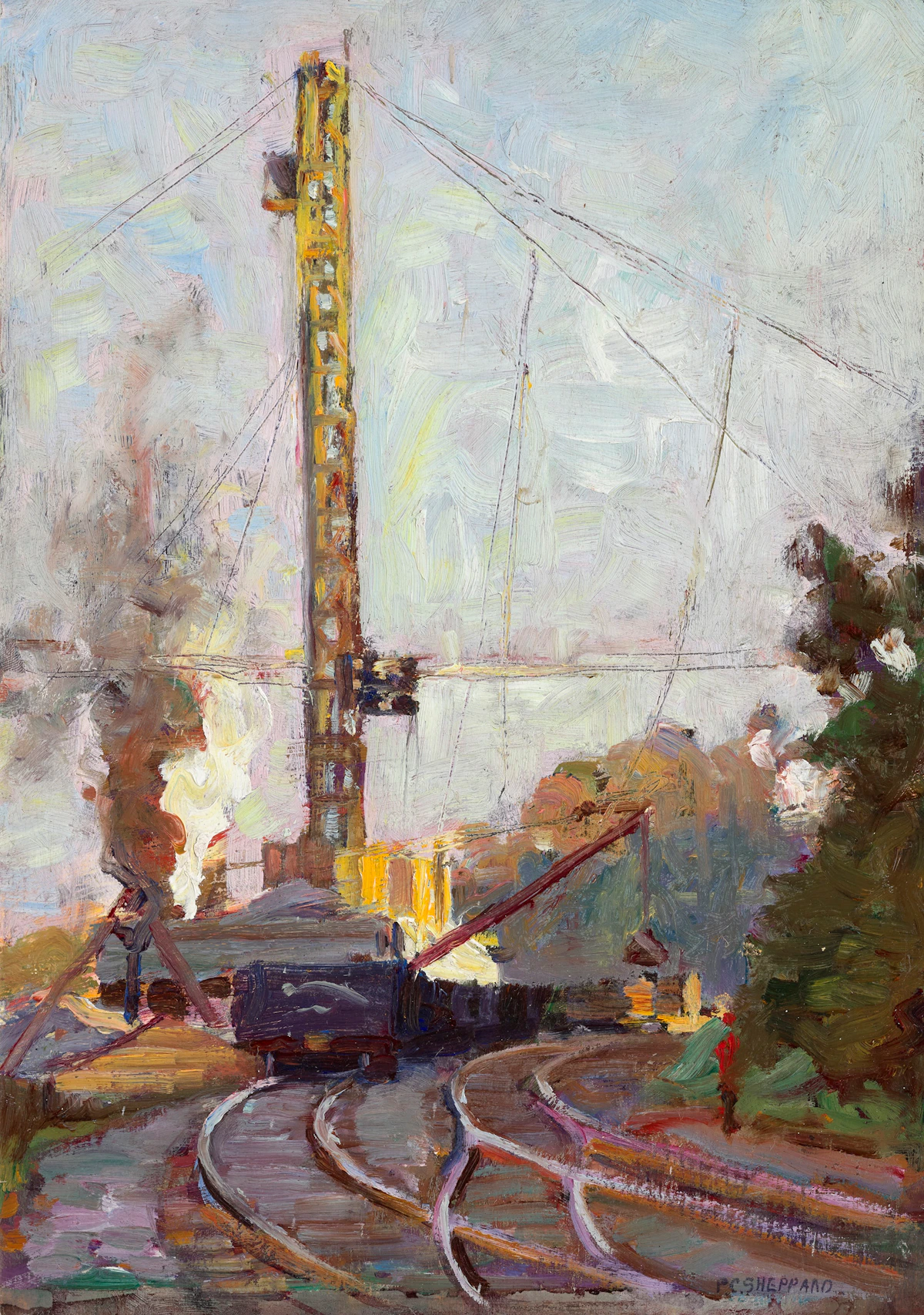
signed lower right; estate stamp (LG097) on the reverse
13.5 × 9.75 in (34.3 × 24.8 cm)
(including Buyer's Premium)
Estate of the Artist
Private Collection, Toronto
Tom Smart, Peter Clapham Sheppard: His Life and Work, Richmond Hill, 2018, reproduced page 104
Peter Clapham Sheppard displayed a fascination throughout his career with the architecture and apparatus of the modern city, whether in Toronto, Montreal or New York. Gasworks and locomotives, skyscrapers and shacks, freighters and tugboats—these were the recurring protagonists of many of his works.
It was therefore almost inevitable that he would turn his attention to the Bloor Street Viaduct as it began spanning the Don Valley in 1915. Few infrastructure projects better embodied Toronto’s urban ambitions. Authorized by referendum in January 1913, the viaduct represented Toronto’s most audacious municipal undertaking to date. For years the Don Valley had formed a formidable natural barrier east of downtown. The proposed bridge promised to bind the historic core to the rapidly suburbanizing east end and to facilitate the movement of workers, goods and services across the widening metropolis.
Construction began on June 16th, 1915. Conceived as a multi-deck truss-arch structure in reinforced concrete, the viaduct was celebrated as a bold feat of modern engineering. Its central span—approximately 85.8 metres (281.5 feet) across the Don—soared above the valley floor, while additional sections extended westward over the Rosedale Ravine and eastward toward Danforth Avenue. Opened in 1919, the viaduct was an assertion that Toronto was a modern city, capable of mastering its geography and shaping its own urban destiny.
The massive construction site offered everything that appealed to Sheppard’s modern eye: the restless geometry of cranes pivoting above the ravine, cables strung in taut diagonals, skeletal pylons climbing upward from concrete footings. He painted several oil sketches of the site as well as at least one large canvas in 1915, The Bridge Builders, Construction, Bloor Street Viaduct (sold by Cowley Abbott in May 2025).
In this sketch, as in his other industrial scenes, Sheppard responded not merely to the structure itself but to what it represented: energy, expansion and optimism. He constructed the composition through sweeping, sinuous railway tracks whose converging lines accelerate the viewer into the heart of the construction site. A string of open-topped freight cars curves along the rails, reinforcing the sense of motion and industrial momentum. Smoke rises from below the crane, dissolving into a pale, scumbled sky. Against this haze, shafts of sunlight catch the yellow lattice of the derrick tower and flare through drifting vapour. The cumulative effect is one of kinetic optimism: a city in the act of building itself, rendered in swift, responsive paint.
We extend our thanks to Ross King, art historian and author of Defiant Spirits: The Modernist Revolution of the Group of Seven, for his assistance in researching this artwork and contributing the preceding essay.
